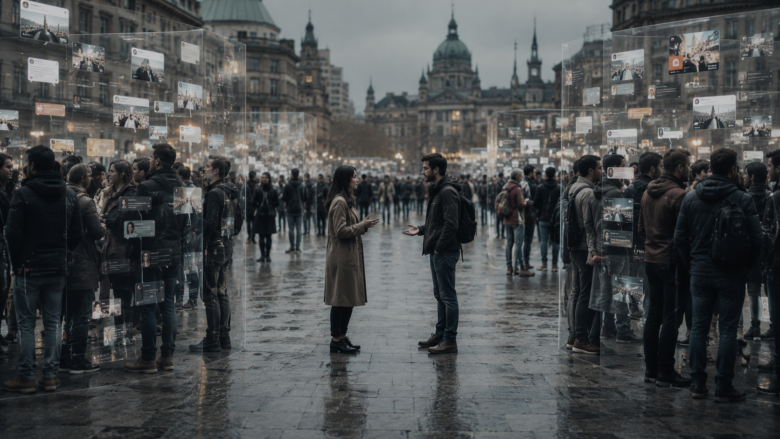
There is a strange tension running through modern life.
People talk constantly. Opinions are everywhere. Every issue attracts commentary within minutes. We are surrounded by debates, arguments, reactions, and counter-reactions. By almost every measure, we are expressing our views more than ever before.
Yet many people quietly feel that genuine disagreement has become harder.
Not disagreement itself. There is no shortage of conflict.
The difficult part is staying in the conversation after the disagreement begins.
Somewhere along the way, disagreement started feeling less like a difference of opinion and more like a rupture in the relationship itself. A political disagreement becomes a moral judgment. A disagreement about culture becomes a question of identity. Even relatively small differences can sometimes feel strangely personal.
The change is easy to miss, yet it reshapes the entire conversation.
For much of human history, disagreement was unavoidable. Villages, families, workplaces, and communities consisted of people who often saw the world differently. They still had to cooperate. They still depended on one another. Walking away was rarely an option.
People argued, sometimes fiercely. But they also shared meals afterward. They worked together the next morning. The disagreement existed inside a larger relationship.
Today, many disagreements occur in environments where the relationship barely exists at all.
A comment section. A social media post. A stranger’s opinion appearing on a screen.
The argument arrives before the human being does.
We encounter conclusions without context. Positions without stories. Certainty without familiarity. The result is that disagreement often feels less like a conversation and more like a collision.
Part of the problem may be that modern life increasingly encourages us to build identities around beliefs.
Beliefs have always mattered. But there is a difference between holding an opinion and becoming attached to it as part of who you are.

When that line begins to blur, criticism of an idea can feel like criticism of the person holding it.
A challenge to a belief becomes a challenge to identity. The conversation changes immediately. The goal is no longer understanding. The goal becomes self-protection.
Psychologists have long observed that human beings are not purely rational creatures evaluating evidence from a distance. We are social creatures. We belong to groups. We seek acceptance. We develop loyalties. We build narratives about who we are and who everyone else is.
Those instincts served important purposes for most of human history. But they can make disagreement surprisingly difficult.
When people feel that their group, values, or identity are under threat, the brain often becomes less interested in curiosity and more interested in defence. Listening starts to feel risky. Changing one’s mind begins to feel like losing something.
The argument becomes emotional long before anyone notices.
Technology may be amplifying this tendency. Many digital platforms reward certainty more than curiosity. Strong opinions travel farther than tentative ones. Outrage attracts attention. Nuance moves slowly.
A person who says, “I might be wrong, but here is what I think,” rarely receives the same visibility as someone who declares absolute confidence.
Over time, entire environments begin to reward performance over exploration.
People stop asking questions. They start defending positions. The tragedy is that disagreement itself is not the problem. Human progress has always depended on disagreement.
Science advances because ideas are challenged. Democracies function because perspectives compete. Relationships deepen when difficult conversations are allowed to happen honestly.
The issue is not that people disagree. The issue is that many people no longer experience disagreement as something separate from rejection.
A friend disagrees. A colleague disagrees. A family member disagrees. And somewhere beneath the surface, a deeper fear appears.
Do you still respect me? Do I still belong? Those questions are rarely spoken aloud. Yet they often shape the conversation more than the topic itself.
Perhaps this is why the most productive arguments rarely begin with facts. They begin with trust.
People are surprisingly willing to consider new ideas when they feel understood. People become far more comfortable with uncertainty when they don’t feel they are under attack. They listen differently when they believe the other person is trying to understand rather than win.
That sounds obvious. Yet many of the spaces where we communicate today seem built to encourage the exact opposite.
Maybe the real problem is not that nobody knows how to argue anymore. Maybe we have forgotten what an argument is supposed to be.
An argument is not a battle to determine who deserves to exist in the conversation. It is a shared attempt to see something more clearly.

That process has always been uncomfortable. It has always involved uncertainty, frustration, and moments of tension. But it was never supposed to feel like betrayal.
Perhaps one of the most important skills of the future will not be learning how to avoid disagreement.
It will be learning how to remain connected while disagreement exists. Because a society where nobody disagrees is impossible. But a society where nobody knows how to disagree may be far more dangerous.
Author’s Note
Many of us say we value open discussion, yet increasingly struggle when conversations become uncomfortable. The challenge may not be disagreement itself. It may be remembering that another person’s opinion is not the same thing as their worth. Some of the most meaningful conversations in life begin exactly where agreement ends.
G.C., Ecosociosphere contributor.