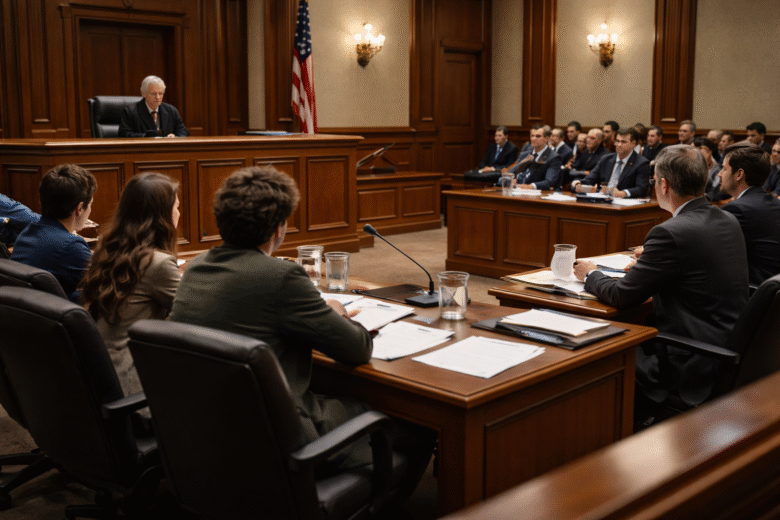
What happens when the youngest generation stops protesting in the streets and starts arguing in courtrooms?
There is something quietly revolutionary about a teenager standing before a judge and saying, “You are stealing my future.”
This is not poetry. It is the law.
In courtrooms from Europe to North America, young people are filing climate lawsuits against their own governments — and in some cases, they are winning. The headlines may not always dominate prime-time debates, but the implications are enormous. For the first time in history, children and teenagers are using constitutional rights, human rights law, and environmental statutes to demand climate action — not as activists, but as plaintiffs.
This is not just a protest movement. It is a legal movement.
And it is reshaping the climate conversation.
The Case That Changed Everything: The Netherlands
In 2019, the Supreme Court of the Netherlands ruled in favour of the environmental organization Urgenda, ordering the Dutch government to cut greenhouse gas emissions more aggressively.
While not strictly a youth-only case, it set a precedent: governments have a legal duty to protect citizens from climate harm.
That ruling sent a signal across the world. Climate policy was no longer just politics — it was liability. Young people were watching.
Germany: When Students Forced Policy Change
In 2021, Germany’s Constitutional Court ruled that parts of the country’s climate law were insufficient because they placed an unfair burden on future generations.
The plaintiffs included young activists. The court did something remarkable: it acknowledged that weak climate action today restricts the freedoms of tomorrow’s citizens.
Think about that.
Climate change was framed not only as an environmental issue, but as an intergenerational justice issue. The government was required to revise its climate targets.
The message was clear: delay is discrimination.
The United States: A Constitutional Argument
In the United States, a group of young plaintiffs filed the case Juliana v. United States, arguing that government inaction on climate change violated their constitutional rights to life and liberty.
The case has faced legal obstacles, but it changed public discourse. It introduced a radical idea: that a stable climate system could be considered a fundamental right. Even when cases stall, the courtroom becomes a stage. The legal filings become public documents. The moral argument becomes institutional.
And that matters.

Why This Is Bigger Than Climate Policy
Youth climate lawsuits are not merely about emission targets. They are about accountability.
For decades, climate action has been framed as a negotiation between industries and policymakers. Young plaintiffs disrupt that framework. They introduce a third party — the future.
They are saying:
You cannot negotiate away our adulthood.
You cannot compromise our lifespan.
You cannot delay and call it “balanced policy.”
In many cases, courts are beginning to agree that governments have a duty of care. That phrase — duty of care — may become one of the most important legal concepts of the century.
A Shift in Strategy: From Streets to Statutes
We are witnessing a strategic evolution.
The early wave of climate activism was built around marches and mass mobilization. Those protests shifted culture. They moved climate change into daily conversation.
But lawsuits shift power. Courts do not ask what is popular. They ask what is lawful. This is a crucial difference.
When judges rule that weak climate laws violate constitutional rights, governments are compelled to act — not because they want to, but because they must.
The Psychological Power of Youth Litigation
There is something deeply symbolic about a 16-year-old addressing a courtroom. It changes the emotional temperature of the debate.
Climate change is often abstract — parts per million, temperature graphs, long-term models. But when a teenager testifies about wildfire smoke disrupting school or floods destroying neighbourhoods, the crisis becomes immediate.
It becomes personal. And in a world saturated with doomscrolling, these lawsuits offer something rare: structured hope.
Hope grounded in institutions. Hope backed by legal language. Hope that is enforceable.
Are Courts the New Climate Battleground?
Not everyone agrees with this approach. Critics argue that climate policy should be determined by elected officials, not judges. Others warn of legal overreach.
But consider this: Many historic rights movements — civil rights, gender equality, environmental protections — were accelerated through courts. The judiciary often becomes the place where moral arguments are translated into binding obligations.
Climate litigation may follow that path.

The Generational Line Has Been Drawn
The most striking element of youth climate lawsuits is not the verdicts. It is the clarity.
Young plaintiffs are not asking for symbolic gestures. They are asking for measurable emission cuts, enforceable timelines, and accountability mechanisms.
They are forcing governments to confront a simple question: If you know the damage is coming, and you have the power to reduce it, what is your excuse?
That question is difficult to answer under oath.
Why This Story Matters Right Now
In a time when headlines are filled with geopolitical tension and economic anxiety, youth climate victories are easy to overlook.
But they represent something profound: a shift from protest to precedent.
If courts continue to recognize climate harm as a rights violation, the legal landscape will transform. Corporations may face increased scrutiny. Governments may no longer be able to delay action without legal consequences.
For young people growing up in a warming world, that shift could define the rest of the century.
Conclusion: The Courtroom as a Climate Classroom
When teenagers take governments to court, they are not rejecting democracy. They are using it. They are saying that laws mean something. They are insisting that constitutions are not ceremonial documents.
They are reminding institutions that the future is not an abstract concept. It has names, ages, and birth certificates. And perhaps that is the most hopeful development of all. Not that climate change is solved.
But that the youngest generation refuses to be silent about it.
Author’s Note
There is something quietly humbling about watching young people argue for their right to breathe clean air and inherit a stable planet. It reminds us that courage does not wait for grey hair. Sometimes it wears a school uniform. Writing about these cases feels less like reporting and more like witnessing a generational turning point. And perhaps that is what journalism is meant to do — not just document power, but record when it begins to shift.
G.C., Ecosociosphere contributor.
References & Further Reading
- Held v. Montana – Youth Climate Case (Wikipedia)
- Montana Supreme Court Affirms Youth Climate Victory – Reuters
- Juliana v. United States – Federal Youth Climate Lawsuit (Wikipedia)
- German Constitutional Court Climate Ruling (Neubauer v. Germany)
- S. Youths Win Landmark Climate Case – UN Human Rights Office
- Wisconsin Youth Climate Lawsuit – Inside Climate News