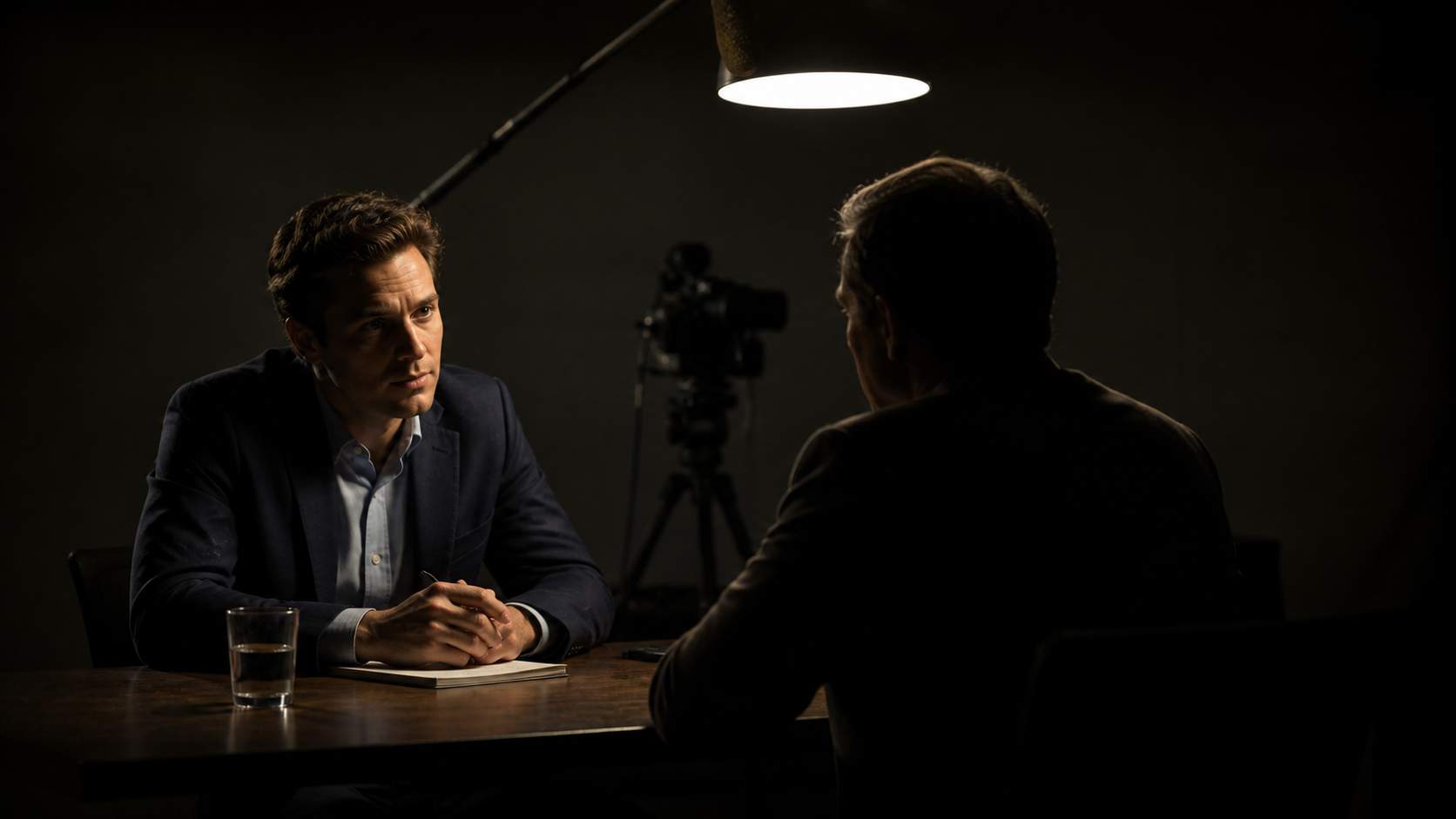
Did you know that most people form opinions about public figures without ever meeting them—only through interviews?
There’s something quietly powerful about a conversation that millions get to witness but only two people actually control. That’s where Interviews Aren’t Neutral: The Hidden Influence begins—not as a criticism of interviews, but as a closer look at how something so ordinary shapes what we believe without us even noticing.
We tend to trust interviews. They feel direct, unscripted, almost honest by default. One person asks, another answers, and we assume we are getting closer to the truth. But the reality is more layered. An interview doesn’t lie—but it doesn’t tell everything either. What it gives us is a version of reality, carefully shaped by what is asked, what is answered, and just as importantly, what is left out.
Think about the last interview you watched. It might have been a celebrity explaining a controversy, a politician defending a decision, or even a student speaking after an exam result. The words sounded natural. The tone felt real. And yet, the entire conversation existed within invisible boundaries. The interviewer chose the questions. The platform decided the format. The editor decided what stayed and what didn’t. Somewhere in that process, reality was not just shared—it was framed.
That framing matters more than we think.
Because most of us don’t meet public figures in real life. We don’t sit across from them, ask follow-up questions, or notice what they avoid saying. We meet them through interviews. And over time, those interviews become our understanding of who they are. A confident answer becomes credibility. A hesitation becomes doubt. A carefully worded response becomes truth.
But what if the question itself was leading? What if the most important question was never asked?
The person asking the question often writes half the answer. It’s a quiet kind of power—less visible than influence, but just as strong. A tough question can expose. A soft question can protect. A repeated question can shape perception. And a missing question can change everything.
This is not to say interviews are dishonest. In fact, some of the most revealing moments in public life have come from them. But the danger lies in treating them as complete. Because they are not.
Take long-format interviews that are later cut into short clips. A two-minute segment goes viral, stripped of context. A single sentence becomes a headline. The nuance disappears, but the impact stays. People react, judge, and form opinions based on fragments. In that moment, the interview stops being a conversation and becomes a tool.
And then there’s performance.
Anyone who has sat in front of a camera knows this—the moment you know you’re being watched, something changes. Words become measured. Expressions become controlled. Even silence becomes strategic. Interviews don’t just capture reality; they invite performance. Sometimes subtle, sometimes obvious.

That doesn’t make them fake. It makes them human.
But it also means we are not just watching a person. We are watching a version of them that exists in that setting, under those conditions, for that audience. And without realizing it, we accept that version as the whole story.
There’s another layer we rarely think about—the audience itself. Interviews are not just conversations between two people. They are designed for viewers. That means they are shaped to hold attention, create impact, and sometimes even provoke reaction. The goal is not always depth. Sometimes, it is reach.
And reach changes everything.
Because what spreads faster is not always what is most accurate—it is what is most engaging. A sharp answer travels further than a thoughtful one. A dramatic moment outperforms a balanced explanation. Slowly, the nature of interviews begins to shift. Not entirely, but enough to matter.
So where does that leave us?
Not in a place of distrust, but in a place of awareness.
Interviews are not useless. They are not manipulative by default. They are simply not neutral. They are shaped, influenced, edited, and presented. They are one lens, not the entire picture.
The problem begins when we forget that.
Because once we start treating interviews as complete truth, we stop asking questions of our own. We stop noticing what’s missing. We stop thinking critically about what we’re being shown. And that’s where influence becomes invisible.
Maybe the point is not to stop watching interviews, but to watch them differently. To listen not just to what is said, but how it is said. To notice the pauses, the deflections, the unanswered questions. To remember that every answer exists because a particular question was asked.
And every story could have been different if a different question had been chosen.
In a world where conversations are constantly being broadcast, edited, and shared, understanding this might be one of the most important skills we can develop—not as experts, but as everyday viewers.
Because the truth is not always hidden.
Sometimes, it is simply framed.
Author’s Note
This idea stayed with me because interviews feel so normal. We watch them without thinking twice, trusting the format almost instinctively. But the more I looked at it, the more I realised how much power sits quietly in those exchanges. Not loud, not obvious—just present. Writing this wasn’t about questioning interviews, but about noticing them more carefully. And sometimes, noticing is where understanding begins.
G.C., Ecosociosphere contributor.