
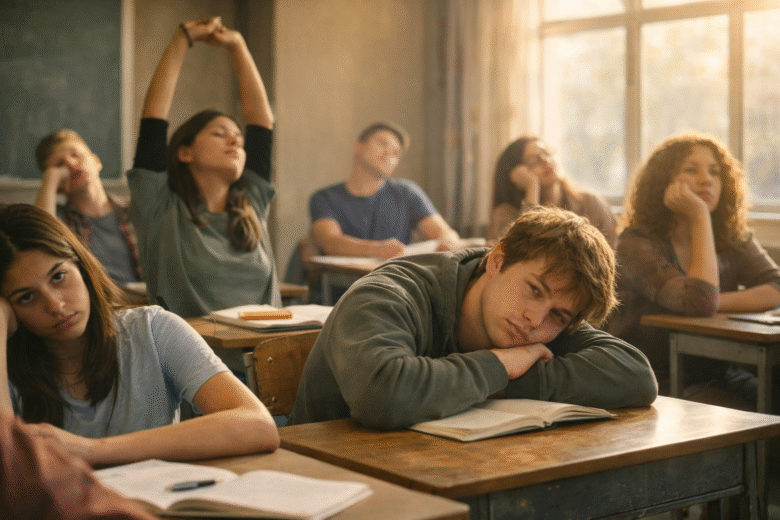
Fun fact: Your brain naturally dips in alertness twice a day—even if you’ve had a full night’s sleep—and one of those dips often hits right in the middle of your class or meeting.
“Why People Feel Sleepy in Classrooms or Meetings” is not just a casual complaint—it’s a shared human experience that silently plays out in schools, offices, and training halls every single day. You sit down, determined to focus. The teacher begins. The presenter clicks to the next slide. And within minutes, your eyelids grow heavy, your thoughts blur, and suddenly you are fighting a battle you didn’t sign up for: staying awake.
But here’s the uncomfortable truth—this isn’t just about laziness or lack of interest. Sometimes, the environment is failing you. Sometimes, the system is working against your biology. And sometimes, we’ve designed learning spaces that unintentionally make people want to sleep.
Your Brain Isn’t Built for Long Passive Listening
Let’s start with the obvious but ignored reality: the human brain does not like being passive for long. When you sit in a classroom or meeting, you are often expected to just listen. No movement. No interaction. No engagement. Just absorb information.
But the brain is not a storage device—it is an active processor. When it doesn’t get stimulation, it switches modes. It drifts. It slows down. And eventually, it tries to conserve energy.
That “sleepy feeling”? It’s your brain quietly saying:
“This isn’t engaging enough to stay alert.”
Think about it—when was the last time you felt sleepy during an exciting conversation or while watching something you love? Exactly.
The Post-Lunch Energy Crash Is Real
Now add food into the equation. After lunch, your body redirects energy toward digestion. Blood flow shifts. Your system slows slightly. This creates what scientists call a circadian dip—a natural drop in alertness.
So, when a student feels sleepy in class at 2 PM, or an employee zones out in a meeting after lunch, it’s not poor discipline—it’s biology. And yet, we schedule some of the most important learning sessions right in this window. It’s like asking someone to sprint when their body is programmed to rest.
The Environment Is Quietly Making You Sleepy
Look around most classrooms or meeting rooms. Closed windows. Artificial lighting. Monotonous voice. Fixed seating. Minimal movement. It’s almost like these spaces are designed to calm you down—not energize you.
Low oxygen levels in poorly ventilated rooms can actually make people feel drowsy. Dim lighting signals your brain that it’s time to relax. Repetitive tones in speech act almost like lullabies. No one intends it—but the setup itself becomes a sleep trigger.
Lack of Emotional Connection Kills Attention
Here’s something we don’t talk about enough: People don’t fall asleep when something feels meaningful. They fall asleep when it feels distant.
If the content being taught or discussed doesn’t connect to your life, your curiosity, or your emotions, your brain simply doesn’t prioritize it. It’s not being rude. It’s being efficient.
A student listening to a dry explanation of a topic may feel sleepy. The same student hearing a story, a real-life example, or a surprising fact? Fully awake. Attention follows meaning. And when meaning is missing, sleep steps in.
Sleep Debt Is Catching Up With You
Let’s be honest—many people are already tired before they even enter the classroom or meeting. Late-night scrolling. Early wake-ups. Academic pressure. Work stress.
What you call “sleepiness in class” is often just accumulated fatigue finally catching up. And the moment your body senses a safe, still environment, it tries to recover. That classroom chair? It becomes an opportunity for rest.
The Hidden Problem: We Confuse Stillness with Discipline
There is a deeper issue here—especially in education systems. We often equate silence with attention. Stillness with discipline. But real attention doesn’t look like that.
Real attention can be noisy. It can involve movement, discussion, questioning, reacting. When students or participants are forced into rigid stillness, their bodies comply—but their minds quietly disengage. And disengagement often leads to drowsiness.
Meetings Are Not Much Better
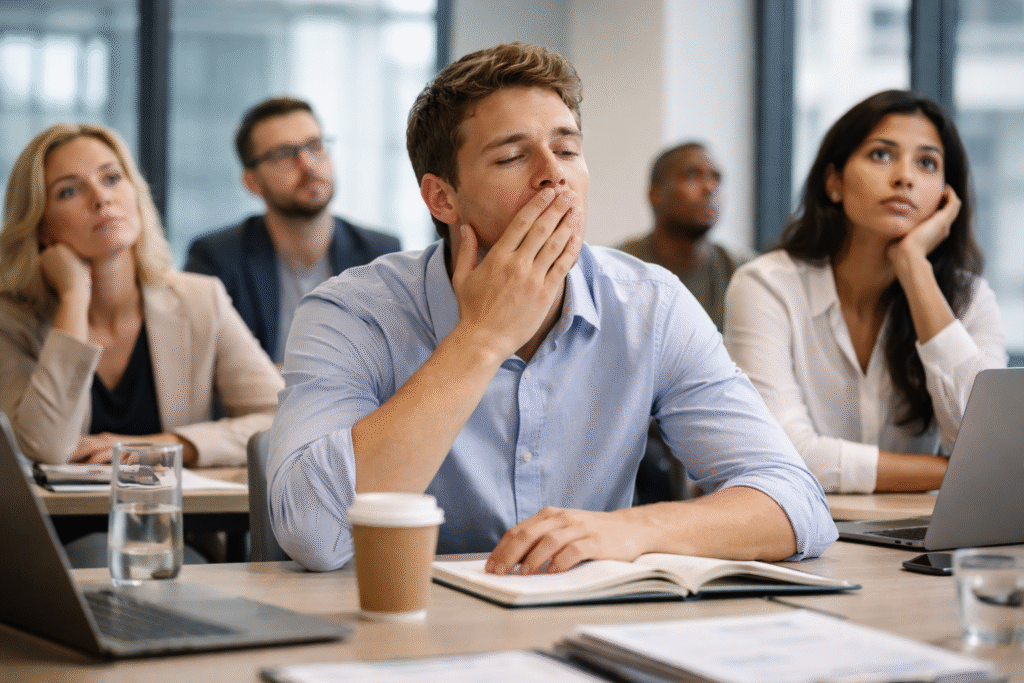
This isn’t just a student problem. Adults in meetings experience the exact same thing. Endless slides. One-way communication. Lack of participation.
People stop processing and start enduring. You’ll notice it in subtle ways—blank stares, slow nods, drifting attention. Sleepiness is just the visible version of disengagement.
Conclusion
So, why do people feel sleepy in classrooms or meetings? It’s not just about tired individuals. It’s about tired systems. It’s about how we design learning and working environments that ignore human biology, underestimate the need for engagement, and overestimate the power of passive listening.
If we want people to stay awake—not just physically, but mentally—we need to rethink how we teach, how we present, and how we structure attention itself. Because the real problem isn’t that people are sleepy. The real problem is that too many environments are not worth staying awake for.
Author’s Note
There’s a moment every teacher recognizes—the slight drop in a student’s head, the unfocused gaze, the quiet drift away. It’s easy to label it as disinterest. Harder to ask what made the mind leave in the first place.
Writing this felt personal. Because somewhere between teaching and observing, you start realizing that attention is not demanded—it is invited. And maybe writing, like teaching, is not about delivering information. It’s about keeping someone awake—long enough to feel something, think something, question something.
G.C., Ecosociosphere contributor.



Comments
This guide explained everything clearly.