Fun fact: Most people assume human evolution stopped thousands of years ago, but some scientists argue that human evolution may actually be happening faster today than at many points in our past.
When people hear the word evolution, they often imagine dinosaurs, ancient fossils, or early humans learning to use stone tools. Evolution feels like something that belongs to the distant past. Yet the question behind Are Humans Still Evolving? may be more relevant than ever because the environments shaping human beings today are changing at extraordinary speed.
For most of human history, nature was the primary force influencing survival. Food shortages, predators, diseases, climate, and physical hardship determined who survived long enough to pass on their genes. Today, however, many of those pressures have been transformed by medicine, technology, cities, and modern lifestyles.
The interesting question is not whether humans have escaped evolution. It is whether we have created entirely new forms of it.
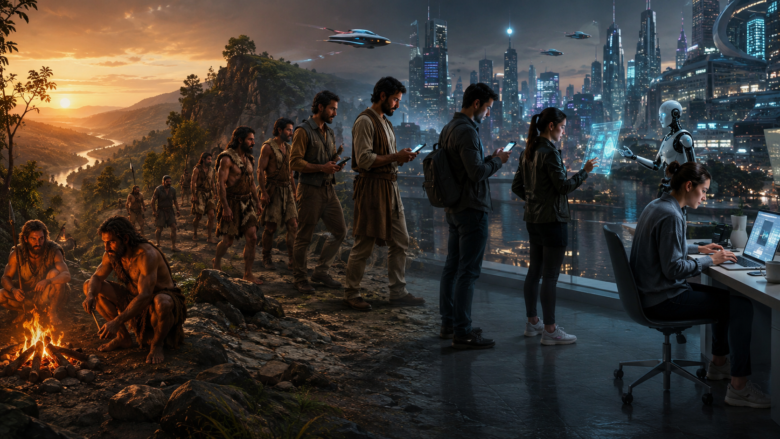
For nearly all of our existence, humans lived as hunter-gatherers. Our bodies and brains evolved in small communities where physical movement was unavoidable and information travelled slowly. The world we now inhabit would have been almost unimaginable to our ancestors.
Today billions of people spend large portions of their lives indoors.
We interact with screens more often than with forests. We communicate across continents instantly. We survive diseases that would once have been fatal. We travel farther in a day than many ancient people travelled in a lifetime.
The environment changed. Human biology did not receive a memo.
This mismatch may explain many modern challenges. Our brains evolved to pay attention to novel information because it could signal danger or opportunity. Social media platforms and digital notifications exploit that tendency continuously. Our ancestors rarely encountered endless streams of information, yet modern humans navigate them every day.
The result is not necessarily a new species.
But it may be a new set of evolutionary pressures.
One fascinating example involves medicine. In the past, many people died before reaching adulthood or having children. Modern healthcare has dramatically reduced mortality rates. This is one of humanity’s greatest achievements, but it also changes the relationship between biology and survival.
Traits that once might have prevented reproduction may no longer do so. This does not mean evolution stops. It means the rules influencing it change.

At the same time, entirely new pressures emerge. People increasingly delay parenthood. In many countries, education, career choices, urban living, and economic conditions influence reproductive patterns. Some researchers suggest these social factors may now play a larger role in shaping future populations than many traditional environmental pressures.
Culture itself may have become an evolutionary force.
Cities offer another intriguing example.
More than half of humanity now lives in urban areas. Cities expose people to different diets, pollution levels, social structures, noise environments, and lifestyles than those experienced by previous generations.
Urban living may already be affecting human biology.
Studies suggest city environments can influence stress responses, sleep patterns, immune function, and even mental health. While these changes are not necessarily genetic, they demonstrate how rapidly human beings adapt to new surroundings.
The body is constantly responding to the world around it.
Sometimes evolution begins with adaptation.
Consider eyesight.
Millions of children spend increasing amounts of time indoors focusing on screens and close-up tasks. Researchers have observed rising rates of myopia, commonly known as near-sightedness, in many parts of the world.
Genes alone cannot explain such rapid shifts. Environmental changes are clearly involved.
Whether future populations develop biological responses to these conditions remains unknown, but it illustrates how modern life can create pressures that did not exist for most of human history.
Even our jaws may be changing.
Anthropologists have noted that softer modern diets require less chewing than the foods consumed by our ancestors. Some researchers suggest this contributes to smaller jaw development and the increasing prevalence of crowded teeth and impacted wisdom teeth.
The fork, blender, and processed food industry may be influencing human anatomy in subtle ways. That is a strange thought.
Technology adds another layer to the story.
For the first time, humans are surrounded by tools that extend memory, navigation, communication, and problem-solving abilities. Smartphones remember phone numbers. Search engines store information. Navigation systems guide travel.
Many tasks once performed entirely by the brain are now partially outsourced to technology.
This raises an interesting possibility.
Perhaps the most important changes occurring in humans today are not biological but cultural.
Human evolution has always involved more than genes. Language, knowledge, traditions, and tools can spread through populations much faster than genetic changes. A useful invention can transform billions of lives within decades. A genetic mutation may require thousands of years to become widespread.
In that sense, culture may now evolve faster than biology can keep up.
Yet evolution itself has not disappeared.
Scientists have identified several relatively recent human adaptations. Some populations evolved the ability to digest milk into adulthood. Others developed adaptations related to high-altitude living or disease resistance. These changes occurred far more recently than many people realize.

Evolution never truly stopped. The timescale simply makes it difficult to notice.
There is another possibility worth considering.
The future may introduce evolutionary pressures unlike anything humanity has experienced before. Artificial intelligence, genetic engineering, climate change, urban megacities, and space exploration could all influence the environments in which future generations live.
The next chapter of human evolution may not look anything like the last one.
And perhaps that is the most important point.
When people imagine evolution, they often picture a ladder leading from primitive ancestors to modern humans. Reality is messier. Evolution is not a destination. It is an ongoing process of adjustment between living organisms and changing environments.
The environments are changing faster than ever.
Which means the story may still be unfolding.
Thousands of years from now, future humans may look back at the twenty-first century as a turning point. Not because evolution ended, but because humanity began creating many of the forces that would shape its own future.
The question is no longer whether humans are evolving. The question may be what we are evolving into.
Author’s Note
What fascinates me about human evolution is that it forces us to see ourselves as part of a much larger story. We often think of modern life as separate from nature, yet our bodies and minds are still products of evolutionary history. The technologies, cities, and lifestyles we create today may become part of the evolutionary environment of tomorrow. Whether those changes are beneficial, harmful, or something in between remains one of the most interesting questions our species can ask.
G.C., Ecosociosphere contributor.