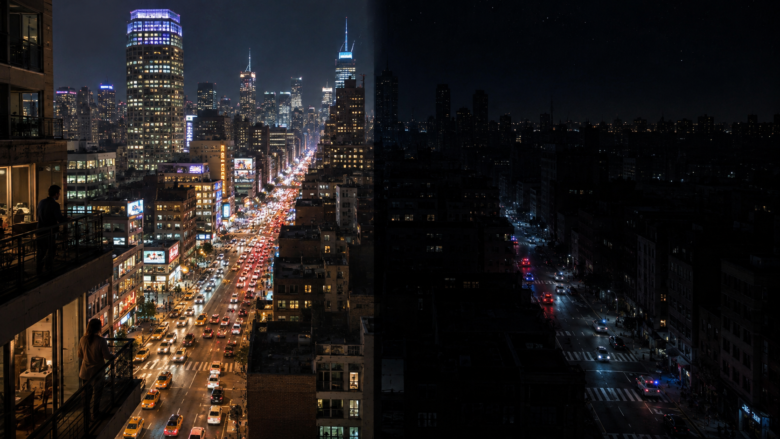
Most people do not think about electricity until it disappears.
One moment, life moves with effortless precision. Lights glow without a second thought. Phones recharge silently on bedside tables. Refrigerators hum in the background. Traffic signals keep vehicles flowing. Internet routers blink patiently in forgotten corners of our homes. Then, with a single click somewhere far beyond our sight, everything stops.
The silence that follows is strangely unsettling. It reminds us that modern civilization rests upon something so reliable that we have almost stopped noticing it exists.
A power outage is more than an inconvenience. It is one of the few moments when the hidden machinery of civilization briefly becomes visible.
For most of human history, sunset marked the end of productive activity. Families gathered around firelight or oil lamps because darkness imposed limits that no amount of determination could overcome. Cities remained comparatively small, industries paused overnight, and communication travelled only as fast as a horse or a ship.
The widespread generation and distribution of electricity transformed every one of those limitations. Artificial light extended the day, electric motors powered factories, refrigeration preserved food, and digital networks eventually connected billions of people across continents.
Electricity did not simply improve civilization; it quietly became the foundation upon which nearly every other modern system was built.
That dependence is remarkably easy to forget because the electrical grid is designed to be invisible. Thousands of power stations, substations, transformers, transmission towers, and maintenance crews operate continuously so that electricity appears to arrive effortlessly at the flip of a switch.
Few people know where their electricity originates, how it travels hundreds of kilometres, or how engineers constantly balance supply and demand every second of the day. The better the system performs, the less anyone notices it.
A blackout reverses that illusion almost instantly.
Within minutes, everyday routines begin to unravel. Elevators stop between floors. Cash registers become useless. Mobile networks grow congested as millions attempt to contact family members at once. Fuel pumps cease operating because they rely on electricity. Supermarkets can no longer process digital payments. Air conditioning disappears in summer, while heating systems fail in winter.

Even clean drinking water may eventually become scarce if electric pumping stations remain offline for long enough. One interruption begins cascading through dozens of systems that seemed completely unrelated only moments earlier.
This chain reaction reveals something important about civilization itself. Modern societies are not collections of independent technologies. They are tightly connected networks in which nearly every system depends on another.
Hospitals rely on electricity, but electricity companies rely on telecommunications, transportation, fuel supplies, and skilled personnel. Banks require data centres, data centres require cooling systems, cooling systems require power, and emergency services depend upon all of them simultaneously. What appears to be resilience often depends upon countless invisible connections functioning exactly as intended.
The same complexity that allows modern civilization to run efficiently can also leave it unexpectedly vulnerable.
Yet blackouts reveal more than engineering. They also expose human behaviour.
When the lights go out, people’s reactions often unfold in predictable stages. At first, there is mild annoyance as everyone assumes the interruption will last only a few minutes. Then uncertainty begins to replace confidence. People check their phones repeatedly, look out of windows to see whether neighbouring buildings are dark, and search for information.
Psychologists have long recognised that uncertainty creates far more stress than known difficulties because the brain constantly attempts to predict what will happen next. Without reliable information, even a routine outage can feel far more threatening than it actually is.
Interestingly, prolonged blackouts often produce two opposite social responses at the same time.
Some people rush to secure supplies, fearing shortages before they even occur. Others become unexpectedly cooperative. Neighbours who rarely speak suddenly share candles, extension cords, meals, and generators. Children step outdoors because televisions and gaming consoles no longer compete for their attention. Families spend evenings talking rather than scrolling through separate screens.
Streets that normally echo with traffic become unusually quiet, allowing people to notice sounds they had long forgotten—birds, distant conversations, or simply the absence of constant electrical noise.
These moments should not romanticize blackouts. Extended outages can be dangerous, especially for hospitals, elderly people, and communities facing extreme weather. Food spoils, medical equipment fails, businesses lose income, and emergency services operate under enormous pressure.
The hardships are real. Yet the temporary changes in human interaction reveal something equally real: many aspects of our daily lives are shaped not only by technology itself but by the rhythms that technology quietly creates.
Electricity has changed our relationship with time more profoundly than we usually acknowledge. Artificial lighting erased the natural boundary between day and night. Twenty-four-hour economies became normal. Emails arrive at midnight, entertainment never pauses, and global markets continue trading while entire countries sleep.
Constant electrical availability has encouraged a culture in which uninterrupted activity feels ordinary.
A blackout briefly reminds us that this expectation is historically unusual.

Recent large-scale outages around the world have demonstrated another lesson. As societies become increasingly digital, resilience becomes just as important as efficiency. Renewable energy, smart grids, distributed power generation, battery storage, cybersecurity, and stronger infrastructure are no longer simply engineering challenges.
They have become essential investments in social stability. Every major blackout encourages governments and engineers to redesign systems so that the next failure causes less disruption than the last.
Perhaps the most revealing aspect of a power outage is psychological rather than technological.
When electricity disappears, we do not suddenly realise how much we enjoy having lights. We realise how many ordinary experiences quietly depend upon something we rarely acknowledge.
Every online conversation, refrigerated meal, traffic light, hospital monitor, classroom projector, water pump, and financial transaction rests upon an invisible flow of energy that most people never consciously notice. Civilization often appears solid because its supporting systems remain hidden.
The day the power goes out reminds us that modern life is less like a monument carved from stone and more like a living organism.
Millions of people, machines, cables, and decisions work together continuously to sustain comforts that can vanish in an instant if those connections fail.
Perhaps that is the greatest lesson hidden inside every blackout. Civilization is not defined by skyscrapers, smartphones, or glowing city skylines. It depends on countless unseen systems working together so consistently that we barely notice them—until a blackout suddenly makes their importance impossible to ignore.
Author’s Note
Electricity is one of those technologies that becomes almost invisible precisely because it works so well. We rarely think about the enormous network operating behind a glowing bulb, a charging phone, or a working traffic signal.
This article began with a simple idea: one of the clearest ways to understand civilization is to see what happens when a system supporting everyday life suddenly disappears. A blackout does exactly that. For a few hours, the invisible becomes impossible to ignore.
G.C., Creator & Writer, Ecosociosphere.
References & Further Reading
For readers who would like to explore the science, engineering, and social consequences of electrical blackouts further: