Try running your fingers lightly along the side of your neck or across the sole of your foot. You will certainly feel the touch, and it might even be a little uncomfortable, but it is unlikely to make you burst into laughter. Now picture someone else lightly touching that very same spot. Suddenly, you might find yourself pulling away, twisting your body or laughing despite trying very hard to remain still. The fingers have not become particularly different, and neither has your skin. Yet something about knowing that the movement is your own seems to take much of the tickle away.
This is especially strange when you consider how sensitive our skin can be. A tiny insect crawling along your arm can catch your attention immediately, and the lightest unexpected touch may make you jump. You can also make yourself feel pain by pinching your skin, or produce an uncomfortable sensation by rubbing it too vigorously.
So why should tickling be different? It is tempting to say that we cannot surprise ourselves, which sounds reasonable enough. But that explanation leaves out something rather interesting about the way our brains handle our own movements.
Much of what we do during the day involves touching ourselves without paying much attention to it. We scratch an itch, rub our eyes, adjust our glasses or brush a strand of hair away from our face. Each movement produces sensations that our skin is perfectly capable of detecting. Yet we rarely become distracted by the constant stream of familiar touches. We can even reach for an object while talking to someone and hardly notice the contact between our fingers and our own palm.
Our nervous system appears to treat sensations caused by our actions somewhat differently from those arriving unexpectedly.
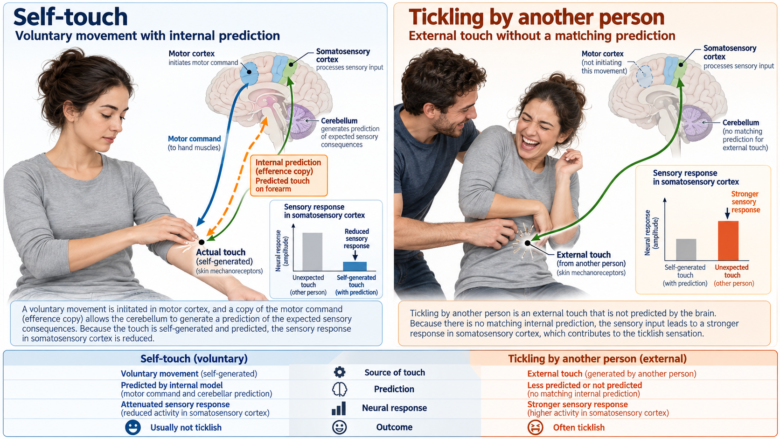
One important part of the explanation lies in a small structure at the back of the brain called the cerebellum. Many of us may remember it from school biology as the region associated with balance and coordination. That description is correct, but its work extends much further.
The cerebellum helps the nervous system anticipate the consequences of movement, allowing us to make adjustments before every little mistake becomes noticeable.

When you lift a glass towards your mouth, for example, your brain does not have to wait until the glass touches your lips to begin preparing for where it will arrive.
Something similar seems to happen when you reach out to touch your own skin. As your brain sends instructions to move your hand, the motor system also provides information that can be used to predict the sensations that movement is likely to produce. Scientists call this an efference copy, essentially an internal copy of the movement command. It is not a second movement, and it does not travel to your hand. Instead, it helps the nervous system estimate what the upcoming action will feel like. The cerebellum is thought to play an important role in generating these predictions.
This means that when your fingers approach your ribs, your brain already has information about where they are going, when they are likely to arrive and what kind of contact to expect. By the time your skin registers the touch, the nervous system has something to compare it with. If the incoming sensation closely matches what was predicted, its impact can be reduced. Researchers call this sensory attenuation, a process that makes some self-generated sensations feel weaker than comparable sensations caused by someone else.
Your skin still feels the touch. Your brain simply gives that expected touch less importance.
The idea becomes easier to appreciate when we think about the difference between touching something and being touched. If you rest your hand on a table, you have a fairly good idea of where your fingers will land and how much pressure they will apply. If someone unexpectedly places a hand on your shoulder, you have much less information about when the contact will happen or how it will feel. Both experiences involve signals from the skin, but one comes with an internal prediction and the other generally does not. That difference helps explain why another person’s fingers can produce a much stronger tickling sensation.
Scientists have actually tested this rather than relying only on our everyday observations. In a well-known 1998 experiment, researchers Sarah-Jayne Blakemore, Daniel Wolpert and Chris Frith examined brain activity while participants experienced self-produced and externally produced touch. They found that touch generated by someone else produced greater activity in parts of the brain involved in processing bodily sensations. Their findings also suggested that the cerebellum contributes to predicting the sensory effects of our movements, allowing the nervous system to reduce its response when the sensation is expected.
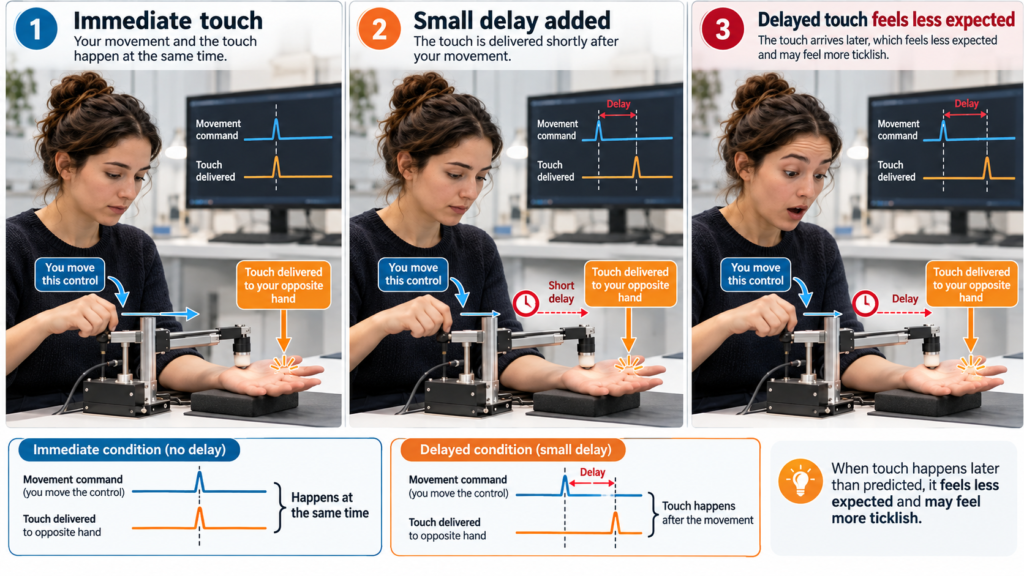
There is an amusing complication here. If prediction is responsible for making self-tickling ineffective, what would happen if we made our own touch slightly unpredictable? Researchers explored this using devices that allowed people to control a touching movement indirectly. When the touch followed their movement immediately and predictably, it generally felt less ticklish. But introducing a small delay between the movement and the resulting contact made the sensation feel more ticklish.
The brain’s expectation no longer matched the actual timing quite so well.
I find that detail particularly revealing because the person was still responsible for the movement. They had not suddenly forgotten that they were controlling the device. What changed was the relationship between their action and the sensation that followed.
It suggests that being aware of who is doing the touching is only part of the story.
The nervous system appears to care about how accurately it can predict the consequences.
Of course, tickling is not entirely explained by a mismatch between prediction and sensation. Some people are far more ticklish than others, and even the same person may react differently depending on their mood, the body part being touched or who is doing the tickling. A playful encounter with a friend can feel very different from an unexpected touch in a crowded place. Tickling can produce laughter, but laughter does not always mean the experience is pleasant. These social and emotional influences complicate the picture, although the brain’s predictive system offers a strong explanation for why self-produced touch is usually less ticklish.
The more we consider this mechanism, the more familiar it becomes in other parts of life. Think about walking across a room. Your feet constantly press against the floor, your clothes move against your skin, and your arms occasionally brush your body. If every predictable sensation demanded as much attention as an unexpected one, ordinary movement could become rather distracting.
The brain benefits from recognising which sensory changes are likely to have been produced by its own actions.
It can then remain more responsive to things that do not fit those expectations.
There is an important distinction here, though. The brain does not completely switch off our ability to feel ourselves. You still know when your hand touches your face, and you can deliberately pay attention to the pressure of your fingers. Strong, unusual or painful sensations can remain highly noticeable even when you caused them.
Sensory attenuation is better understood as a change in how strongly certain expected sensations are processed, rather than an absolute inability to feel them.
That is why the familiar claim that we cannot tickle ourselves is generally true, but not an unbreakable rule.
Something else about this process is worth considering. We often think of perception as something that happens after the world affects our senses. A hand touches the skin, the nerves send a message, and the brain tells us what happened. Yet the research on tickling suggests that our brains are already preparing an interpretation before some sensations even arrive. The information coming from our skin still matters, but it is being considered alongside expectations formed by our own movements.
What we feel depends partly on what our nervous system was expecting to feel.
The next time you try tickling the sole of your foot, you will probably encounter the same disappointing result. Your fingers will move, your skin will register their contact, and you may wonder why such a sensitive part of the body remains so uncooperative. Meanwhile, your nervous system has already used the movement you initiated to anticipate much of what is about to happen. The touch reaches your skin, but it brings relatively little surprise.
And perhaps that is the peculiar thing about trying to tickle yourself: your brain has already prepared for the touch before your fingers have even arrived.
Author’s Note
I remember trying to tickle myself as a child and wondering why something that worked so easily when someone else did it became almost useless in my own hands. What interests me now is that the answer has less to do with laughter than with how the brain prepares for our movements. The idea that some sensations become weaker simply because we expected them makes an ordinary childhood puzzle rather more interesting.
G.C., creator and writer of Ecosociosphere.
References and Further Reading
- Blakemore, Wolpert & Frith (1998) — Central Cancellation of Self-Produced Tickle Sensation
- Blakemore, Wolpert & Frith (2000) — Why Can’t You Tickle Yourself?
- Sarah-Jayne Blakemore (Scientific American) — Why Can’t a Person Tickle Himself?
- Karolinska Institutet (2022) — Why Can’t You Tickle Yourself?
- Simpson (2001) — Why Can’t You Tickle Yourself?