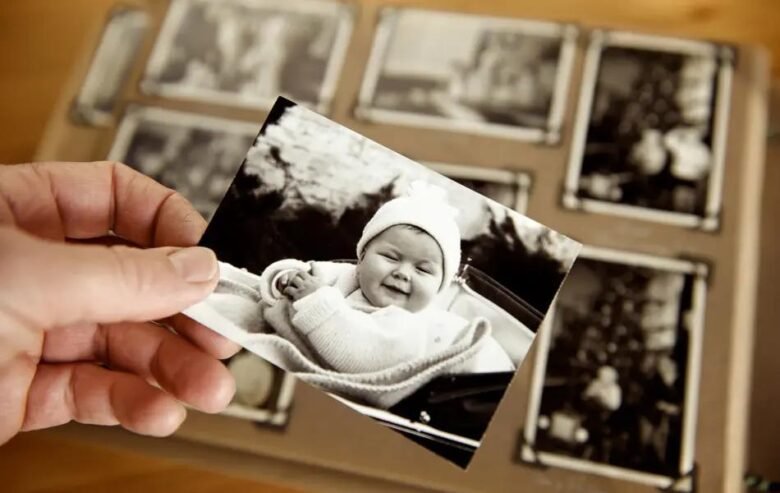
There is probably a photograph of you as a baby somewhere in your family’s collection. Perhaps you are sitting on someone’s lap, staring at the camera with an expression nobody can explain anymore. Your parents might remember when it was taken, what you were doing that day, or how difficult it was to make you sit still. You, however, remember nothing. You recognise the child because you have been told it is you, and because the face carries some resemblance to the one you see in the mirror.
It is an unusual situation when you think about it: you are looking at a period of your own life that is almost entirely inaccessible to you.
Most of us have very few personal memories from our first three or four years. Psychologists call this childhood amnesia, although the name can make an ordinary part of development sound like a medical condition. The memories we associate with childhood become more numerous as we grow older, gradually forming the personal history we carry into adulthood. Yet our bodies were already living through those forgotten years. Our hearts were beating, our eyes were responding to light, and our brains were learning about the world. Some of the biological structures involved in those early experiences are still with us today.
Take the neurons in your brain. We often hear that the brain changes throughout life, which is true, but that does not mean every brain cell is regularly replaced. Research has shown that many neurons in the cerebral cortex can survive for essentially an entire lifetime. In 2005, scientists studying the human brain found that neurons in the occipital cortex, a region involved in vision, were approximately as old as the individuals themselves. Some of the brain cells you are using to read these words have been with you since before you could read, and even before your earliest memories began to form.
Scientists discovered this through an unexpectedly historical method. Atmospheric nuclear weapons testing during the twentieth century temporarily increased the amount of radioactive carbon-14 in the environment. That carbon entered plants, food and eventually human tissues. By measuring it in cellular DNA, researchers could estimate when particular cells were formed.
Traces of nuclear experiments helped reveal that parts of the human brain had been present since the beginning of a person’s life.
It is a rather unusual meeting of human history and biology.
But those neurons have not spent decades sitting unchanged inside our heads. They have adjusted their connections, produced and replaced countless molecules, and participated in different patterns of activity as we learned new things. A neuron that existed when you were a baby is not functioning exactly as it did then. This also explains why the survival of a brain cell does not guarantee the survival of an early memory. Memories depend on changing patterns across networks of neurons, rather than being stored like photographs inside individual cells. The physical structure can remain while the information it once helped process becomes inaccessible.
There is an even stranger example inside your eyes. The lens contains specialised proteins called crystallins, which help it remain transparent and focus light. Many crystallins deep in the centre of the lens are formed around birth and remain there for life, with remarkably little replacement. Someone in their sixties may therefore still carry proteins in their eyes that were present before they could speak or recognise themselves in a mirror.
Some of the oldest molecules in your body are helping you look at the world as it exists today.
That persistence comes with complications. Over time, these proteins gradually undergo chemical changes, but the lens has very little ability to replace the ones that have been there the longest. Over decades, some of these changes contribute to the clouding associated with cataracts. Elsewhere in the body, however, renewal happens much more quickly. Red blood cells typically circulate for around four months, while many cells lining the intestine are replaced within days. The familiar claim that our entire body becomes new every seven years overlooks this enormous variation.
We are made of biological parts that have lived through very different amounts of time.
The distinction becomes more interesting when we consider what happens to memories during those same years. A baby learns to recognise familiar voices, respond to repeated routines and gradually coordinate movements, yet will probably remember none of those particular learning experiences as an adult. Learning and conscious recollection are different processes. The nervous system can retain skills and adapt to experience without preserving an accessible personal account of how those abilities developed. You can walk across a room today without remembering the countless attempts that eventually taught you how.
Recent research has made the mystery of early memory even more intriguing. In a 2025 study, scientists used brain imaging to investigate memory formation in awake infants. They found evidence that the hippocampus, a brain region important for remembering experiences, participates in encoding information during infancy. The findings suggest that young children may form certain memories even though those experiences later become unavailable to conscious recall. Researchers are still investigating whether early memories disappear, become difficult to retrieve, or are affected by several developing processes.
Forgetting an experience may not always mean that every trace of it has vanished.
Of course, this does not mean our bodies secretly remember everything that happened to us. A surviving neuron is not a recording of infancy, and an old protein cannot tell us what we felt on our first birthday. Biological continuity and autobiographical memory are different things. What makes their relationship interesting is that our personal histories depend on both. The body continues through experiences we cannot recall, while the mind gradually develops a story about the person who lived through them.
And that creates an awkward little question about identity. If you remember almost nothing about being two years old, in what sense are you the same person as that child? We normally have no difficulty accepting the connection. The child grew into you through an uninterrupted process of biological development, even while appearance, behaviour, understanding and personality changed. Philosophers have long debated whether personal identity depends primarily on psychological continuity, the persistence of a living organism, or some relationship between the two. Biology cannot settle that debate by counting old cells, but it gives the question a surprisingly physical foundation.
Our memories are essential to how we understand ourselves, although they cover only a fraction of what we have actually experienced. Some years disappear almost completely, and even remembered periods are full of gaps. Meanwhile, a living body carries on, preserving certain structures, rebuilding others and adapting as life unfolds. The person we remember being is therefore only part of the person we have been.
Our biological history begins before the story we are able to tell about ourselves.
That brings us back to the childhood photograph. The baby looking toward the camera is someone you cannot really remember being, and perhaps that is why old photographs occasionally feel as though they belong to another person. Yet somewhere inside your head, neurons from that period may still be functioning, while proteins formed around the time of your birth continue helping your eyes focus on the photograph. You have forgotten almost everything about that little child, but the distance between the two of you is not quite as complete as it seems.
Author’s Note
I have always found old childhood photographs a little peculiar, especially those taken before we can remember anything. We accept that the child in the picture is us, although we know almost nothing about what being that child actually felt like. What interested me during the research was discovering that biological continuity can be much more literal than we might expect. The question of identity remains open, but knowing that parts of our bodies have accompanied us through years we cannot recall makes those photographs feel slightly different.
G.C., creator and writer of Ecosociosphere.
References
- Spalding, K. L., et al. (2005). Retrospective Birth Dating of Cells in Humans.
- Lynnerup, N., et al. (2008). Radiocarbon Dating of the Human Eye Lens Crystallines Reveal Proteins without Carbon Turnover throughout Life.
- Bauer, P. J. (2015). A Complementary Processes Account of the Development of Childhood Amnesia and a Personal Past.
- Yates, T. S., et al. (2025). Hippocampal Encoding of Memories in Human Infants.