Set a small compass on a table and notice how its needle slowly turns before coming to rest. It turns almost imperceptibly before coming to rest, pointing towards a direction you might recognise as north. There is nothing visible pulling it, no machinery operating beneath the table, and no obvious reason why a tiny piece of magnetised metal should behave so consistently. Yet the needle is responding to something generated thousands of kilometres beneath your feet. Deep inside the Earth, enormous quantities of liquid metal are constantly moving, producing a magnetic field that extends far beyond the atmosphere.
Every movement of that compass needle connects an ordinary moment on the surface to extraordinary processes unfolding near the centre of our planet.
We often learn that Earth behaves like a gigantic magnet, with a north and south magnetic pole. The comparison makes sense because Earth’s magnetic field has a broadly similar pattern to the field surrounding an ordinary bar magnet. But the explanation becomes rather misleading if we imagine an enormous piece of permanently magnetised iron buried inside the Earth. The core is much too hot for that. Iron loses its ordinary ferromagnetic properties above a certain temperature, and the temperatures within Earth’s core reach several thousand degrees Celsius. Whatever produces our planet’s magnetism must therefore be something other than a permanent magnet.
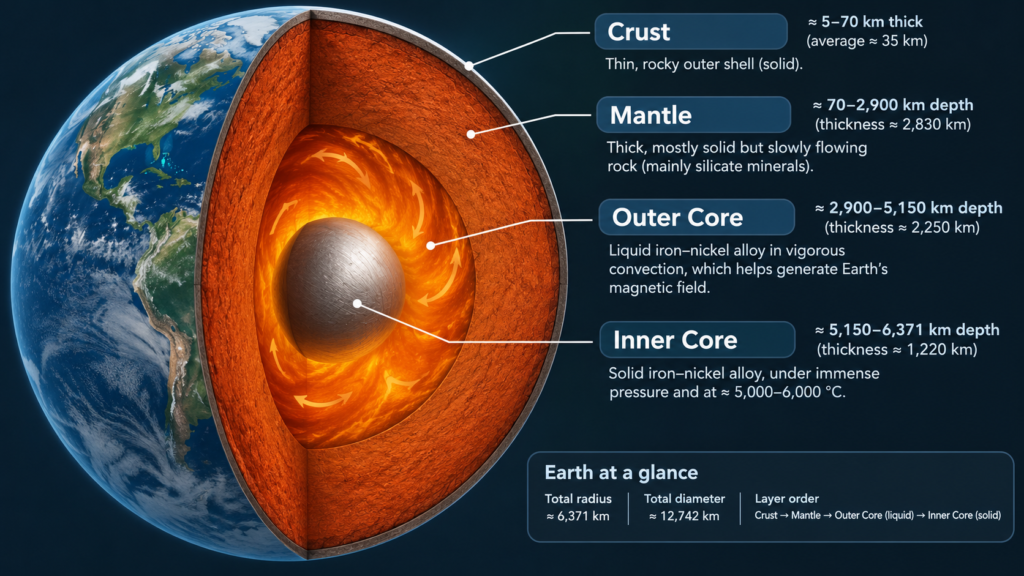
The answer lies roughly 2,900 kilometres beneath the surface, where the rocky mantle gives way to the metallic core. At Earth’s centre lies a solid inner core, enclosed by a much thicker layer of liquid metal consisting primarily of iron, along with nickel and lighter elements. The inner core remains solid because of the immense pressure at the planet’s centre, while the surrounding outer core is liquid under its particular temperature and pressure conditions. This outer layer is approximately 2,260 kilometres thick, and its electrically conducting material is continually moving.
Earth’s magnetic field is generated not simply because the planet contains iron, but because some of that iron is moving in a particular way.
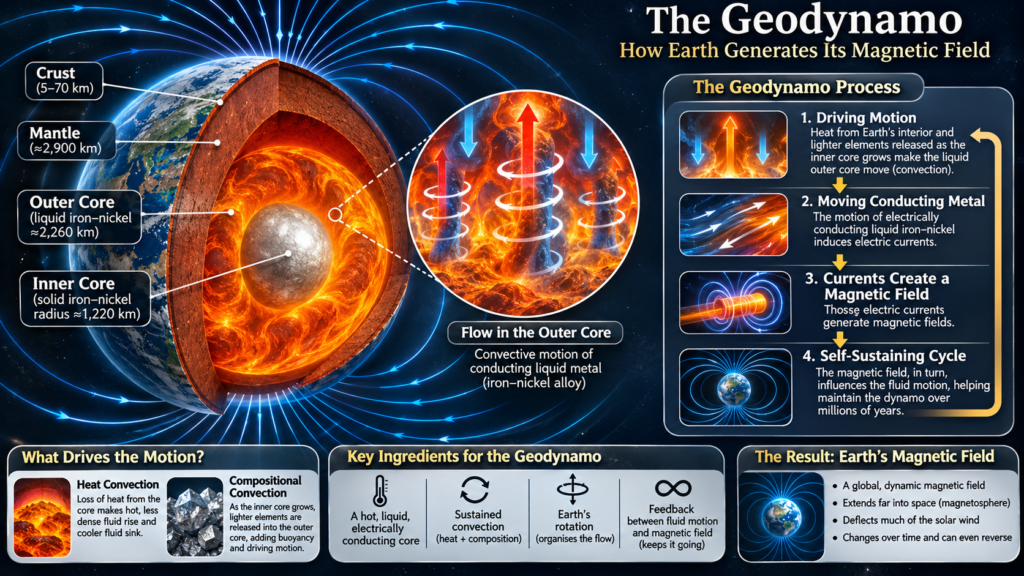
To understand why movement matters, consider what happens when electric charges flow through a wire. As electric charges flow through the wire, they generate a magnetic field in the surrounding space. Something related occurs in Earth’s outer core, although there are no wires or neatly arranged electrical circuits. The liquid metal conducts electricity, and its motion through an existing magnetic field induces electrical currents. These currents generate additional magnetic fields, which interact with the moving fluid. Under suitable conditions, the process can sustain itself through a continuous feedback between motion and magnetism. Scientists call this mechanism the geodynamo.
But a liquid core does not automatically produce a successful dynamo. Its movement must be maintained by an energy source. Earth is gradually losing heat from its deep interior, and differences in temperature can help drive convection within the outer core. Another contribution comes from the slow growth of the solid inner core. As iron-rich liquid crystallises, lighter elements tend to remain in the surrounding fluid, creating differences in composition and buoyancy that encourage further movement. Earth’s rotation also influences the flows through the Coriolis effect, helping organise them into complicated patterns.
The magnetic field surrounding us is sustained partly by the slow cooling and internal evolution of the planet itself.
We cannot watch any of this happening directly. No instrument has travelled into the outer core to observe its liquid currents, and the pressures and temperatures involved make such exploration impossible with present technology. Instead, scientists study how the magnetic field changes at Earth’s surface and use mathematical models to investigate the movements that could produce those variations. The field itself provides indirect evidence of what the deep interior is doing. In that sense, a compass is responding to the consequences of a process we understand through physics rather than direct observation.
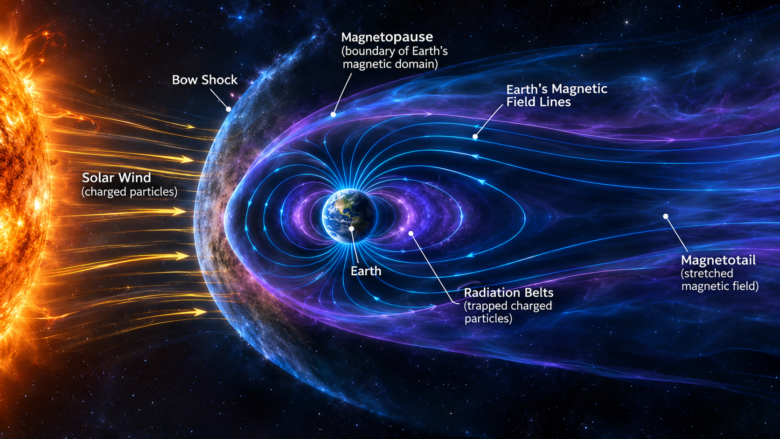
The field generated inside Earth does not remain confined to the ground. It extends outward into space, where it encounters the solar wind, a continuous stream of charged particles released by the Sun. Their interaction shapes a vast region around the planet known as the magnetosphere. On the side facing the Sun, the solar wind compresses this region, while on the opposite side it stretches into a long magnetic tail. The resulting structure is constantly changing as conditions in space vary.
An invisible field born in the depths of the Earth helps determine how our planet interacts with the Sun.
This interaction provides important protection, although the familiar description of the magnetic field as a shield needs some explanation. Charged particles respond to magnetic forces, so Earth’s magnetic environment can redirect many of the particles arriving from space. But it does not block everything. Some particles enter the magnetosphere, and energetic interactions can produce geomagnetic storms that disturb satellites, radio communication and electrical infrastructure. Nor does the magnetic field simply prevent all harmful radiation from reaching the surface. Earth’s atmosphere provides much of that protection, including absorption of ultraviolet radiation by ozone. The atmosphere and magnetosphere are different parts of a much larger system that makes conditions on Earth comparatively favourable.
One of the most beautiful consequences of this system is the aurora. Under suitable conditions, energetic particles travel into the upper atmosphere near the polar regions and interact with oxygen and nitrogen. These interactions produce the shifting curtains of light we recognise as the northern and southern lights. The colours are not the magnetic field itself becoming visible. They are light emitted by atmospheric constituents after interactions with energetic particles whose movements are influenced by Earth’s magnetic environment. It is a remarkable connection between processes occurring deep underground and something people can occasionally witness across the night sky.
The field is also less permanent than it appears. Magnetic north does not remain in one fixed position, and the strength of the field changes over time. More surprisingly, Earth’s magnetic polarity has reversed repeatedly throughout geological history. Scientists know this because certain rocks preserve traces of the magnetic field that existed when they formed. The last major reversal occurred roughly 780,000 years ago, but reversals do not follow a predictable schedule. Although measurements show that the global magnetic field has weakened over recent centuries, this does not establish that another reversal is imminent.
The magnetic field is a continuing planetary process, not a perfectly stable feature installed when Earth first formed.
Its history may be almost as old as the planet’s earliest surviving rocks. In 2024, researchers studying ancient formations in Greenland reported evidence of a magnetic field approximately 3.7 billion years ago. The preserved signals suggest a field whose strength was already comparable in order of magnitude to today’s. This introduces another puzzle because Earth’s solid inner core may not yet have existed in its present form. If so, the ancient dynamo must have been sustained through a somewhat different balance of processes. Our planet has apparently maintained magnetic activity across an extraordinary stretch of geological time, even as the conditions inside it have changed.
Return to the compass on the table. Its needle is still pointing in approximately the same direction, giving no indication of the turbulent liquid metal, electrical currents and planetary rotation involved in producing that simple movement. Far above it, the magnetic field continues interacting with particles from the Sun, while far below it, the outer core continues losing heat and circulating. We rarely experience either process directly. Yet both belong to the same physical system, connecting the deepest accessible questions about Earth’s interior with the space surrounding it. The compass has not revealed anything new about the room. It has simply reminded us that the apparently solid ground beneath our feet belongs to a planet that is still remarkably active inside.
Author’s Note
What interested me most about Earth’s magnetic field was discovering that the planet’s enormous iron core cannot simply behave like an ordinary magnet. The explanation is far more dynamic, involving moving liquid metal, electrical currents and a planet that is gradually cooling. I find the connection between these hidden processes and something as familiar as a compass particularly striking. It is easy to forget that the Earth beneath us is not entirely still.
G.C., creator and writer of Ecosociosphere.
References & Further Reading
- U.S. Geological Survey. How Does the Earth’s Core Generate a Magnetic Field?
- NASA Science. Earth’s Magnetosphere: Protecting Our Planet from Harmful Space Energy
- U.S. Geological Survey. Is the Earth a Magnet?
- NOAA Space Weather Prediction Center. Earth’s Magnetosphere
- Oxford University (2024). Researchers Find Oldest Undisputed Evidence of Earth’s Magnetic Field
- U.S. Geological Survey. Is It True That Earth’s Magnetic Field Occasionally Reverses Its Polarity?
- U.S. Geological Survey. Are We About to Have a Magnetic Reversal?