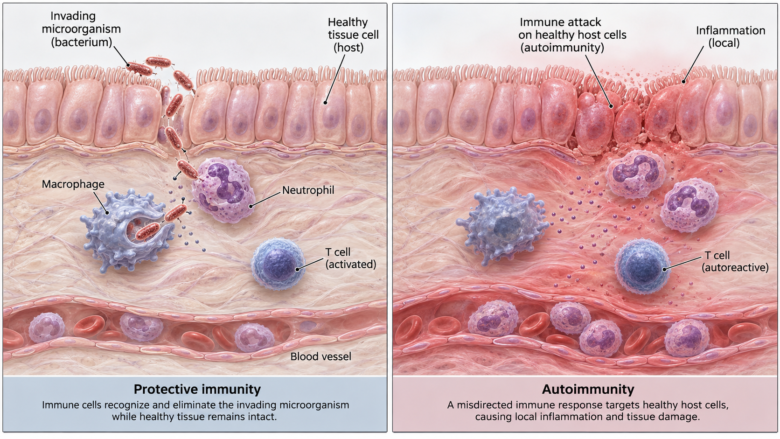
Imagine having a defence system so sophisticated that it can recognise countless threats it has never encountered before. It identifies invading microorganisms, remembers previous infections and helps protect the body from dangers we rarely notice. Yet in some people, this same system begins attacking the tissues it was supposed to defend. Cells in the pancreas may become targets, joints can develop persistent inflammation, and even the protective structures surrounding nerves may come under attack. The damage is not necessarily caused by an invading organism.
Sometimes, the body’s own defence system becomes the source of the danger.
We often describe the immune system as an army trained to distinguish between friends and enemies. It is a convenient comparison, although the biology is considerably more complicated. Our immune cells respond to molecular structures, chemical signals and the circumstances in which they encounter them. They do not possess a complete list of everything that belongs to us. Instead, the developing immune system must learn which responses could damage the body and how to restrain them. This ability is called immune tolerance, and without it, even a healthy immune system would be capable of causing considerable harm.
The difficulty begins with the extraordinary variety of immune cells our bodies produce. Certain white blood cells, particularly B lymphocytes and T lymphocytes, possess receptors that recognise specific molecular features. Their diversity is generated partly through the rearrangement of genetic material during development. This allows the immune system to recognise an enormous range of possible threats, including some it has never encountered. But the process is not perfectly selective. By generating receptors with so many different recognition patterns, the body also produces cells capable of responding to its own molecules.
The ability to recognise almost anything comes with the possibility of recognising ourselves as a target.
Fortunately, the immune system has ways of reducing that risk. Developing T cells undergo important stages of selection in the thymus, a small organ located behind the breastbone. Cells that react too strongly to certain self-molecules can be eliminated before they become fully functional. B cells undergo related screening processes in the bone marrow, where potentially dangerous receptors may be altered or the cells removed. Scientists call these processes central tolerance. It is an extraordinary arrangement: the immune system must test some of its own developing cells to prevent them from becoming harmful later.
There is an especially curious detail within the thymus. Some specialised cells can display proteins normally associated with entirely different organs, including tissues that developing T cells would not otherwise encounter there. A regulatory protein called AIRE helps make this possible. By exposing developing immune cells to a broad collection of the body’s own molecular features, the thymus improves the chances of identifying potentially harmful responses. Rare inherited defects affecting AIRE can cause severe autoimmune disease, demonstrating how important this screening process is.
Yet the screening is incomplete, and that is not necessarily a biological failure. Some self-reactive immune cells escape into the circulation without causing disease. Their activity is restrained through additional mechanisms collectively called peripheral tolerance. Certain cells become unresponsive when they encounter an antigen without the appropriate activating signals. Others are suppressed by specialised regulatory T cells, which help prevent inappropriate immune reactions. These controls operate throughout the body, long after the original immune cells have developed.
Recognising something as foreign or familiar is only part of the immune response; deciding whether to attack is another matter entirely.
Autoimmune disease can develop when these protective arrangements become insufficient. In type 1 diabetes, immune-mediated destruction of insulin-producing pancreatic beta cells progressively impairs the body’s ability to regulate blood glucose. In rheumatoid arthritis, the immune system mistakenly targets tissues within the joints, causing ongoing inflammation that can gradually damage their structure. In multiple sclerosis, immune-mediated injury affects structures within the central nervous system, particularly the protective myelin surrounding nerve fibres. These conditions differ considerably in their biology, and there is no single malfunction that explains them all. What connects them is an immune response directed against the body’s own components.
But why would tolerance break down in the first place? Sometimes the answer involves genetic susceptibility. Variations in genes associated with immune recognition and regulation can make certain autoimmune diseases more likely. Environmental influences also matter, including some infections, smoking and other exposures. Even then, possessing a genetic risk factor does not mean someone will necessarily develop an autoimmune disease. The outcome often reflects several influences interacting over time, many of which researchers are still trying to understand.
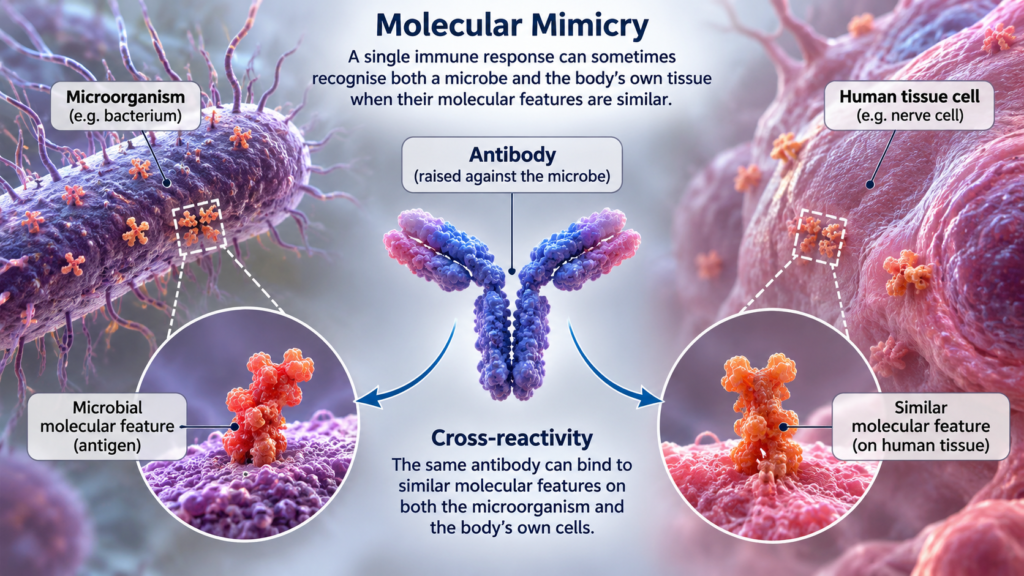
One of the most intriguing proposed mechanisms is called molecular mimicry. Occasionally, a microorganism possesses molecular structures that resemble components of the human body closely enough for an immune response to recognise both. The resemblance need not involve an entire protein. Sometimes a relatively small molecular feature is sufficient. The immune system responds to an infection, but certain antibodies or immune cells may also react with the body’s own tissues.
A defence response aimed at an invader can sometimes recognise something familiar in the organism it is trying to protect.
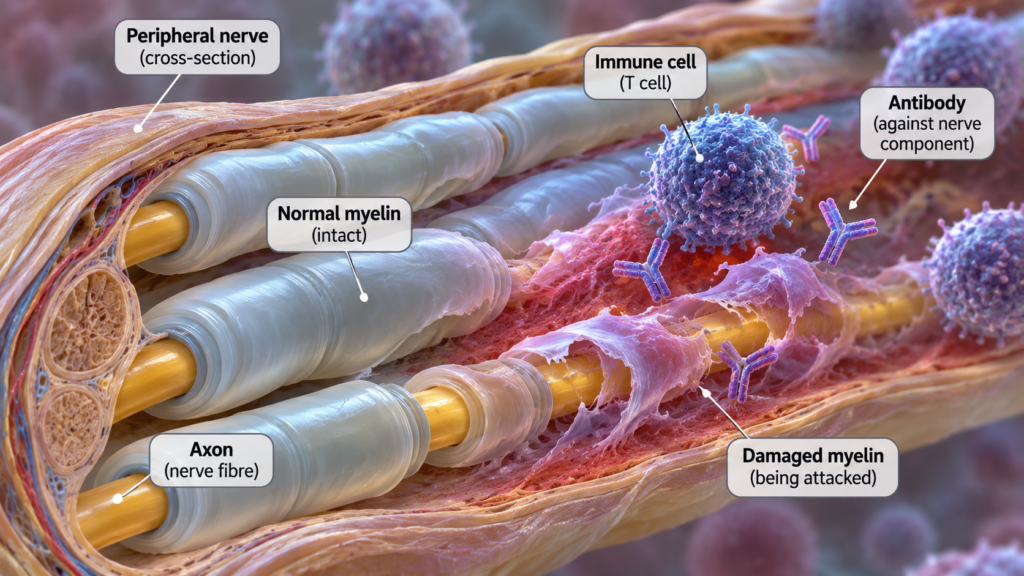
A particularly well-studied example involves Guillain–Barré syndrome, an immune-mediated disorder affecting peripheral nerves. Some cases develop after infection with the bacterium Campylobacter jejuni, which commonly causes gastrointestinal illness. Certain bacterial surface molecules resemble gangliosides found in human nerve tissue. Antibodies produced against the bacterial structures can sometimes cross-react with these nerve components, contributing to neurological damage. Most people infected with Campylobacter do not develop Guillain–Barré syndrome, and not every case involves this bacterium. Nevertheless, the connection provides unusually compelling evidence that molecular resemblance can sometimes have serious biological consequences.
It would be misleading, however, to assume that every autoimmune disease begins with an infection that tricks the immune system.
Molecular mimicry is only one possible contributor. Researchers also investigate how inflammation exposes normally concealed molecules, how immune reactions expand to additional targets, and how defects in immune regulation allow damaging responses to persist. In many diseases, the original trigger remains uncertain. The immune system is complicated enough that similar symptoms may arise through different combinations of biological events.
There is another uncomfortable aspect to autoimmunity. Many of the mechanisms causing damage are not fundamentally different from those that protect us during infections. Antibodies, inflammatory signalling molecules and immune cells are all essential components of ordinary defence. The problem lies partly in where their activity is directed and whether it is appropriately controlled. This is also why treating autoimmune diseases can be difficult. Suppressing harmful immune responses may reduce inflammation and tissue damage, but broad suppression can interfere with the body’s ability to fight infections. More targeted treatments attempt to interrupt particular immune pathways without unnecessarily disabling the entire system.
What makes this subject especially strange is that the immune system cannot simply stop recognising the body’s own molecules.
It encounters them constantly, and some degree of self-recognition is involved in normal immune regulation. The challenge is to maintain responses that are flexible enough to defend against changing threats while restrained enough to avoid damaging ordinary tissues. That balance is achieved through many overlapping mechanisms, not through an infallible distinction between what belongs to us and what does not.
Most of us spend our lives unaware of this delicate arrangement. Immune cells circulate through our blood, enter tissues, examine molecular signals and respond to potential threats without attracting our attention. Usually, these activities help preserve the body they inhabit. Occasionally, the balance is disturbed, and the consequences reveal how difficult the task has always been.
The immune system’s greatest achievement may not be its ability to attack, but its ability to recognise when an attack should never begin.
Author’s Note
What interested me most about autoimmune disease was discovering that the immune system doesn’t begin with a perfect understanding of what belongs to the body. It has to develop that restraint through several overlapping processes, and even then, the distinction is not infallible. The idea of molecular mimicry makes the problem especially curious: something capable of recognising a dangerous microorganism may also recognise a similar structure within ourselves. It is a reminder that biological protection depends as much on restraint as it does on strength.
G.C., creator and writer of Ecosociosphere.
References & Further Reading
- Goodnow et al. (2005). Cellular and Genetic Mechanisms of Self Tolerance and Autoimmunity — Nature.
- Janeway et al. Self-Tolerance and Its Loss — Immunobiology.
- Anderson & Su (2016). AIRE Expands: New Roles in Immune Tolerance and Beyond
- Understanding Autoimmunity: Mechanisms, Predisposing Factors, and Cytokine Therapies (2024). Read the review
- Potential Clinical Implications of Molecular Mimicry-Induced Autoimmunity (2024). Read the review
- Molecular Mimicry in the Pathogenesis of Autoimmune Rheumatic Diseases (2025). Read the review
- Molecular Mimicry Revisited: Novel Perspectives on Autoimmune Disease Initiation and Progression (2026). Read the review