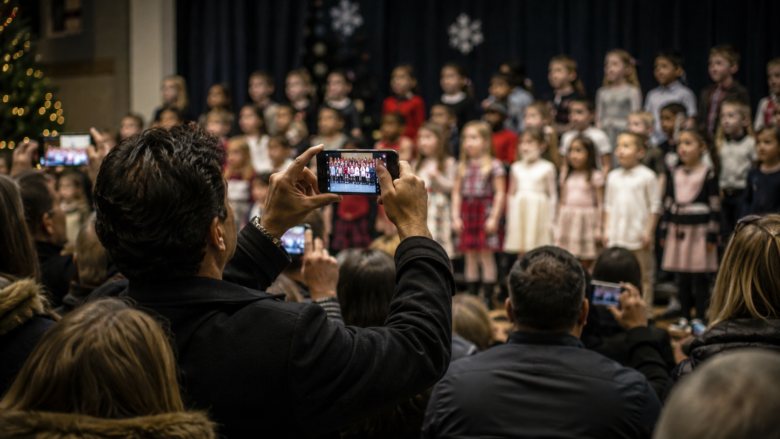
Not long ago, most childhood memories belonged almost entirely to the family.
A birthday party might be photographed. A school performance might be recorded on a camcorder. Parents shared those moments with relatives, friends, and perhaps future generations through photo albums and home videos. The audience existed, but it was small and personal.
Today, childhood unfolds in a much more public space.
The first steps, the first day of school, the first sports medal, the first dance recital, and countless ordinary moments can now be shared with hundreds or even thousands of people within minutes.
What was once primarily a family memory can instantly become public content.
The desire to share is not new.
Parents have always been proud of their children. They have always celebrated milestones and wanted others to share in their joy. What has changed is not the instinct to share. What changed was how many people are now watching.
And audiences tend to change behaviour.
Anyone who has stood in front of a camera or spoken to a crowd understands this instinctively. The awareness of being observed makes us slightly more conscious of how we appear. We begin viewing ourselves through the eyes of others.
Modern parenting increasingly takes place under similar conditions.
Many parents are raising children while simultaneously presenting parts of family life to an audience. Sometimes that audience consists of close friends and relatives. Sometimes it includes people they have never met. Either way, family life is no longer entirely private.
This visibility creates something else as well.
For most of human history, parents compared themselves to other parents within their immediate community. The comparison group was limited. There were only so many families a person could observe on a regular basis.
The internet removed those limits.

A parent scrolling through social media can encounter dozens of families in a few minutes. One child appears academically gifted. Another excels in sports. Another speaks multiple languages. Another family seems to travel constantly while maintaining a perfectly organized household.
Individually, there is nothing wrong with any of these images.
The problem arises when the mind begins combining them.
The achievements of one child merge with the talents of another. The experiences of one family merge with the routines of another. Eventually, an imaginary standard emerges—a family that does not actually exist, but one against which many real families are measured.
What often goes unnoticed is that these comparisons are rarely just about children. They are also about parents.
When people see a successful child, they often assume there must be successful parenting behind that outcome. The achievement may belong to the child, but the credit frequently extends to the parent.
Over time, this can subtly change how milestones are perceived.
A school award remains a source of genuine pride. A sports trophy remains something worth celebrating. But in a highly visible culture, these moments can begin to serve another purpose.
They become signals.
Signals that a child is thriving. Signals that opportunities are being provided. Signals that a parent is doing a good job.
Most parents do not consciously think this way. Yet social environments do not require conscious participation to influence behaviour. Human beings naturally respond to the expectations and standards that surround them.
Eventually, everyone is looking at everyone else’s edited reality.
The interesting part is that most parents already know this.
They know social media is selective. They know people tend to share celebrations rather than disappointments. They know a smiling family photograph reveals very little about the challenges that exist outside the frame.
Yet comparison survives knowledge remarkably well.
A person can understand that an image represents only a small part of reality and still feel influenced by it. After all, people do not compare facts alone. They compare impressions, emotions, and stories.
And stories are powerful.
A single photograph rarely changes how someone feels about their parenting. Hundreds of photographs viewed over the years can.
Not because they convince parents that they are failing. More often, they quietly shift the standard of what success is supposed to look like.
The milestones appear more frequent. The achievements appear more impressive. The families appear more organized.
Gradually, ordinary life can begin to feel less impressive than it actually is.
This is where parenting becomes about more than the parent and child.
Not because parents stop caring about their children. Not because family moments become fake. But because visibility naturally encourages presentation.
A birthday party becomes something to celebrate and something to document. A family outing becomes something to enjoy and something to share.
A milestone becomes something to remember and something to display. The experience and the presentation begin occupying the same space.
Sometimes they coexist comfortably. Sometimes they compete. Perhaps that is what makes modern parenting unique.
Previous generations certainly faced pressure, expectations, and judgment. But they rarely carried a permanent audience in their pockets.
Today, many parents do. The audience can be supportive. It can create community. It can allow families to share joy and learn from one another.
But it can also make it easy to forget what parenting was originally meant to be.
Not a competition. Not a performance. Not a carefully managed public image. But a relationship.
A relationship built through ordinary conversations, repeated lessons, patient encouragement, and countless moments that never appear online.
Those moments rarely attract attention. Yet they may be the moments that matter most.
Because years from now, children are unlikely to remember how many people viewed a photograph of their achievement.
They are far more likely to remember how it felt when someone they loved was there to celebrate it with them.
Author’s Note
Parents have always celebrated their children’s achievements. What is new is the audience. As more of family life moves online, the challenge may not be deciding what to share, but remembering that the most important parts of parenting often happen away from the camera.
G.C., Ecosociosphere contributor.