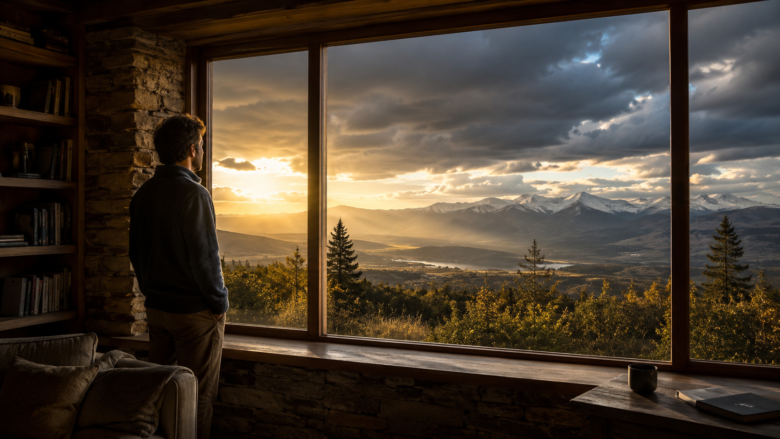
A wall is one of humanity’s simplest inventions. It separates inside from outside, protects us from weather, keeps danger at a distance, and gives us a space we can call our own. Yet almost as soon as humans learned to build walls, they began cutting holes into them.
Those openings eventually became windows.
At first glance, a window seems like an ordinary architectural feature, so familiar that we rarely think about why it exists. We expect bedrooms to have them, offices feel unpleasant without them, and a room with no windows can quickly seem confined or unnatural.
But the window represents an unusual compromise in human behaviour.
We build shelters because we want separation from the outside world, then deliberately create openings because complete separation feels wrong. In that contradiction lies a surprisingly deep story about light, safety, curiosity, and our relationship with the world beyond our walls.
The earliest shelters did not have windows in the modern sense. Caves, huts, and primitive dwellings depended largely on entrances and small openings for ventilation and daylight. Openings could also be dangerous. They allowed cold air, rain, insects, smoke, and potentially hostile animals or people to enter.
From the perspective of pure protection, a completely enclosed shelter might seem preferable. Yet darkness created its own problems. Humans needed to see what they were doing, monitor their surroundings, and maintain some awareness of what was happening outside.
Long before artificial lighting, sunlight determined much of the rhythm of human life. Bringing daylight into a shelter extended the usefulness of an interior space without requiring fire. People could prepare food, repair tools, weave, work, and interact while remaining protected from the elements.
As buildings became larger and more permanent, openings for light became increasingly important.
Architecture was no longer simply about creating a barrier against nature. It was also about deciding how much of nature should be allowed back in.
This relationship with daylight runs deeper than convenience. Human biology evolved under the predictable cycle of bright days and dark nights. Light reaching the eyes helps regulate the body’s circadian system, influencing sleep, alertness, hormone production, and daily patterns of activity. Modern research has repeatedly shown that access to natural light can affect mood, sleep, and wellbeing.
The attraction of a sunlit room, then, is not merely an aesthetic preference. A bright window connects an enclosed human environment to biological rhythms that existed long before buildings did.
But windows provide something that light alone cannot: a view.

That distinction matters because humans are intensely visual and curious animals. We constantly gather information about our surroundings, even when there is no immediate reason to do so.
A window allows us to remain protected while still observing movement, weather, people, animals, approaching visitors, or changes in the landscape. It turns a solid wall into an information source.
There is an interesting evolutionary logic behind this arrangement. An exposed position offers information but little protection. A completely enclosed position offers protection but limited information. A window provides elements of both. From behind it, a person can observe the environment without being fully exposed to it.
Modern architecture may be far removed from prehistoric survival, but the basic appeal remains remarkably familiar: we often prefer places where we can see without necessarily being seen.
This helps explain why certain window positions feel especially comfortable. A seat beside a window in a café, train, classroom, or home gives us a protected place from which the wider world remains visible. We can watch pedestrians pass, see rain moving across a street, notice birds in a garden, or simply follow clouds across the sky.
None of this information may be necessary, yet the ability to observe seems to satisfy something fundamental. The outside world remains available to us without demanding that we participate in it.
Windows therefore do more than connect spaces. They create psychological distance.
A thunderstorm experienced outdoors can feel threatening; watched through glass, it can become fascinating. Snow, heavy rain, strong wind, or the movement of a crowded street can be enjoyed differently when a physical boundary separates observer from environment.
The glass reminds us that we are inside, while the view prevents that safety from becoming isolation. Perhaps this is why looking through a window can feel strangely calming. We experience the world while retaining control over how much of it reaches us.
Over time, advances in glassmaking transformed this ancient compromise. Early openings might have been covered with shutters, cloth, animal hide, thin stone, or other translucent materials. Glass eventually allowed something extraordinary: a barrier that behaved visually as though it were barely there.
It could block wind and rain while admitting light and preserving a view. With larger and cheaper panes of glass, windows expanded dramatically, eventually becoming entire walls in modern houses, offices, shops, airports, and skyscrapers.
Their purpose expanded with them. Windows became displays of wealth, architectural statements, sources of ventilation, instruments of surveillance, and frames through which landscapes could become part of an interior.
A carefully positioned window can turn a mountain, garden, skyline, or ordinary street into something resembling a living picture.

Architects do not simply decide where light should enter a building; they decide what its occupants will repeatedly see.
Yet our dependence on windows becomes clearest when they disappear. Windowless rooms often require deliberate design to prevent them from feeling enclosed. Underground spaces can feel disorienting because we lose easy information about daylight, weather, and time.
Even in buildings filled with artificial illumination, people frequently seek seats near windows. Technology can reproduce brightness remarkably well, but a glowing ceiling cannot tell us whether clouds are gathering outside.
That may be the most revealing thing about windows. Humans have spent thousands of years improving their ability to create controlled environments. We can heat rooms in winter, cool them in summer, illuminate them at midnight, and construct buildings hundreds of metres above the ground.
In theory, modern architecture can separate us from the natural environment more completely than ever before.
And yet we keep building windows.
We want the wall, but we also want the horizon beyond it. We want protection from the storm and the ability to watch it arrive. We want privacy without complete isolation, shelter without blindness, and an interior world that still tells us something about the larger one outside.
A window is therefore more than a hole in a wall or a sheet of glass in a frame. It is an architectural expression of an old human compromise: the desire to be safely inside while remaining connected to everything beyond.
Perhaps that is why a room can contain everything we physically need and still feel incomplete without one. The wall gives us shelter. The window reminds us what the shelter is protecting us from—and what, eventually, we may want to step outside and explore.
Author’s Note
Windows are so ordinary that we rarely consider what a peculiar invention they really are. We build walls to separate ourselves from the outside world, then deliberately make parts of those walls transparent so that we can continue seeing it.
What interested me about this subject was that contradiction. The history of the window is not simply a story of architecture or glassmaking. It reflects something much older in us—the desire to feel protected without becoming disconnected, to bring daylight indoors, and to remain curious about whatever lies beyond the walls we build.
G.C., creator and writer of Ecosociosphere.
References & Further Reading
- National Institute of General Medical Sciences — Circadian Rhythms
- Encyclopaedia Britannica — Window
- Encyclopaedia Britannica — Glass
- National Park Service — Preservation Brief on Historic Windows
- Appleton, J. — The Experience of Landscape — A classic work associated with prospect-refuge theory and our preference for environments combining visibility with shelter.