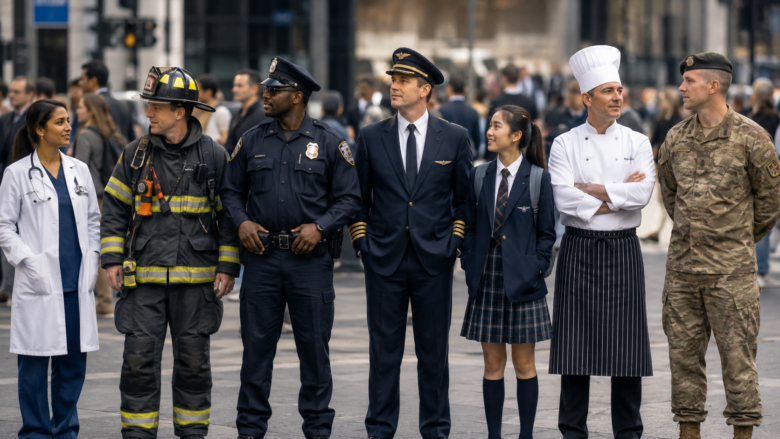
A uniform does something curious to a person before they have said a single word. A white coat suggests medical knowledge. A police uniform signals authority. A school uniform places a child inside an institution, while a military uniform can communicate rank, discipline, and national service from across a crowded room.
Even when we know nothing about the individual wearing it, the clothing has already begun to tell us who they are, what role they occupy, and sometimes how we are expected to behave around them.
Few pieces of clothing carry so much social information while revealing so little about the person underneath.
Humans have used clothing to communicate identity for thousands of years, long before the modern uniform appeared. Colours, fabrics, ornaments, armour, robes, and symbols could reveal occupation, social position, religious role, military allegiance, or membership of a particular community.
As societies grew larger, however, recognizing roles became increasingly important. In a small village, people might personally know the healer, guard, priest, or leader. In a city containing thousands or millions of strangers, that familiarity disappears. Uniforms provide a remarkably efficient solution: instead of knowing the person, we learn to recognize the role.
This works because the human brain is constantly searching for shortcuts. Social life would be exhausting if we had to evaluate every unfamiliar person entirely from scratch. We therefore rely on visible signals—clothing, behaviour, surroundings, badges, tools, and countless other cues—to make rapid judgments about who someone might be.
A firefighter arriving in recognizable protective clothing does not need to explain why they are entering a dangerous area. An airport employee in uniform can be identified among hundreds of travellers. A nurse moving through a hospital is easier for patients to recognize because appearance and environment reinforce one another.
The uniform turns an invisible social role into something immediately visible.

But uniforms do more than help outsiders identify people. They also change how wearers understand themselves. Social psychologists have long studied the way group membership becomes incorporated into personal identity.
We do not think of ourselves only as isolated individuals; we also define ourselves through families, professions, schools, communities, teams, nations, and other groups. Wearing the same clothing as other members makes that shared identity tangible. The individual becomes visibly connected to something larger than themselves.
This helps explain the enduring presence of uniforms in schools. Their practical advantages are frequently debated, but their psychological purpose is equally interesting. When students enter a school wearing similar clothing, some of the visible differences created by everyday fashion become less prominent.
The uniform repeatedly reminds students that, whatever their personalities or backgrounds, they temporarily occupy the same institutional role. Of course, clothing cannot erase economic inequality, social divisions, or individuality. Students quickly find other ways to express themselves.
Yet the uniform still establishes a visual baseline: inside this space, you belong to this group.
The same mechanism becomes much stronger in military organizations. Military uniforms are deliberately standardized because armies depend upon coordination, hierarchy, and collective identity. Rank insignia identify authority, while common colours and designs distinguish one force from another.
Historically, uniforms also helped soldiers recognize allies amid the confusion of battle. But their psychological function reaches further. Dressing alike, training alike, and following shared routines can strengthen the feeling that personal action is connected to collective responsibility.
The clothing becomes part of a much larger system designed to transform individuals into members of a coordinated unit.
Authority is another reason uniforms have such power. Experiments in social psychology have repeatedly demonstrated that people respond differently to individuals whose clothing suggests legitimate status or expertise.
We tend to associate certain uniforms with institutions that possess recognized responsibilities: police officers enforce laws, judges represent legal authority, doctors possess medical expertise, and security personnel control access to particular spaces. The effect can be surprisingly automatic. Before credentials have been examined or competence demonstrated, appearance has already influenced expectation.
That shortcut is useful, but it also exposes an important weakness.
A uniform can signal trustworthiness without guaranteeing it.
Someone wearing professional clothing may appear more knowledgeable, reliable, or authoritative than the same person dressed casually. This is precisely why impersonators and confidence tricksters sometimes use uniforms, badges, or professional-looking clothing. They exploit a social habit that normally serves us well.
Humans learn to trust recognizable signals because verifying every person’s identity independently would make ordinary institutions painfully inefficient.
Trust, therefore, may be one of the uniform’s most important functions. Modern societies require enormous numbers of strangers to cooperate. We board aircraft flown by people we have never met, accept assistance from emergency workers we do not personally know, leave children with teachers we may initially know very little about, and follow instructions from officials encountered briefly.

Uniforms cannot create genuine competence or integrity, but they provide a visible connection between an unfamiliar individual and a familiar institution.
We may not know the person, but we recognize what they represent.
There is, however, another side to this collective identity. The same uniform that creates belonging can reduce individuality. This is partly intentional. Institutions often want attention directed toward the role rather than the personality occupying it.
Yet people do not stop being individuals simply because their clothing becomes standardized. A doctor remains a person beneath the coat, a soldier beneath the fatigues, a student beneath the school colours. Sometimes our response to the uniform becomes so automatic that we begin interacting with the symbol rather than the human being wearing it.
Perhaps that is why uniforms remain so revealing despite their apparent simplicity. They demonstrate how much human civilization depends upon shared symbols. A piece of fabric has no authority by itself. Its meaning exists because millions of people have learned what particular colours, shapes, badges, and designs represent. Once that agreement becomes widespread, clothing can organize behaviour without anyone explaining the rules aloud.
Uniforms work because humans do not merely see clothes; we see the stories, institutions, responsibilities, and communities attached to them.
They allow strangers to recognize one another, groups to strengthen belonging, institutions to display authority, and societies to extend trust far beyond personal relationships. Yet underneath every standardized jacket, robe, coat, or shirt remains an individual whose character cannot be stitched into fabric. The uniform tells us the role a person has been given. Understanding the person still requires looking beyond it.
Author’s Note
Uniforms are so ordinary that we rarely notice how much information they carry. A school shirt, white coat, military jacket, or police uniform can change our expectations of a stranger before they have spoken a word.
This article grew from that small observation: clothing does not simply cover the individual; sometimes it temporarily gives them a social identity. Looking at uniforms reveals something much larger about how humans create belonging, recognize authority, and learn to trust people they have never met.
G.C., creator and writer of Ecosociosphere.