
You get up from your chair because you need something from the kitchen. The reason is perfectly clear when you begin walking, and you barely give it another thought. But when you reach the kitchen, you stop and look around. You know you came here for something, although whatever it was seems to have disappeared during the short journey. You check the counter, open a cupboard for no particular reason, and eventually return to the room you came from. Then, almost annoyingly, you remember.
It is such a familiar experience that we usually laugh at ourselves and carry on, but why should walking a few steps into another room make a perfectly ordinary intention so difficult to remember?
Psychologists have been investigating a curious possibility: the doorway itself may have something to do with it. The idea is commonly called the doorway effect, and it suggests that moving between locations can sometimes make recently held information harder to retrieve. It sounds almost too convenient as an explanation for our everyday forgetfulness, especially since we can walk through dozens of doorways without losing track of anything. Still, there is genuine experimental research behind it, and the findings reveal something interesting about how the mind organises experience.
In 2006, psychologists Gabriel Radvansky and David Copeland investigated what happened to memory when people moved through virtual rooms. Participants interacted with objects while navigating the environment and were periodically asked to recognise objects they had recently encountered. The researchers found that information about those objects became less accessible after participants moved into another room, compared with remaining within the same spatial region. Later experiments also found similar effects in real environments.
Crossing into a different room appeared to influence memory, even when the information being tested was only moments old.
One possible explanation comes from the way our minds organise ordinary experiences throughout the day. We rarely perceive life as one enormous, uninterrupted sequence. Instead, we naturally divide what happens into smaller events: preparing breakfast, travelling to work, attending a meeting, or settling down to watch something in the evening. Each event has its own setting, people, objects and immediate purpose. Our brains seem to use these distinctions to keep track of what is currently happening, rather than treating every passing moment as equally relevant.
Researchers describe this process as event segmentation. As we move through an experience, the brain maintains a working understanding of the current situation, sometimes called an event model. Entering a new room can signal that the situation has changed, encouraging the mind to update that model. Information associated with the previous setting may then become less immediately accessible.
The doorway is less like a switch that erases memories and more like a boundary between two chapters of an ongoing experience.

Think about leaving your bedroom to collect a glass of water. While you are still in the bedroom, the intention belongs to everything you are currently doing. Perhaps you have been reading, feel thirsty, and decide to get up. The thought fits naturally into that situation. Once you enter the kitchen, however, the surroundings change. The refrigerator, utensils, dishes and numerous other familiar objects provide different things to notice. If your intention was never particularly strong to begin with, it may be surprisingly easy to lose track of it while your attention adjusts.
That explanation sounds reasonable, but science becomes more interesting when an attractive idea does not work quite as consistently as expected. In 2021, researchers tested the doorway effect across four experiments involving virtual reality, videos and movement through real environments. They did not find a reliable general tendency for doorways to cause forgetting. One experiment did show poorer memory discrimination after crossing doorways when participants were also carrying a substantial working-memory load.
In other words, the effect seemed more likely to appear when the mind was already busy keeping track of other information.
This is worth considering because we often have several thoughts competing for our attention when we move from one room to another. We might be thinking about an unfinished conversation, planning dinner, or mentally reviewing tomorrow’s work while walking across the house. An intention such as fetching a charger occupies only a small part of our attention, and competing thoughts can interfere with it. Under those circumstances, a change of surroundings may make an already fragile thought harder to retrieve. The evidence does not suggest that every doorway automatically produces a little burst of amnesia.
Yet later studies have continued to find effects of event boundaries under certain conditions. Research published in 2023 found that even anticipating an upcoming boundary in a simulated environment could interfere with memory performance. A 2024 study found that visual event boundaries could disrupt information participants were deliberately trying to maintain. More recently, research published in 2026 again found boundary-related memory effects in an immersive virtual environment.
These findings suggest that the underlying relationship is real enough to investigate, although its strength depends on the task, the surrounding context and what the person is trying to remember.
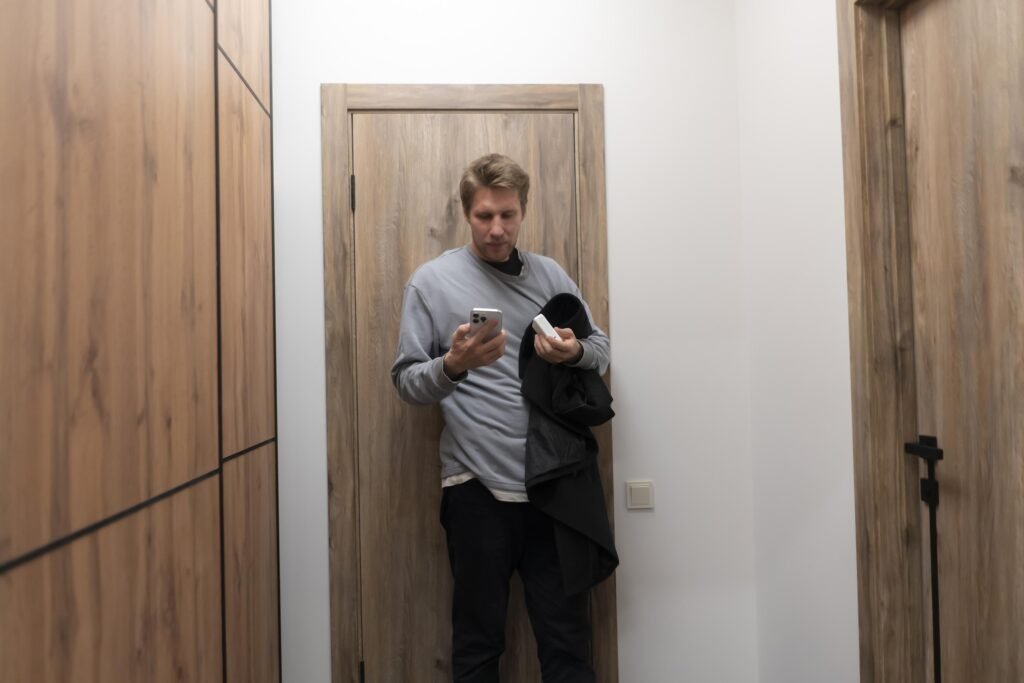
There is another everyday detail that deserves attention. Sometimes, after forgetting what we wanted, simply returning to the original room seems to bring the intention back. That fits with the broader idea that surroundings can provide cues for remembering. A desk, an open laptop or a half-finished activity might remind us of what we were doing immediately before getting up. Interestingly, one doorway-effect experiment found that returning to the original room did not eliminate the memory difficulty in its particular task. So retracing our steps may help in ordinary situations, but it is not a dependable reversal of the experimental effect.
We should also distinguish these momentary failures from the more serious forms of memory loss people sometimes worry about. Forgetting an intention during a distraction-filled walk is common and does not, by itself, indicate a neurological problem. The information may have been weakly maintained, interrupted or difficult to retrieve at that moment. Often the intention returns when something provides the right reminder. Persistent or worsening memory problems that interfere with ordinary functioning, however, deserve a different level of attention.
What I find especially curious is that this familiar annoyance may be connected to a generally useful feature of memory. If our minds never separated experiences into events, keeping track of what belonged to yesterday’s meeting, this morning’s breakfast or the conversation we just finished would become much more difficult. Boundaries help organise continuous experience into manageable pieces, even if some details become harder to access across them.
A system that helps us distinguish one situation from another may occasionally make us lose track of something we still need from the previous one.
So the next time you arrive in the kitchen and stand there wondering what brought you, the doorway may have played a part, but it probably did not act alone. Your attention, the strength of the original intention and whatever else was occupying your mind may all have contributed. You might return to your chair, notice the book beside your empty glass, and suddenly remember that you wanted water. The kitchen is still the same kitchen, and the distance you walked has not changed. What has changed is the situation your mind is trying to keep track of, and sometimes a simple thought gets left behind in the transition.
Author’s Note
I find the doorway effect particularly interesting because the experience is so ordinary that it barely seems worth questioning. We forget something, retrace our steps, remember it and move on. What surprised me during the research was how much more conditional the effect appears to be than the popular explanation suggests. The doorway may matter, but the larger story seems to involve how our minds manage changing situations while trying to keep track of unfinished intentions.
G.C., creator and writer of Ecosociosphere.
References
- Radvansky, G. A., & Copeland, D. E. (2006). Walking Through Doorways Causes Forgetting: Situation Models and Experienced Space.
- Radvansky, G. A., Krawietz, S. A., & Tamplin, A. K. (2011). Walking Through Doorways Causes Forgetting: Further Explorations.
- Baumann et al. (2021). Doorways Do Not Always Cause Forgetting: A Multimodal Investigation.
- Here It Comes: Active Forgetting Triggered Even Just by Anticipation of an Impending Event Boundary (2023).
- Visual Event Boundaries Trigger Forgetting Despite Active Maintenance in Visual Working Memory (2024).
- The Effect of Spatial Boundaries on Memory in a Virtual Environment (2026)