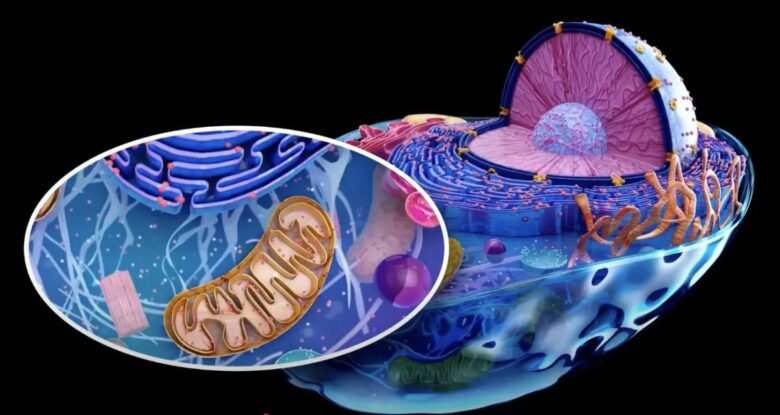
You probably remember learning that the nucleus is the control centre of a cell, the place where DNA stores the instructions needed to build and maintain a living organism. It is a useful explanation, although it leaves out an unusual detail. Scattered throughout many of your cells are tiny structures called mitochondria, and they carry something that most other parts of the cell do not: their own DNA. They even have some of the machinery needed to use those genetic instructions. It seems a rather complicated arrangement when the cell already has a nucleus doing much of that work.
What makes mitochondria different enough to require their own DNA when the cell already stores genetic information in its nucleus?
Mitochondria are usually introduced as the powerhouses of the cell, a description that has become almost inseparable from their name. They help convert energy from nutrients into ATP, a molecule that cells use to power countless activities. Muscle contraction, nerve signalling and much of the ordinary work of staying alive depend on processes supported by this energy supply. Cells with high energy demands, such as muscle cells, often contain particularly large numbers of mitochondria. But calling them powerhouses does not explain why they have their own genetic material, or why that material looks rather different from the DNA stored in the nucleus.
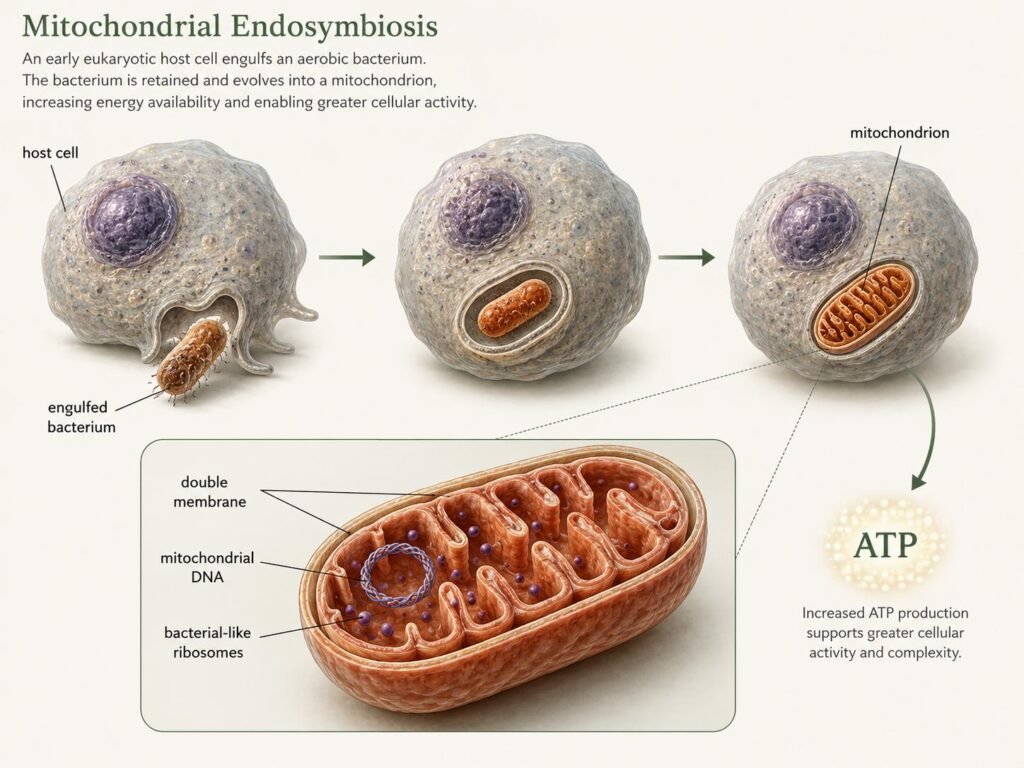
Human mitochondrial DNA is a small, circular molecule containing just 37 genes. Thirteen provide instructions for making proteins involved in cellular energy production, while the remaining genes help mitochondria manufacture those proteins. Compared with the thousands of genes in our nuclear DNA, this is a remarkably modest collection. Mitochondria also possess their own ribosomes, the structures that assemble proteins from genetic instructions, although these are specialised and very different from the ones found elsewhere in the cell. Taken together, these features suggest that mitochondria have a history that cannot be explained simply by treating them as ordinary cellular compartments.
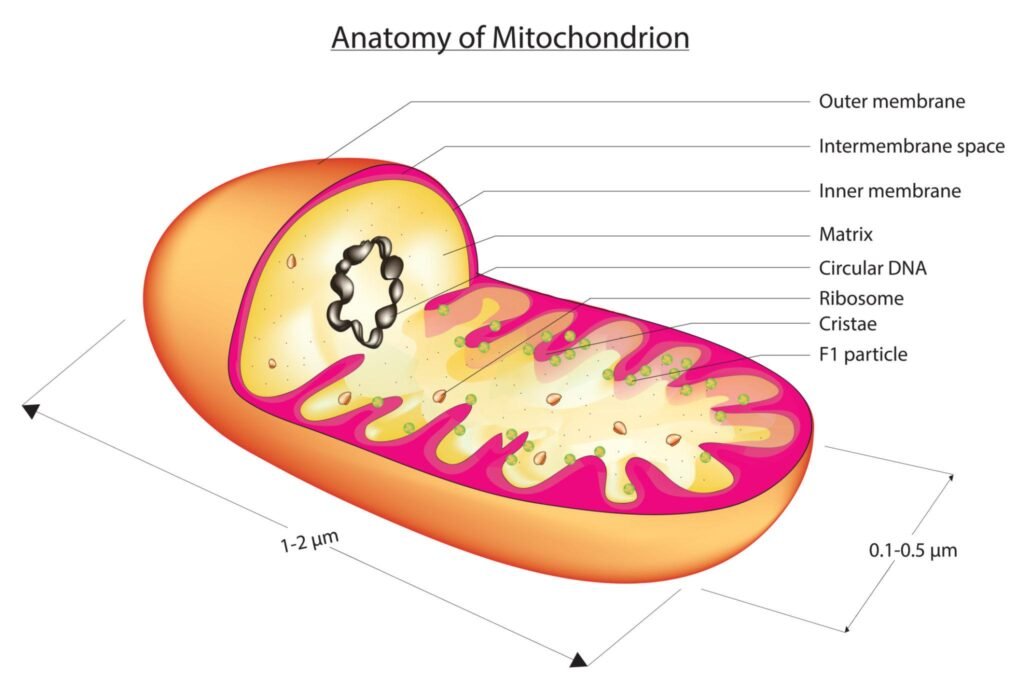 The clues become more interesting when we compare mitochondria with bacteria. Many bacteria carry their genetic information in circular DNA molecules, and they reproduce by dividing. Mitochondria also divide within cells, contain bacterial-related genetic machinery and are surrounded by two membranes. None of these features alone proves a particular evolutionary history, but comparisons of mitochondrial genes with bacterial genes provide especially strong evidence.
The explanation scientists have developed is extraordinary: the ancestors of mitochondria were once separate organisms.
The story takes us back well over a billion years, to a world populated entirely by microorganisms. At some point during the evolution of complex cells, an ancient host organism formed an association with a bacterium related to the evolutionary group known as alphaproteobacteria. Exactly how that relationship began remains uncertain. The host may have enclosed the bacterium, or the two organisms may have developed a close metabolic partnership before becoming permanently associated. What seems clear is that the relationship eventually became so intimate that the bacterium was no longer able to continue as an independent organism.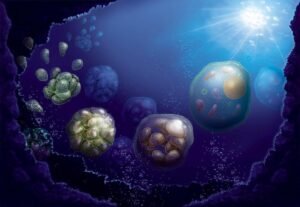
Scientists call this process endosymbiosis, meaning a relationship in which one organism lives inside another. We sometimes see examples of close partnerships in nature today, such as microorganisms living within the bodies or cells of larger organisms. But the ancient association that gave rise to mitochondria went considerably further. Over evolutionary time, the partners became integrated into a single cellular system. The bacterium contributed metabolic capabilities, while the host provided an increasingly stable environment. A relationship between two organisms gradually became part of the architecture of one cell.
There is an important complication, however. Modern mitochondria are not simply tiny bacteria living inside us. Their genomes have been reduced enormously over evolutionary time. Over millions of years, some of the genes from their bacterial ancestors disappeared, while others became incorporated into the DNA stored in the cell’s nucleus. Today, most mitochondrial proteins are actually produced using instructions stored in the nucleus and then transported into the mitochondria where they are needed.
The two genetic systems have become so closely connected that neither functions as a completely independent organism.
That raises an obvious question. If so many mitochondrial genes moved into the nucleus, why did any remain behind? Scientists are still investigating the answer. One possibility is that certain genes are particularly useful when kept close to the machinery they help operate, allowing local responses to changing conditions inside mitochondria. Other explanations involve the difficulties of relocating particular genes and transporting their protein products back into the organelle. Different organisms have retained different numbers of mitochondrial genes, suggesting that evolution did not produce one universal arrangement. Our 37 mitochondrial genes represent just one surviving version of a much longer evolutionary process.
 The history becomes even more personal when we consider how mitochondrial DNA passes between generations. In humans, it is inherited almost entirely from the mother because the mitochondria that persist in the developing embryo ordinarily come from the egg. This produces a pattern of inheritance different from that of most nuclear DNA, which comes from both parents. Researchers can use variations in mitochondrial DNA to investigate maternal ancestry and aspects of human population history. The popular term mitochondrial Eve refers to the most recent woman from whom all living humans inherited their mitochondrial DNA through an uninterrupted maternal line. Many other women lived during her lifetime, but she is the one whose maternal genetic lineage can be traced to all humans living today.
There is something rather unexpected about carrying a genetic system inherited along one line of our family while the organelles containing it descend from organisms that lived long before humans existed. Yet we should be careful with the image of a tiny ancient bacterium surviving unchanged inside each of us. Mitochondria have undergone enormous evolutionary changes, and the ones in your cells are products of countless generations of cellular reproduction. Their bacterial ancestry survives through inherited biological structures and genetic relationships, not through the continued existence of one original microorganism.
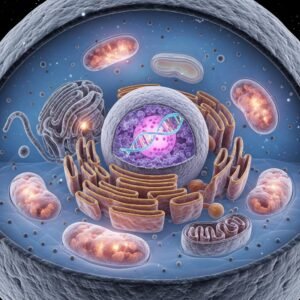 The consequences of that ancient partnership extend far beyond the DNA itself. Mitochondria participate in cellular signalling, metabolism and processes involved in controlling cell survival. Their activities are closely coordinated with the rest of the cell, making them essential participants in how complex organisms function. The relationship that began between two microorganisms eventually became part of the cellular organisation shared by animals, plants, fungi and many other organisms. We cannot confidently reconstruct every step of that transformation, but the acquisition of mitochondria was a major development in the history of complex life.
It is tempting to describe this as a story of cooperation, although the word can make evolution sound more purposeful than it actually is. The original association might not have been friendly, and the surviving arrangement emerged through natural selection over immense stretches of time. Still, the outcome challenges the neat boundaries we usually draw between organisms.
Something that was once evolutionarily separate became so thoroughly incorporated into another form of life that we now regard it as an essential part of ourselves.
Return for a moment to an ordinary cell in your body. Its nucleus contains the overwhelming majority of its genetic instructions, just as a school textbook might suggest. But elsewhere inside that same cell, mitochondria continue to maintain and use a much smaller collection of DNA, descended from an ancient bacterial lineage. Every time your muscles move or your neurons communicate, processes involving these organelles help make that activity possible. The cell appears to be a single living unit, and today it is. Its history, however, includes a time when some of its essential parts belonged to different living lineages.
Author’s Note
What interested me most about mitochondria was not simply that they possess their own DNA, but why they still need it after becoming so completely integrated into our cells. We usually imagine the different parts of a cell as structures that evolved together, each assigned a particular job. Mitochondria suggest a much less straightforward history, one in which evolution transformed a relationship between organisms into a permanent feature of complex life.
G.C., creator and writer of Ecosociosphere.
References
- Butenko, A., et al. (2024). Mitochondrial Genomes Revisited: Why Do Different Lineages Retain Different Genes?
- Martijn, J., et al. (2018). Deep Mitochondrial Origin Outside the Sampled Alphaproteobacteria.
- Timmis, J. N., et al. (2004). Endosymbiotic Gene Transfer: Organelle Genomes Forge Eukaryotic Chromosomes.
- U.S. National Library of Medicine. Mitochondrial DNA — MedlinePlus Genetics.
- Hua, H. (2026). Dating the Mitochondrion’s Arrival.