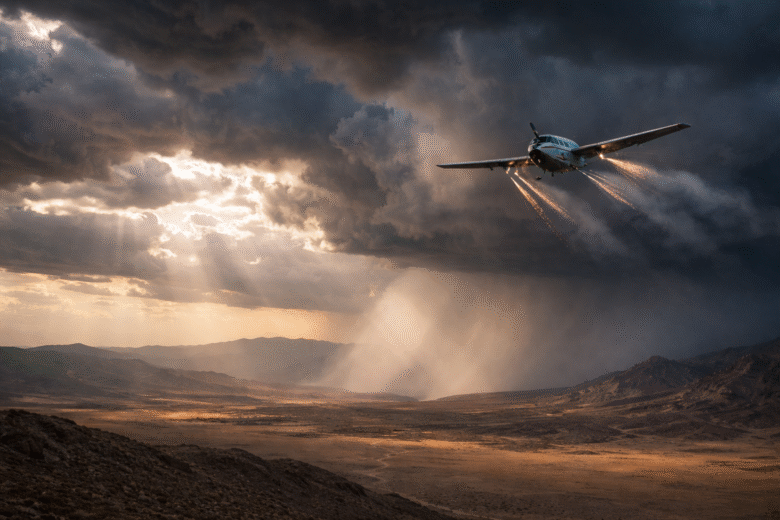
For most of human history, rain was something we prayed for. Farmers watched the sky. Communities performed rituals. Entire civilizations depended on clouds behaving in ways no one could predict.
But today, something remarkable — and slightly unsettling — is happening. Across the world, governments are trying to manufacture rain.
From China’s massive weather-modification programs to the United Arab Emirates’ cloud-seeding aircraft, the idea of synthetic rain is moving from science fiction to a policy tool.
The question is no longer whether humans can influence the weather. The real question is whether we should.
What Exactly Is Cloud Seeding?
Cloud seeding is a weather-modification technique designed to encourage clouds to release rain or snow. The process sounds surprisingly simple.
Aircraft or ground-based generators release tiny particles — usually silver iodide, potassium iodide, or salt crystals — into clouds. These particles act as condensation nuclei, giving water vapor something to cling to.
If conditions are right, droplets grow large enough to fall as precipitation. In theory, this can increase rainfall by 5 to 20 percent under suitable atmospheric conditions. In practice, the results are far more complicated.
A Global Experiment Already Underway
Cloud seeding is not an experimental idea anymore. It is already happening — at scale.
China operates the largest weather-modification program in the world, deploying rockets and aircraft to influence rainfall across vast regions. The program has been used to reduce drought impacts and even to clear skies before major national events.
The United Arab Emirates has invested heavily in cloud-seeding research, flying aircraft equipped with specialized flares designed to stimulate rainfall in the desert.
In the United States, cloud seeding has been used for decades in states like Colorado and Wyoming to increase snowpack in mountain ranges.
Even India has experimented with artificial rain during drought periods in states such as Karnataka and Maharashtra. What was once experimental is slowly becoming infrastructure.
The Temptation of Climate Control
In a warming world, the appeal of synthetic rain is obvious. Droughts are intensifying. Water shortages threaten agriculture and cities alike. Climate change is causing weather patterns to become more erratic and difficult to predict.
If technology can coax more rain from the sky, why not use it? For policymakers, cloud seeding offers a seductive possibility: a technological fix to environmental uncertainty. Instead of waiting for rain, we try to make it. But the atmosphere is not a laboratory.
The Problem with Playing with Clouds
Weather systems are enormously complex. Changing precipitation in one region may subtly influence weather somewhere else. Scientists still debate how effective cloud seeding truly is, and measuring its success is notoriously difficult.
There are also environmental concerns. Silver iodide — one of the most commonly used seeding materials — is generally considered safe in small quantities, but its long-term ecological impact remains under study.
And then there are geopolitical questions. If one country increases rainfall in its region, could it unintentionally reduce rainfall elsewhere? Could future disputes arise over who controls the clouds? The idea of weather manipulation as geopolitical leverage may sound far-fetched — but so did many technologies before they became reality.

Weather Wars: Science Fiction or Future Politics?
The possibility of weather manipulation has worried governments for decades. In fact, the United Nations adopted a treaty in 1976 banning the use of environmental modification techniques for military purposes.
The agreement — known as the ENMOD Convention — was designed to prevent weather manipulation from becoming a weapon. But civilian programs for rainfall enhancement remain legal and increasingly common. The line between environmental management and environmental engineering is getting thinner.
The Psychological Shift
Perhaps the most fascinating part of synthetic rain isn’t the technology itself. It’s the mindset behind it. For thousands of years, humans accepted weather as something beyond control.
Now we are beginning to see the atmosphere as a system we might engineer. The shift is subtle but profound. Rain is no longer just a natural event. It is becoming a policy decision.
What Happens If It Works Too Well?
Imagine a future where cities routinely schedule rainfall. Agricultural regions trigger storms during the planting season. Ski resorts manufacture snowfall during dry winters. Governments use weather modification to stabilize water supplies.
At first glance, it sounds efficient. But it also raises uncomfortable questions.
Who decides when the rain falls?
Who benefits — and who doesn’t?
And how do we manage a technology that affects an entire planet’s atmosphere?
The weather does not respect borders. And once we begin modifying it deliberately, the consequences may ripple far beyond the clouds we target.
Conclusion: The Sky Is No Longer Untouchable
Human civilization has always tried to shape nature. We dammed rivers. We engineered crops. We transformed landscapes. Now we are attempting something even more ambitious: shaping the sky itself.
Synthetic rain represents both ingenuity and caution. It reminds us that technological power is expanding rapidly — sometimes faster than our understanding of its consequences.
For centuries, we looked up at the clouds and wondered what they might bring. Today, we are starting to ask a different question. What happens when we start telling them what to do?
Author’s Note
There is something quietly surreal about the idea of ordering rain. For most of history, clouds represented uncertainty — something that reminded humans of their limits. Writing this made me realize how much our relationship with nature is changing. We are no longer just observers of the weather. Slowly, carefully, we are becoming its designers.
G.C., Ecosociosphere contributor.
References & Further Reading
- Cloud Seeding Explained – National Oceanic and Atmospheric Administration
- China’s Expanding Weather Modification Program – BBC
- UAE’s Artificial Rain Program – The Guardian
- Weather Modification Research – National Center for Atmospheric Research
- Environmental Modification Convention (ENMOD) – United Nations