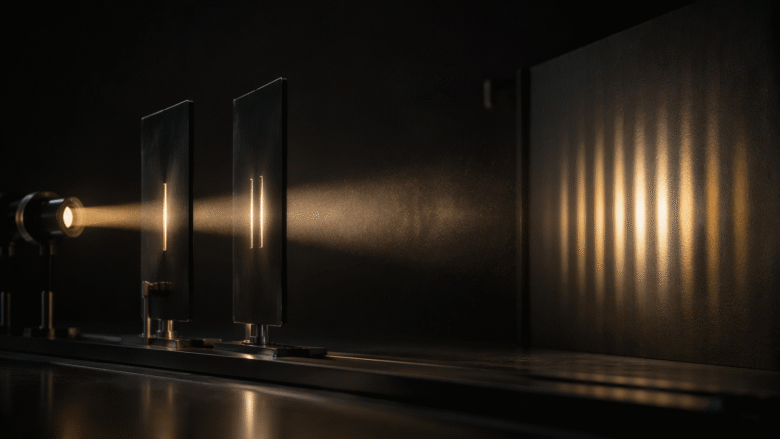
Fun fact: Light can pass through two tiny slits at once—like a wave—and still hit a screen as individual dots—like tiny bullets.
That sounds like nonsense. And yet, this is exactly what modern physics tells us. The idea that light can behave like both a particle and a wave is not just strange—it’s deeply unsettling. It breaks something inside our understanding of reality. And here’s the part that makes it even more uncomfortable: even after more than a century, nobody fully understands why.
When Light Refused to Choose a Side
For a long time, scientists argued over a simple question: what is light?
In the 17th century, Isaac Newton believed light was made of particles—tiny bits shooting through space. This idea made sense when explaining reflection and shadows.
But then came Thomas Young in the early 1800s. He performed what is now famously known as the double-slit experiment, and suddenly, light started behaving like a wave.
When light passed through two slits, it didn’t just form two bright lines. Instead, it created an interference pattern—alternating bright and dark bands—exactly what waves do when they overlap.
So, was light a wave? Physics thought it had the answer. Until it didn’t.
Then Light Started Acting Like Particles Again
Enter Albert Einstein in 1905. He studied something called the photoelectric effect—where light hits a metal surface and knocks out electrons. If light were purely a wave, increasing its brightness should increase energy. But that’s not what happened.
Instead, only light above a certain frequency worked, regardless of intensity. Einstein proposed something radical: light comes in packets of energy, called quanta—later named photons.
This meant light was behaving like a particle again.
So now physics had a problem:
Light behaves like a wave.
Light behaves like a particle.
And neither explanation alone is enough.
The Double Life of Light
This strange behaviour is called wave-particle duality. But here’s where things get even stranger.
When scientists repeat the double-slit experiment and try to observe which slit the light goes through, the interference pattern disappears. Light stops behaving like a wave and acts like a particle. It’s almost as if light “decides” how to behave based on whether we are watching it.
Let that sit for a moment. Are we influencing reality just by observing it?
This idea sits at the heart of Quantum Mechanics—a branch of physics that describes the behaviour of the very small. And unlike classical physics, it doesn’t always offer comforting answers.

So… What Is Light Really?
Here’s the honest answer: we don’t fully know.
Scientists use mathematical models to describe light’s behaviour very accurately. These models work incredibly well—they power lasers, smartphones, solar panels, and medical imaging.
But when it comes to what light actually is, the answer becomes philosophical.
Is it a wave?
Is it a particle?
Is it something else entirely, and we’re just seeing different aspects of it?
Some interpretations suggest light exists as a probability wave—a spread-out cloud of possibilities that “collapses” into a particle when measured. Others suggest multiple realities where every possibility actually happens.
None of these explanations are easy to accept. And none feel complete.
Why This Matters More Than You Think
You might wonder—why does this matter outside physics labs? Because the idea that light can behave like both a particle and a wave forces us to rethink how reality itself works.
We grow up believing the world is predictable, solid, and logical. At its deepest level, it simply isn’t. Reality is stranger than our intuition. And that has consequences.
The same principles behind wave-particle duality are used in technologies like:
- Semiconductors (used in phones and computers)
- Lasers (used in surgery and communication)
- Quantum computing (a future technology that could change everything)
So this isn’t just abstract theory. It’s quietly shaping the modern world.
The Discomfort of Not Knowing
There’s something deeply human about wanting clear answers. But quantum physics doesn’t always give them.
The fact that light can behave like both a particle and a wave—and that nobody fully understands why—reminds us of something important: knowledge has limits.
And sometimes, the deeper we go, the less certain things become. That’s not a failure of science. That is science.
Conclusion: Living With the Mystery
Light refuses to fit into a single definition. It slips between categories, challenges our assumptions, and refuses to be pinned down. And maybe that’s the point. Maybe reality isn’t meant to be simple. Maybe the universe isn’t something we fully “get”—but something we slowly learn to live with, question, and explore.
The next time you see sunlight filtering through a window or a beam cutting through dust, remember this:
You are looking at something that behaves like both a particle and a wave. And even now, we’re still trying to understand it.
Author’s Note
I’ve explained this topic in classrooms before, watched students nod, and then pause—because something about it doesn’t sit comfortably. And that pause matters. It means they felt the edge of understanding.
G.C., Ecosociosphere contributor.