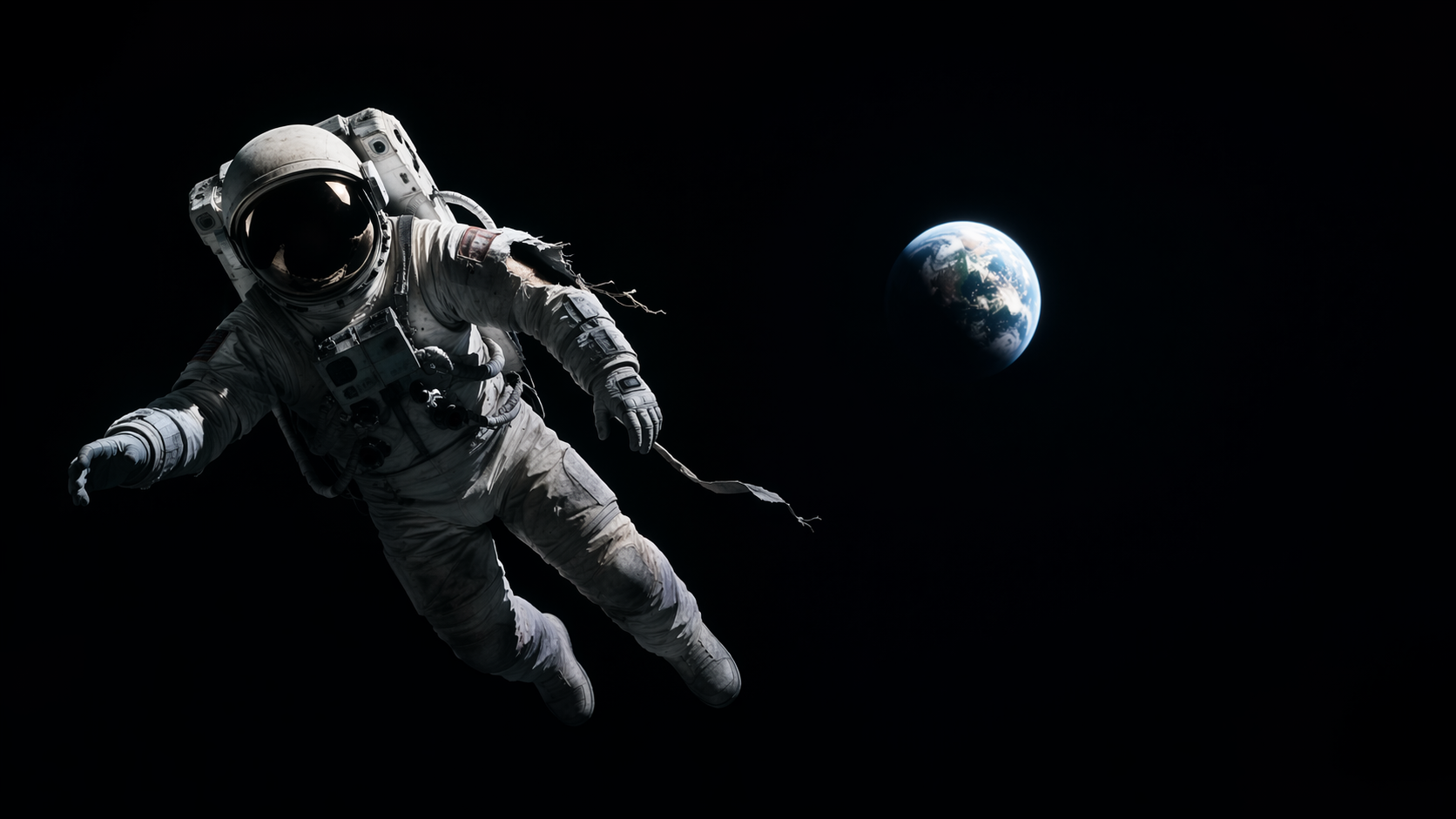
Here’s a strange fact: if you were suddenly exposed to outer space without a spacesuit, you wouldn’t explode—you’d stay conscious for about 10 to 15 seconds before everything begins to shut down.
That’s the uncomfortable truth behind the idea that you can survive in space — for about 15 seconds. Not minutes. Not even half a minute. Just enough time to realize something is very, very wrong.
We’ve grown up watching space in films where one small crack in a helmet leads to instant death or dramatic explosions. Reality, as usual, is quieter… and far more unsettling.
The First Few Seconds: Silence, Not Screaming
The moment you are exposed to space, the first thing you notice is not pain—it’s silence.
There is no air, so there is no sound. You cannot scream even if you want to. Your lungs still have air inside them, but if you try to hold your breath, it could actually damage your lungs. The correct instinct—if there is one—is to exhale immediately.
Within seconds, the oxygen in your blood starts to drop. Your brain, which is incredibly sensitive to oxygen levels, begins to struggle.
This is what gives rise to the widely cited “15-second” window. That’s roughly how long you remain conscious before hypoxia (lack of oxygen) takes over.
What Happens to the Body?
Now comes the part that sounds like science fiction, but isn’t.
Your body doesn’t explode. Your blood doesn’t boil in the way you imagine boiling water. But something equally disturbing happens.
Because space is a vacuum, the pressure outside your body drops to almost zero. This causes a phenomenon called “ebullism,” where liquids in your body begin to form vapor bubbles.
Your saliva starts to bubble. The moisture on your tongue begins to evaporate. Your skin swells slightly—not bursting, but stretching like a balloon.
At the same time, your body starts losing heat—but not instantly freezing. Space is cold, but heat loss in a vacuum happens slower than most people think. Ironically, suffocation kills you long before freezing does.
The 15-Second Window
Those 10 to 15 seconds are strange.
You’re not immediately in pain. You’re not instantly dead. You’re just… fading.
Your vision begins to narrow. Your thoughts slow down. The world dims.
There’s something deeply unsettling about that. Not because it’s violent, but because it’s quiet.
It’s not a dramatic ending. It’s a gradual disappearance.
And then you lose consciousness.
Can You Be Saved?
Here’s where it gets interesting—and slightly hopeful. There have been real incidents where humans were briefly exposed to near-vacuum conditions and survived.
In one well-documented case during a space simulation accident, a technician was exposed to a near-vacuum environment. He reported that the last thing he felt before losing consciousness was the saliva on his tongue starting to boil.
He regained consciousness after pressure was restored—alive, shaken, but not permanently damaged. This tells us something important. Fifteen seconds is not a death sentence.
It’s a deadline. If rescued within that window, survival is possible. Push beyond it, and the damage becomes irreversible.

Why Space Is So Unforgiving
Space doesn’t kill you with force. It kills you with absence.
No air.
No pressure.
No oxygen.
Everything the human body quietly depends on—without thinking—is suddenly gone. We evolved under a thick blanket of atmosphere on Earth. That invisible layer protects us from radiation, maintains pressure, and gives us air to breathe.
Remove it, and the human body is completely out of its element. This is why space exploration is not just about rockets and technology. It’s about building tiny, artificial Earths—spacesuits and spacecraft that recreate the conditions we take for granted.
The Myth vs Reality Problem
Movies have taught us the wrong fear. We imagine explosive decompression, bodies bursting, instant freezing. But the real danger is slower and more psychological.
You don’t die dramatically. You fade out. And somehow, that feels more terrifying. Because it means you are aware—at least for a few seconds—of what’s happening.
What This Says About Us
There’s something oddly humbling about this 15-second rule. It’s a stark reminder of just how delicate we really are.
We talk about colonizing Mars, building cities on the Moon, and becoming a “spacefaring species.” And yet, without a thin layer of air and pressure, we can’t survive even half a minute.
It’s a strange contradiction. We are ambitious enough to reach the stars, but dependent enough to need a fragile bubble of life around us.
Maybe that’s not a weakness. Maybe that’s a reminder.
Conclusion: A Thin Line Between Life and Void
So yes, you can survive in space—for about 15 seconds. But those seconds are not heroic. They are not cinematic. They are a quiet countdown.
A reminder that life, as we know it, exists in a very narrow set of conditions. And outside that thin boundary lies something vast, silent, and completely indifferent.
The next time you look up at the night sky, remember this: space is not trying to kill you. It just doesn’t care if you live.
Author’s Note
I think what stayed with me while writing this wasn’t the science—it was the silence. We spend so much of our lives surrounded by noise, by urgency, by constant motion. And yet, just beyond our world lies a place where none of that exists. Writing about space is never really about space. It’s about perspective. About realizing how thin the line is between “everything” and “nothing.” And maybe, just maybe, learning to value the air we breathe a little more.
G.C., Ecosociosphere contributor.