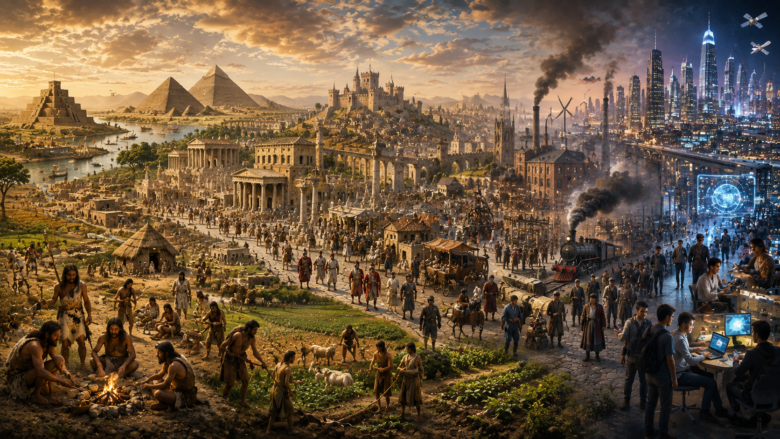
Every civilization eventually develops a story about itself. It may see itself as unusually advanced, uniquely chosen, exceptionally enlightened, or fundamentally different from the societies that came before it. Ancient empires believed their gods and institutions placed them at the centre of the world.
Later societies imagined themselves as the highest expression of reason, order, faith, liberty, or progress. Modern civilization has its own version of this confidence. We have satellites, artificial intelligence, global communication, modern medicine, and scientific knowledge on a scale no previous society possessed.
It is therefore tempting to believe that history may still contain lessons for us, but that its old patterns no longer quite apply.
The details certainly change. A Roman merchant could not have imagined an online marketplace, just as a medieval ruler could not have understood nuclear deterrence or social media. Yet beneath these technological differences, civilizations repeatedly confront remarkably familiar problems.
Wealth accumulates unevenly. Political institutions struggle to adapt to changing conditions. New technologies disrupt established ways of life. Powerful groups compete for influence. Populations migrate. Trade networks expand and sometimes fracture. Environmental pressures intensify. Generations disagree about values, and people become anxious that the social order they inherited is beginning to disappear.
What makes these repetitions difficult to recognise is that history rarely repeats itself in identical form. It changes its clothing. An ancient shortage caused by failed harvests is not the same as a modern supply-chain crisis, but both reveal how dependent societies are on systems that usually remain invisible.
Roman political propaganda was not a viral social-media campaign, yet both attempted to shape public perception and strengthen loyalty.

The mechanisms evolve while the human tendencies beneath them—fear, ambition, cooperation, rivalry, status-seeking and the desire for security—remain surprisingly persistent.
This is partly because every generation experiences its own moment from the inside. We encounter our problems as immediate realities filled with uncertainty, whereas the crises of earlier civilizations arrive as finished stories. The fall of an empire can be compressed into a few pages of a textbook, giving the impression that its decline was obvious and almost inevitable.
To the people living through it, however, events unfolded gradually. They did not wake up one morning and discover that they were living through a historical turning point. They argued about taxes, prices, borders, corruption, morality and political leadership much as people do today, rarely knowing which developments future historians would consider decisive.
Civilizations also tend to build identities around the idea that they have overcome the mistakes of the past.
Progress encourages this belief because progress is real. Modern medicine has defeated diseases that once devastated entire communities. Scientific institutions have transformed our understanding of nature. Democratic systems have expanded political participation in many parts of the world, while technologies have connected billions of people across enormous distances.
But progress in knowledge does not automatically produce progress in human judgment. A society can possess extraordinary technology while remaining vulnerable to tribalism, misinformation, inequality, political rivalry and collective overconfidence.
The belief in uniqueness becomes especially powerful during periods of success.
Prosperous civilizations often interpret their achievements as evidence that their institutions are unusually durable.
Economic growth can make structural weaknesses appear manageable. Military strength can create the impression of permanent security. Technological superiority can encourage the assumption that future problems will always have technical solutions.
Yet history repeatedly shows that successful systems can become victims of their own complexity. The larger and more interconnected a civilization becomes, the more it depends on networks of trade, administration, infrastructure, information and trust continuing to function together.
There is another recurring pattern: societies frequently imagine decline as something dramatic.
Popular images of collapsing civilizations involve invasions, burning cities and governments disappearing overnight.
Historical decline is often far less theatrical. Institutions become less effective. Public trust weakens. Infrastructure becomes harder to maintain. Economic opportunities narrow for parts of the population. Political disputes become more difficult to resolve.

None of these developments necessarily destroys a civilization, and many societies recover from severe crises. But their gradual nature makes them easy to normalize. What looks significant in retrospect may have felt like another temporary problem to the people experiencing it.
At the same time, historical patterns should not be mistaken for historical laws. Rome does not provide a script for the modern world, nor does the collapse of the Maya, the transformation of ancient Egypt, or the decline of previous imperial powers tell us exactly what will happen next. Different technologies, institutions, environments and global connections matter enormously.
History is useful not because it predicts the future with precision, but because it expands the range of possibilities we are willing to consider. It reminds us that arrangements that appear permanent often are not, and that people living inside powerful systems have repeatedly underestimated how quickly circumstances can change.
Perhaps the strongest illusion of every civilization is therefore not that it believes itself perfect, but that it believes itself exceptional enough to escape ordinary historical pressures.
Earlier societies also worried about their future. They debated whether younger generations were becoming irresponsible, whether wealth was corrupting public life, whether outsiders threatened social stability, whether new ideas were destroying traditional values, and whether political institutions could still be trusted. The answers varied enormously, but the anxieties themselves have an unmistakably familiar sound.
Our civilization really is different from those that came before it. Every civilization was. The technologies are different, the institutions are different, and the scale of human connection is unprecedented.
But uniqueness does not erase continuity. Beneath satellites, algorithms, skyscrapers and global markets are human beings carrying many of the same instincts that shaped communities thousands of years ago.
We cooperate and compete, build institutions and distrust them, accumulate power and challenge it, create systems and gradually become dependent on them.
That may be the more useful way to look at history. Not as a collection of dead civilizations whose mistakes belong safely to another age, but as an enormous record of human beings repeatedly confronting prosperity, uncertainty, ambition, change and limits.
The past cannot tell us exactly where our civilization is going. It can, however, challenge one of the oldest assumptions civilizations make about themselves: that because their world looks different, the patterns beneath it must be different too.
Author’s Note
This article grew from a contradiction I find fascinating: civilizations genuinely change, yet the people living within them repeatedly face surprisingly familiar problems. Technology, institutions, borders, and beliefs may transform beyond recognition, but many of the forces shaping societies—ambition, inequality, fear, cooperation, competition, confidence, and uncertainty—remain deeply human.
History becomes especially useful when we stop treating it as a catalogue of vanished worlds and begin seeing it as a record of how people respond to change. The purpose is not to claim that our civilization is destined to repeat the fate of another, but to ask whether believing ourselves completely different sometimes prevents us from recognising patterns worth paying attention to.
G.C., creator and writer of Ecosociosphere.