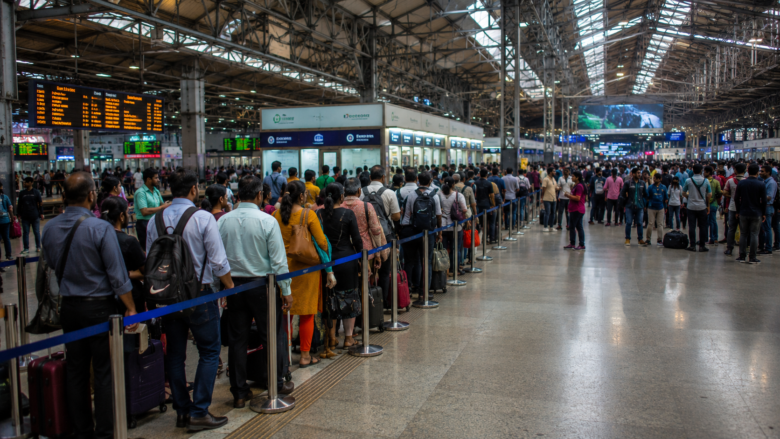
There are few things more ordinary than a line of people waiting. We form them at railway stations, airports, hospitals, supermarkets, school gates, government offices, amusement parks, and food counters.
Sometimes there is a painted barrier telling us where to stand, but often there is nothing at all. One person simply positions themselves behind another, the next person understands what is happening, and within minutes a small social system has appeared. For something that can feel irritating and inefficient, the queue is one of the quietest examples of human cooperation.
At its simplest, a queue solves a problem that appears whenever several people want access to the same limited resource. Only one passenger can speak to the ticket clerk at a time. Only one customer can reach a particular checkout first.
Without some agreed method of deciding who goes next, every such situation could become a competition involving persistence, physical position, status, aggression, or negotiation.
The queue replaces that uncertainty with a remarkably simple rule: those who arrived earlier are usually served earlier.
That rule matters because human beings are unusually sensitive to fairness. We do not merely care about receiving something; we also notice how it is distributed. Psychological research on fairness suggests that people frequently react strongly when they believe another person has gained an undeserved advantage, even when the actual loss to themselves is relatively small.
Someone cutting into a queue may delay everyone behind them by only a minute, yet the reaction can be immediate. Heads turn. Expressions change. Strangers who had previously ignored one another suddenly become united by the feeling that a rule has been violated.
What makes this particularly interesting is that the rule often does not need to be written down. Most queues operate through social norms rather than constant enforcement. Nobody hands us a contract when we enter a supermarket line explaining that we must remain behind the person who arrived before us.
We have learned the system through years of observation, correction, and participation. By adulthood, the basic logic feels so natural that violating it can seem almost morally wrong rather than merely inconvenient.
A queue therefore does more than organise bodies in space. It converts waiting into something that feels legitimate. Waiting itself is unpleasant because it temporarily removes control. We cannot make the train arrive faster or force the person at the counter to finish sooner. But knowing that our position is protected makes the uncertainty easier to tolerate.
We may dislike being tenth in line, but as long as we remain tenth and gradually become ninth, eighth, and seventh, the delay has structure.
Progress is visible, and the system appears predictable.

This also explains why some forms of waiting feel much worse than others. A long but steadily moving queue can be surprisingly tolerable, while a shorter, disorganised crowd can quickly become frustrating. In a crowd, we must constantly monitor whether someone is moving ahead of us.
We may need to defend our position, calculate who arrived first, or worry that politeness will leave us behind. The queue removes much of that mental work. Once our place is established, we can look at our phones, talk to someone, or simply wait because the social order is doing the remembering for us.
Yet queues reveal something else about fairness: people do not always agree about what fairness means. “First come, first served” seems reasonable in many situations, but not all. Hospitals prioritise patients according to medical urgency. Airports allow some passengers to board earlier. Elderly people, pregnant women, or people with disabilities may be given priority in certain settings.
A person buying one item may sometimes be waved ahead by someone with a full trolley. We accept these departures when another principle of fairness appears more important than arrival time.
Problems begin when privilege lacks an explanation that everyone recognises. A person who is visibly given priority because of an emergency may attract little resentment. Someone who simply walks to the front because they believe their time matters more can provoke anger almost instantly.
The difference is not merely the lost minutes. It is the message implied by the action: my claim is more important than yours.
In this sense, queue-jumping violates a small but powerful assumption of social equality.
Different societies have developed different ways of managing this problem. Some prefer clearly marked single-file lines, while others rely more heavily on numbered tokens, waiting rooms, informal clusters, or several parallel queues.
The precise arrangement varies with institutions, population density, local customs, and expectations about public behaviour. Yet the underlying problem remains remarkably similar everywhere: when demand exceeds immediate access, strangers need some method of deciding whose turn comes next.
Modern technology has not eliminated the queue; it has often made it invisible. We wait on customer-service calls while a recorded voice tells us our position. Websites place users in virtual waiting rooms when tickets go on sale. Food-delivery applications show orders being prepared in sequence, while hospitals and banks display electronic token numbers.
Even computer systems process information through queues. The physical line may disappear, but the psychological need remains. People want to know that they have a place and that the system has not forgotten them.
Businesses have also learned that the experience of waiting depends partly on perception. Mirrors, displays, estimated waiting times, music, menus, and visible signs of progress can make delays feel shorter because occupied time often passes more comfortably than unexplained time.
A queue that appears to move gives us reassurance, while one that stops without explanation quickly produces anxiety.

Much of the frustration associated with waiting comes not from the length of the delay alone, but from uncertainty about whether the system is functioning fairly.
Perhaps that is why a simple line of strangers deserves more attention than it usually receives. Each person could attempt to move forward. Most do not. Instead, they temporarily accept a shared rule that gives everyone a recognised place.
There may be no police officer, no written agreement, and sometimes not even a rope separating one line from another. The arrangement survives because almost everyone understands that cooperation is preferable to constant competition.
A queue is therefore a tiny model of civilization. It asks people to restrain immediate self-interest in exchange for predictable treatment from others. It works only while enough people believe that everyone else will respect the same arrangement.
And when someone casually steps in front, the irritation we feel is about more than a few extra seconds of waiting.
For a brief moment, someone has disturbed an invisible agreement that allows strangers to share space without fighting over every opportunity.
Most of the time, however, the agreement holds. People arrive, notice who is already waiting, find the end of the line, and take their place. It is such a routine gesture that we rarely think about what it represents.
Yet behind that small act lies something deeply human: the expectation that even among strangers, there should be an order to things—and that our turn will eventually come.
Author’s Note
Queues are so ordinary that we rarely think about what they represent. Yet every time strangers quietly recognise who arrived first and agree to wait their turn, they are participating in a surprisingly sophisticated form of cooperation. I wanted to explore how something as mundane as standing in line reveals our expectations about fairness, equality, trust, and the unwritten rules that make everyday social life possible.
G.C., creator and writer of Ecosociosphere.