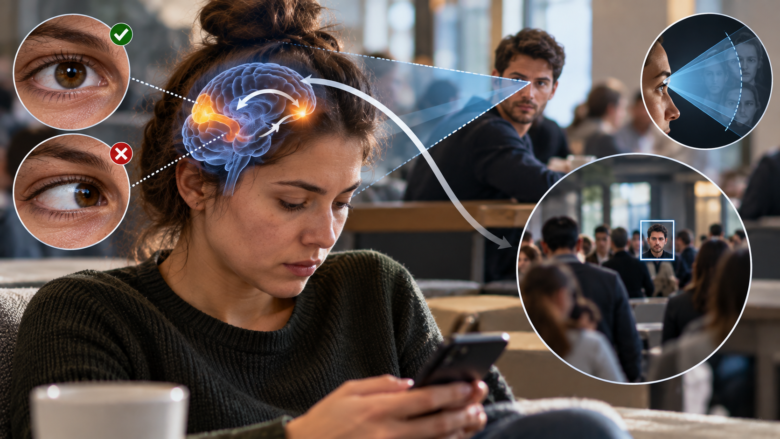
You are sitting in a café, reading something on your phone, when a small discomfort interrupts you.
Nothing has happened. Nobody has spoken. Yet you look up.
Across the room, someone is looking directly at you.
Experiences like this are unsettling partly because the order seems wrong. You did not see the person staring and then become aware of them. You became aware of them, then looked. It can feel as though some part of you detected another person’s attention before your eyes did.
The sensation is common enough to have acquired an almost supernatural reputation. People describe feeling eyes on the backs of their necks. Stories and experiments have asked whether humans possess some faint ability to detect another person’s gaze without seeing or hearing them.
But before we need anything psychic, there is a stranger possibility to consider.
You may have seen much more than you realised you saw.
Peripheral vision feels vague because it is vague. Hold your eyes on these words and try to identify an object far to one side without looking toward it. You can probably tell that something is there, perhaps whether it is moving, but details disappear quickly. Reading becomes impossible surprisingly close to the point you are staring at.
Yet peripheral vision does not need to identify everything around us to be useful. Some of the things that matter most occur outside the tiny region we are examining directly. Movement, approaching objects and changes in the environment can pull attention toward themselves before we have consciously inspected what caused the change.
Faces and eyes belong to an especially important category.
Humans are remarkably sensitive to where other people are looking. The visible contrast between the iris and the surrounding white sclera provides information about eye direction, and experiments show that altering this contrast makes gaze direction harder to judge. A glance can therefore contain information about where another person’s attention is pointed even when the face itself occupies only a small part of our visual world.
Sometimes direct gaze even seems to gain an advantage at the edges of vision. In one eye-tracking experiment, people searching among several characters responded faster to direct than averted gaze when the target appeared in the far peripheral visual field. But the researchers also found that participants were searching rather than experiencing an instantaneous visual “pop-out,” and the advantage depended on where the target appeared and on the surrounding gaze information.

So the familiar moment in the café may begin with something far less mysterious than a sixth sense: a face at the edge of vision, a head turned at a particular angle, the contrast of an eye, a movement that lasts only a fraction of a second.
You need not consciously think, someone over there is looking at me.
You only need to look up.
Sometimes awareness arrives after the information that caused it.
This creates an odd problem when we try to explain our own experience.
We are much better at remembering the moment of discovery than reconstructing the sensory events immediately before it. Once you turn and find someone staring, the sequence feels astonishingly clean: I felt watched. I looked. Someone was watching me.
The tiny clues that may have triggered the turn are harder to recover.
Perhaps there was movement in the periphery. Perhaps the person shifted in their chair. Perhaps you briefly registered the orientation of a face without consciously identifying it. Perhaps someone else nearby glanced toward the same person. Sound, reflections and shadows can also provide information that never becomes the centre of attention.
And sometimes, of course, you turn around and nobody is looking.
Those moments matter because they reveal a second part of the phenomenon. Detecting a possible observer is not the same problem as proving that an observer exists.
In uncertain situations, a perceptual system must tolerate mistakes.
Imagine two errors: occasionally suspecting that someone is watching when nobody is, or repeatedly failing to notice when another person really has directed their attention toward you. Socially, the second error can matter more. A gaze may signal interest, affection, hostility, curiosity, evaluation or simply the beginning of an interaction.
Research on eye contact helps explain why it is so difficult to treat another person’s gaze as ordinary visual information. Direct gaze affects attention and arousal, and physiological studies have found stronger autonomic responses to direct than averted gaze under some conditions. Particularly revealing is what happens when researchers change not the eyes themselves, but whether participants believe the other person can actually see them.
In experiments using live interaction, video calls and prerecorded video, direct gaze increased autonomic arousal when participants experienced genuine reciprocal seeing, including over a live video connection. The same effect was absent when they merely watched a prerecorded person. Other experiments have similarly found that responses to direct gaze depend partly on the experience of being watched, not simply on the geometry of a pair of eyes pointed toward the viewer.
That distinction is easy to overlook.
A portrait can face you. A mannequin can face you. Two dark circles on a piece of paper can resemble eyes. But another person looking at you introduces something else: their attention now contains you.
A gaze is unusual because it is information about someone else’s attention becoming information about yourself.
This may help explain why the sensation carries such immediacy. We do not experience another person’s stare in the same way that we experience a red chair or a passing car. Once we realise that someone is looking at us, we become part of the event.
There is even some uncertainty in exactly how broadly we judge gaze as being directed toward us. Researchers describe a cone of direct gaze: a range of slightly different eye directions that people may still interpret as looking at them rather than somewhere beside them. Earlier studies suggested that this range might be wider in some people with greater social anxiety, although a large 2026 investigation found the existing literature heterogeneous and failed to reproduce that association in its own experiments. Even something as apparently simple as deciding whether another person is looking at you is therefore not a perfectly objective reading of eye position.
But all of this still leaves the most interesting version of the question.
What if you genuinely cannot see the person?

Researchers have tried to test whether people can detect an unseen stare under controlled conditions, including experiments in which an observer watches someone remotely while physiological activity is recorded. A 2004 meta-analysis of 15 remote-staring studies reported a small statistical effect, but the authors also noted a shortage of independent replications and a lack of a convincing theoretical explanation. Later collaboration between researchers who had previously obtained conflicting results failed to reproduce an earlier effect.
That history makes a simple declaration in either direction less interesting than the evidence itself. There have been results that advocates of remote staring consider suggestive. There have also been replication problems, small effects and methodological disagreements. Nothing in this literature establishes a reliable human ability to sense an unseen person’s gaze through some unknown channel.
And we already possess an extraordinarily sensitive known channel.
Vision does not wait patiently for us to look directly at everything before beginning to interpret the world. Attention can be redirected by information we have not consciously examined. Our visual system extracts gaze direction from surprisingly small cues. Direct gaze can alter arousal. Context changes whether ambiguous eyes seem directed toward us. And once we believe another mind has selected us as the object of its attention, the experience acquires a significance that an ordinary visual stimulus does not have.
None of this means that every eerie moment can be reconstructed afterward. Sometimes you will never know what made you turn around.
Perhaps that uncertainty is why the experience remains so convincing.
Tomorrow you may be sitting on a train, standing in a queue or walking through a crowded room when the sensation returns. Something will make you turn your head.
And occasionally, at exactly the place your eyes land, another pair of eyes will already be waiting.
It will feel as though you sensed the stare before you saw it.
You may simply have seen it before you knew you had.
Author’s Note
The interesting part of this question, for me, is that explaining away a psychic sense does not make the ordinary explanation duller. It does the opposite. We tend to imagine perception as something conscious: first we see, then we know. The research on gaze makes that sequence much less tidy. The moment when you consciously discover someone looking at you may be the end of a perceptual process rather than its beginning.
G.C., creator and writer of Ecosociosphere.
References
- Palanica, A., & Itier, R. J. (2011). Searching for a perceived gaze direction using eye tracking. Journal of Vision, 11(2), 19.
University of Waterloo paper page - Palanica, A., & Itier, R. J. (2014). Effects of peripheral eccentricity and head orientation on gaze discrimination.
PubMed record - Palanica, A., & Itier, R. J. (2012). Attention capture by direct gaze is robust to context and task demands.
PubMed record - Hietanen, J. K. (2018). Affective eye contact: An integrative review. Frontiers in Psychology, 9, 1587.
PubMed record - Jun, Y. Y., Mareschal, I., Clifford, C. W. G., & Dadds, M. R. (2013). Cone of direct gaze as a marker of social anxiety in males.
PubMed record - Schmidt, S., Schneider, R., Utts, J., & Walach, H. (2004). Distant intentionality and the feeling of being stared at: Two meta-analyses.
PubMed record