Somewhere in the future, there may be a person who is the last human being on Earth to remember you.
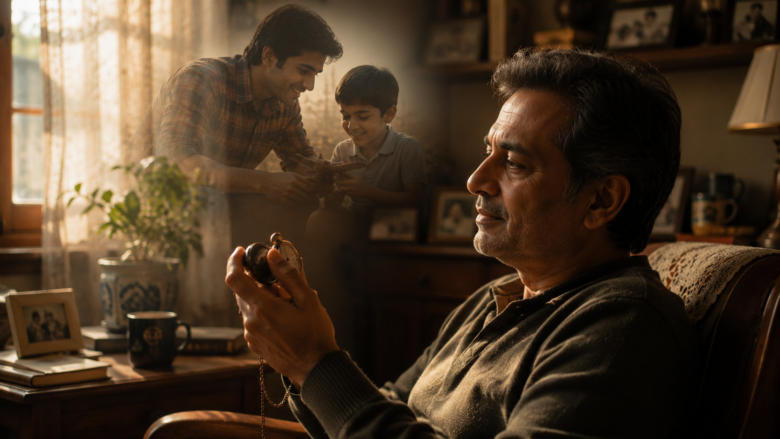
They may be very old by then. Perhaps they will remember the sound of your voice, the way you laughed, or something insignificant you used to do without realizing anyone noticed. They might remember sitting beside you at a table, travelling somewhere with you, or hearing you tell the same story for the tenth time. To everyone else, you may already have become a photograph, a name in an old document, or a person mentioned occasionally in a family story. But inside that one person’s mind, you will still be surprisingly alive.
And then, eventually, that person will be gone too.
We usually think of death as the moment a human life ends, but socially, our existence has a much longer and stranger afterlife. For years after someone dies, they continue occupying the minds of other people. Their jokes are repeated. Their advice appears unexpectedly in conversations. Families continue cooking food the way they taught them. Someone hears a song and suddenly remembers a car journey from thirty years earlier.
A person can disappear physically while remaining remarkably present in the lives of those who knew them.
Memory gives human beings a peculiar kind of second existence. Someone who died decades ago can suddenly return because a particular smell, photograph, street or sentence unlocks a memory that has been sitting quietly inside another person’s brain. For a few moments, details that seemed lost become vivid again—the expression on a face, the rhythm of a voice, perhaps even the feeling of being near that person. But unlike stone monuments or digital records, human memory is carried by living biological minds, and those minds have their own limits.
That means every personal memory has an expiration date.
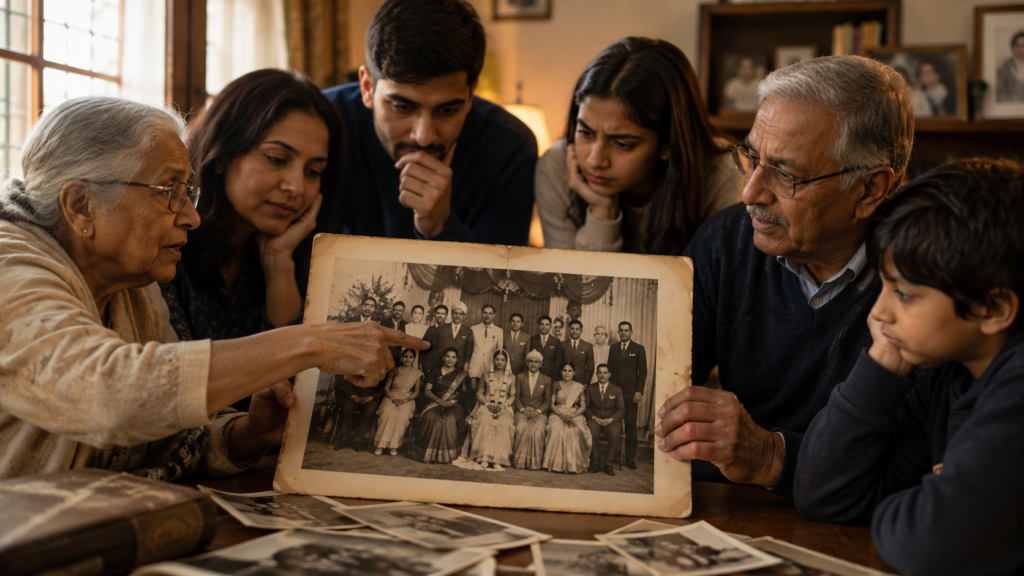
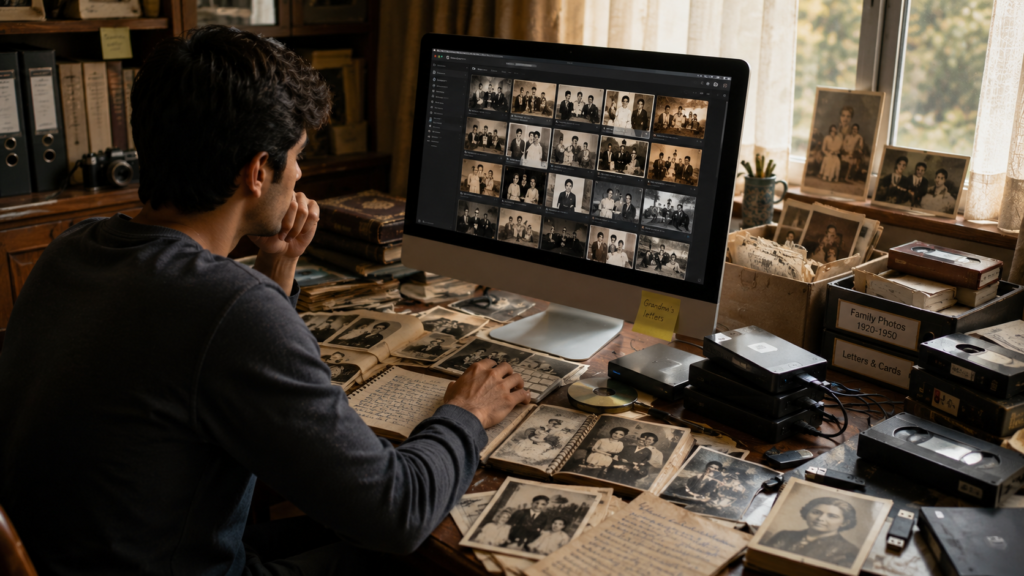
Consider an old family photograph. Perhaps twenty people are standing together at a wedding sometime in the 1940s. A grandparent may still be able to identify nearly everyone: the difficult uncle, the funny neighbour, the cousin who travelled hundreds of kilometres to attend.
A generation later, perhaps only six names remain. Another generation passes and someone points toward a face near the edge of the photograph and asks, “Who is that?” Nobody knows. The person has crossed an invisible boundary between being remembered and merely having existed.
This happens constantly, and it has happened to almost every human being who ever lived. Billions of people loved, argued, worried, celebrated birthdays, raised children, made mistakes and watched sunsets without leaving behind anything that allows us to know them personally.
History preserves a tiny fraction of humanity. Even when it preserves someone’s name, that is not the same as remembering them. We know about people who lived centuries ago, but nobody alive remembers what it felt like when they entered a room.
There is a profound difference between being recorded and being remembered.
Modern technology can make that distinction difficult to notice. Previous generations left photographs, letters and perhaps a few official documents. We leave thousands of photographs, messages, emails, videos, voice recordings and social-media posts.
Future descendants might be able to see our faces and hear our voices with a clarity that previous generations could scarcely imagine. Artificial intelligence may eventually make those archives even easier to explore. Yet an enormous digital record still cannot reproduce the experience of actually knowing someone.
A video may preserve your laugh, but it cannot preserve what hearing that laugh meant to your closest friend.
Perhaps this is partly why the idea of being forgotten makes us uncomfortable. Humans are unusual creatures because we can imagine a world continuing after our own disappearance. We know that streets will remain busy, children will be born, governments will change, technologies will appear and ordinary Tuesday mornings will continue without us.
Faced with that knowledge, we naturally search for ways to extend ourselves into the future. We build things, raise families, write books, create businesses, plant trees and place our names on objects. Legacy becomes a quiet negotiation with mortality.
But there may be something misleading about the way we usually imagine legacy. We tend to measure it through recognition. We imagine that leaving a mark means future people must somehow know who made it.
History encourages this because it celebrates names attached to discoveries, buildings, movements and works of art. Yet most of the things shaping our lives were created, preserved or passed forward by people whose names we will never know.
Think about language. Every ordinary sentence contains words shaped across generations by countless forgotten speakers. Think about recipes passed through families, farming techniques refined over centuries, lullabies altered by parents, neighbourhood customs, gestures of politeness or simple pieces of practical wisdom. Civilization is full of inherited behaviour whose original authors have completely disappeared.
Much of the human world was built by people whom the human world has forgotten.
The same may be true on a much smaller scale within individual lives. A teacher says something encouraging to a nervous student and forgets the conversation entirely. Years later, that student becomes a teacher and offers similar encouragement to someone else. A parent demonstrates patience during a difficult moment, and decades later their child unconsciously behaves the same way toward another person. Someone helps a stranger during an awful day, changing the mood with which that stranger returns home to their family.
None of these moments needs to carry the name of the person who started them.
Influence can travel without identification.
That possibility changes the meaning of being forgotten. If we believe that a life matters only while someone remembers the person who lived it, then almost every human life eventually ends in complete disappearance. But human beings constantly alter one another in ways too subtle to document.
Every relationship leaves small adjustments behind—habits learned, assumptions challenged, confidence given, fears created, kindness copied, stories repeated. Those changes enter other relationships and sometimes continue travelling long after their origin has been forgotten.
Someday, someone may indeed become the last person who remembers you personally. Perhaps they will look at an old photograph and recognize your face while everyone around them sees only another stranger from another time. Eventually, even that final living memory will disappear.
Your name may fade. Your photographs may lose their context. Your voice recordings may sit unheard on some forgotten device or server.
But somewhere in the world that continues without you, there may still be consequences of the fact that you were here.
A habit you taught. A person you encouraged. A decision you influenced. A kindness someone learned from watching you and later passed to somebody you never met.
We spend a great deal of life wondering how we will be remembered. Perhaps there is a quieter question worth asking instead: what will continue because we were here?
Because being forgotten and having never mattered are two very different things.
Author’s Note
The thought behind this article began with something strangely simple: every person we remember was once part of someone’s ordinary everyday life. Eventually, however, even those memories disappear. That may sound unsettling, but I find something unexpectedly hopeful in it. Perhaps the value of a life is not measured by how long a name survives, but by the countless small ways one person changes another.
G.C., creator and writer of Ecosociosphere.