
Look around the room for a moment. You can see the walls, the furniture, perhaps a window and whatever lies beyond it. Everything appears to occupy its proper place, with no obvious gaps in the scene. Even when you close one eye, the world still seems reasonably complete. Yet each eye has a small region in its field of vision where it cannot detect anything, even though we never normally notice it. It has been there throughout your life, following your gaze wherever you look, and you have probably never noticed it.
Your vision contains a permanent patch of missing information, but your experience of the world rarely gives you any reason to suspect it.
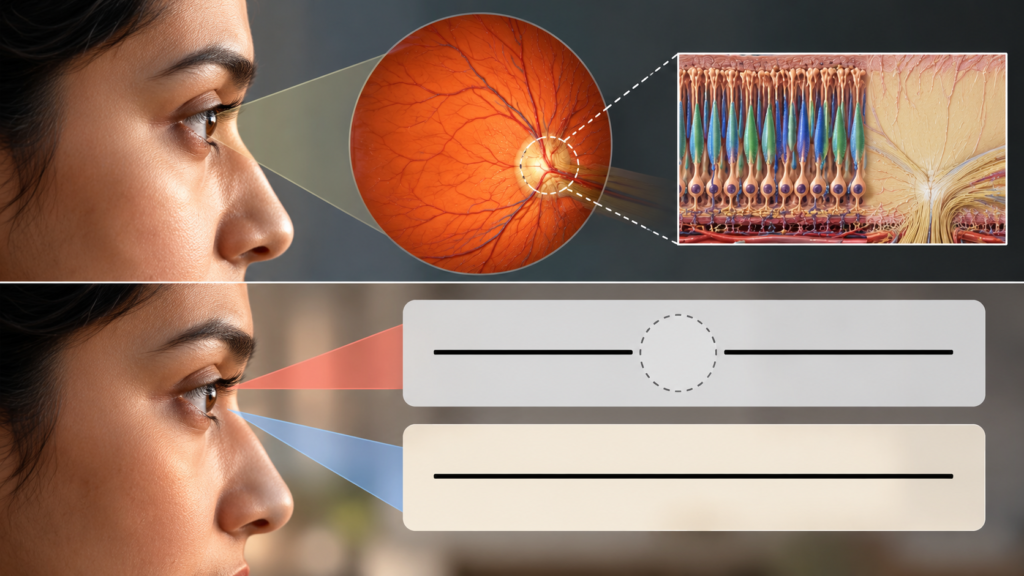
You can actually make this missing patch reveal itself with a small experiment. Draw a cross and a dot on a sheet of paper, with several centimetres between them. Close your left eye, look steadily at the cross with your right eye, and slowly move the paper closer or farther away. At a certain distance, the dot should disappear, even though you know it is still there. Move the paper again and it reappears. If the effect does not work immediately, try changing the distance between the marks or the paper’s position. The dot has not moved, and your eye has not stopped working. Its image has simply reached a part of the retina that cannot detect light.
That part is called the optic disc. At the back of each eye, millions of nerve fibres gather together to form the optic nerve, which carries visual information towards the brain. Where these fibres leave the eye, the retina has no photoreceptors, the specialised cells that normally respond to light. Consequently, anything whose image falls entirely on that region goes undetected by that eye. The corresponding area in our visual field is known as the physiological blind spot. It lies away from the centre of vision, roughly towards the outer side of what each eye sees.
Normally, having two eyes makes the problem less noticeable. Their visual fields overlap, and an area missed by one eye can often be seen by the other. This sounds like a sufficient explanation until we remember the experiment: even with one eye closed, we do not ordinarily see a dark patch where the missing information should be. We still perceive a continuous sheet of paper, an uninterrupted wall or a complete stretch of sky.
The visual system does something with the absence of information instead of presenting that absence as an obvious hole.
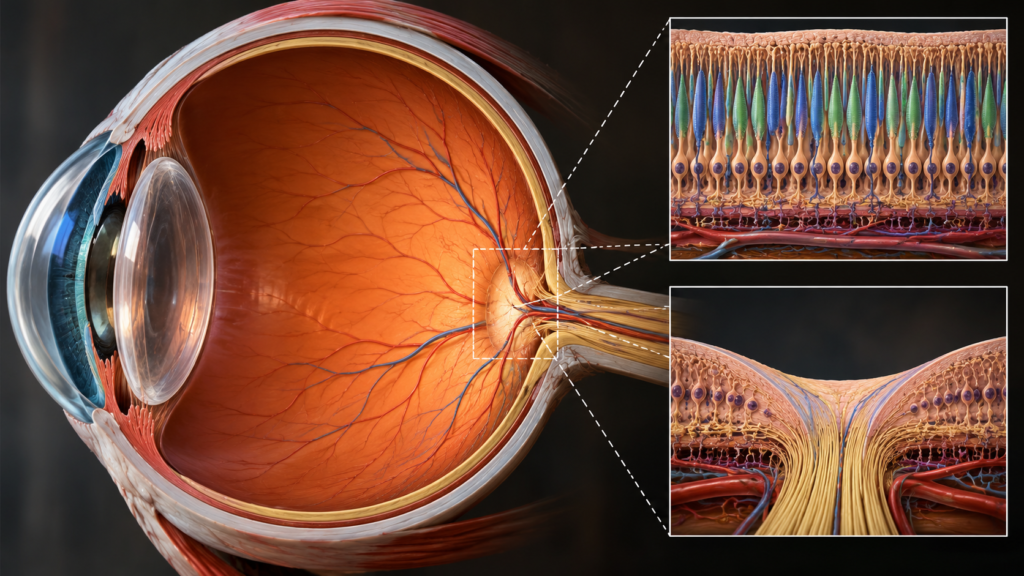
Researchers call this phenomenon perceptual filling-in. When the blind spot falls within a uniformly coloured wall, the missing region generally appears to have the same colour as its surroundings. When a line crosses the blind spot, the line may seem to continue through it. Some patterns, textures and even moving features can also appear perceptually continuous across the missing area. This is not information detected by photoreceptors inside the blind spot, because there are none. The apparent continuity arises through visual processing that uses information available around the region.
That brings up an interesting question. Does the brain actually construct a detailed picture of what is missing, or does it simply treat the absence as unimportant? Researchers have debated different versions of this problem for decades. Some experiments support neural processes that represent features across an unstimulated region, while others suggest that certain effects can be explained through the way our visual system organises surfaces and objects. There probably isn’t one simple operation responsible for every kind of perceptual completion.
Seeing a continuous surface does not necessarily mean the brain has reconstructed everything that would have been visible there.
Consider a plain white wall. If the blind spot covers a small region of it, extending the surrounding whiteness is fairly straightforward. Now imagine a tiny insect resting on the wall, exactly in the area your blind spot prevents you from seeing. With only that eye open, you might not see the insect at all. The brain cannot reliably recreate the insect from information that never reached the retina. It can maintain the appearance of the wall while failing to reveal an object occupying part of it. The result feels complete, even though an important detail could be missing.
This distinction becomes clearer when we think about familiar objects partially hidden from view. A parked car behind a tree does not usually appear to us as two unrelated pieces of metal on either side of the trunk. We understand that the car continues behind the obstruction, even though we cannot see the concealed section. Visual scientists describe related processes using terms such as perceptual completion. The blind spot is a special case because there is no visible object covering the missing region. Yet in both situations, our visual experience depends partly on organising incomplete information into coherent objects and surfaces.
The process is useful because the visual world contains more information than we can inspect in detail at any given moment. Our eyes move constantly, different objects obstruct one another, and much of what falls outside the centre of our gaze is registered with relatively poor detail. The brain must combine these changing signals into an experience stable enough for us to recognise objects and move around confidently. A visual system that made every limitation conspicuous would provide a rather distracting view of ordinary life. The blind spot illustrates how successfully perception can preserve continuity despite incomplete input.
Still, we should be careful about the popular claim that the brain simply invents reality. The optic disc is a specific anatomical region where visual information is genuinely absent, and experiments demonstrate that the surrounding scene influences what we perceive there. But the exact mechanisms involved are complicated, and filling-in does not always work equally well with every pattern. The visual system often relies on the evidence available to it, rather than producing an elaborate imaginary replacement.
What feels like complete vision may sometimes be a convincing interpretation of incomplete evidence.
There is also an important difference between this normal blind spot and vision loss caused by eye disease. Conditions affecting the retina or optic nerve can produce additional areas of missing or distorted vision, which may not be experienced in the same way. Some develop gradually and can escape notice, particularly when the other eye compensates. New blind areas, flashes, a sudden shadow or other unexplained visual changes deserve prompt medical assessment. The ordinary blind spot is a normal feature of eye anatomy, not a sign that something has gone wrong.
What I find most peculiar is how effortlessly we trust the picture in front of us. We look at a wall and assume we are seeing the whole wall, even though a small portion of the scene falls on a region that cannot detect it. In everyday life, however, we can usually see and navigate our surroundings without noticing this missing information. Our two eyes provide overlapping information, our gaze continually shifts, and visual processing makes the resulting experience appear stable. We rarely have any reason to question what is missing.
Try the paper experiment once more, and watch the dot disappear. You may notice that the background does not turn black or reveal a little empty circle. It simply continues as though nothing unusual has happened. A moment earlier, that seemed like an ordinary sheet of paper. Now it is also evidence of how much work goes into the apparently effortless act of seeing. The dot is still there, the light is still reaching your eye, and the missing patch has not changed. You have merely found one place where the world you see is more complete than the information your eye actually received.
Author’s Note
I have always liked visual experiments that require almost nothing beyond a sheet of paper and a little patience. The blind-spot experiment is especially interesting because you can watch an object disappear without anything physically blocking it. What surprised me during the research was that the explanation is more complicated than the familiar claim that the brain simply paints over a hole. There is a difference between perceiving something as continuous and knowing everything that occupies it.
G.C., creator and writer of Ecosociosphere.
References
- Purves, D., et al. (2001). Central Projections of Retinal Ganglion Cells. Neuroscience, 2nd edition.
- Komatsu, H. (2006). The Neural Mechanisms of Perceptual Filling-in. Nature Reviews Neuroscience. Reviews visual filling-in and possible neural mechanisms.
- Durgin, F. H., Tripathy, S. P., & Levi, D. M. (1995). On the Filling in of the Visual Blind Spot: Some Rules of Thumb.
- Asymmetrical Color Filling-in from the Nasal to the Temporal Side of the Blind Spot (2014).
- Stronger Perceptual Filling-in of Spatiotemporal Information in the Blind Spot Compared with Artificial Gaps (2020).
- Blind Spot — Science Snack. Exploratorium. Instructions for the simple disappearing-dot experiment.