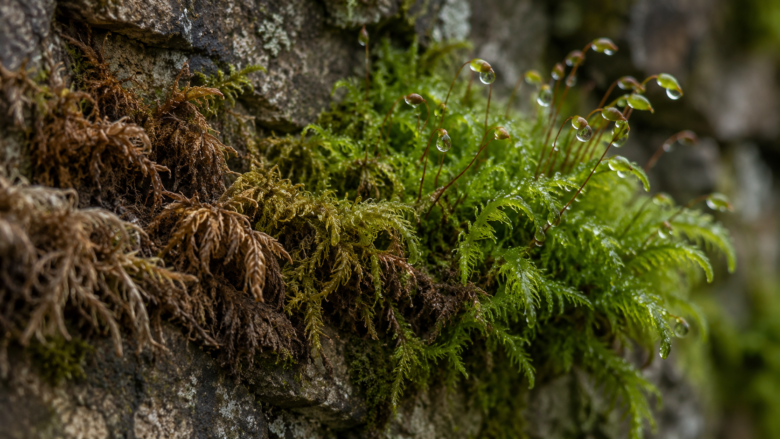
A patch of moss growing on an old wall can look completely lifeless after several weeks without rain. Its green colour fades, its delicate structures shrink, and what was once soft becomes dry and brittle. You might assume that the moss has died, especially if the wall has been exposed to a particularly harsh summer. Yet after a good rainfall, some drought-tolerant mosses can regain their green appearance and resume growing. The change seems almost too dramatic for something so ordinary.
An organism that appeared to have stopped living has somehow found a way to continue where it left off.
We normally associate life with activity. Plants grow, animals move, cells consume energy, and even organisms too small to see are constantly carrying out chemical reactions. These processes collectively form metabolism, the ongoing activity that allows living things to maintain themselves. When metabolism permanently stops, the organism eventually loses the ability to sustain life. But certain organisms have evolved a peculiar alternative when their surroundings become intolerable. Rather than continuing to function under increasingly difficult conditions, they can suppress their metabolic activity to an almost undetectable level and remain that way until conditions improve.
Scientists call this extraordinary survival state cryptobiosis. The term describes a reversible condition in which the normal signs of metabolic activity become extremely difficult, sometimes impossible, to measure. It has been observed in certain microscopic animals, including tardigrades, rotifers and nematodes, as well as in other forms across the living world. Cryptobiosis is different from ordinary sleep or hibernation, during which an animal continues using energy, maintaining body temperature or carrying out other essential functions at reduced rates. In a cryptobiotic organism, metabolic activity can approach a standstill so closely that conventional measurements may detect virtually nothing.
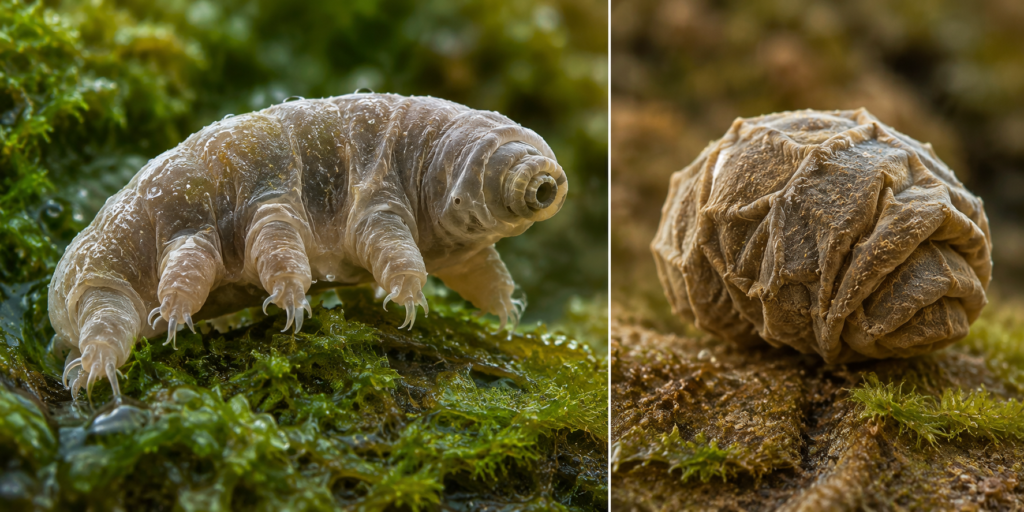
One of the best-known examples is the tardigrade, a microscopic eight-legged animal sometimes called a water bear. Tardigrades inhabit environments ranging from damp moss to freshwater sediments, and many species depend on thin films of water to remain active. When their surroundings begin to dry out, some can withdraw their legs, contract their bodies and enter a compact condition known as the tun state. They lose much of their body water and become small, wrinkled structures that show almost none of their usual activity. Under suitable conditions, adding water can allow them to rehydrate, extend their bodies and begin moving again.
The animal survives by becoming almost entirely inactive at the very moment its environment becomes dangerous.
But losing water creates a problem that would be disastrous for most animals. Water is essential to the structure and chemistry of living cells. Remove too much of it, and proteins may lose their normal shapes, membranes can become unstable, and the delicate internal arrangements that keep cells functioning may collapse. Simply drying out is not enough to survive. An organism must also protect the machinery it will need when water returns.
Researchers have discovered several protective mechanisms, although they differ between species. Some organisms accumulate a sugar called trehalose, which helps stabilise cellular components during dehydration. Certain tardigrades also produce unusual proteins that remain flexible rather than folding into fixed shapes. During drying, some of these proteins can form protective, glass-like arrangements that help preserve cellular structures. Experiments have shown that such proteins contribute substantially to desiccation survival in particular tardigrade species.
The apparent stillness is possible because the organism has prepared its cells to withstand conditions in which ordinary biological activity would fail.
The achievement becomes even stranger when we consider how long some organisms can remain suspended. In 2021, researchers reported recovering a microscopic animal called a bdelloid rotifer from Siberian permafrost dated to approximately 24,000 years ago. The organism was revived under laboratory conditions and subsequently reproduced. Two years later, another research team described a nematode, Panagrolaimus kolymaensis, recovered from permafrost whose age was estimated at roughly 46,000 years. These animals belonged to populations that had remained preserved since a period when woolly mammoths still inhabited parts of the northern world.
The dates are difficult to absorb because they measure something quite different from an ordinary lifespan. A tiny worm might normally live for a relatively short period while actively feeding, moving and reproducing. Yet under exceptional circumstances, its existence can stretch across thousands of years without following the usual pace of biological activity. The radiocarbon evidence concerns the ancient material from which these organisms were recovered, and the findings do not mean that every individual of their species could survive for equally long periods. Even so, the possibility of an animal resuming activity after such an interval forces us to reconsider what we mean by being alive.
There is an important distinction between stopping biological activity and stopping time. The frozen ground continues ageing, chemical reactions in the surrounding environment continue, and the organism remains exposed to physical processes that can eventually damage it. Cryptobiosis does not make an animal indestructible. Even tardigrades, often described as nearly immortal, have limits to their resistance. Survival depends on the species, the conditions under which dormancy begins, the duration of exposure and the stresses encountered along the way.
An organism may dramatically slow its biological processes without escaping the physical passage of time.
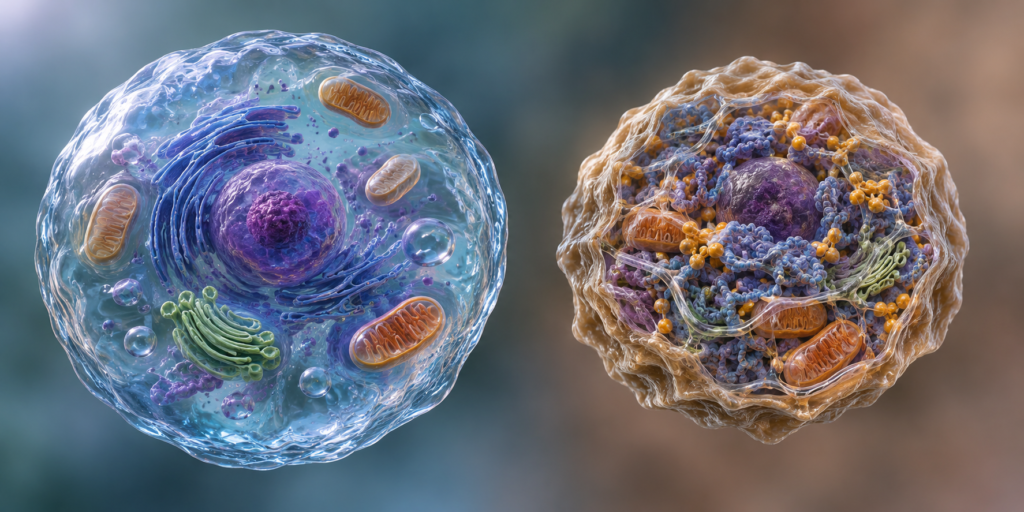
This also complicates the idea of a biological clock. We often use that expression to describe ageing, but ageing is not a single mechanism that can simply be switched off. It involves accumulated damage, changes in cellular maintenance and many interconnected processes. When metabolism becomes extremely low, some processes associated with ordinary ageing may slow substantially. Whether time spent in cryptobiosis effectively pauses biological ageing depends on the organism and the conditions involved. Researchers are still investigating how much deterioration can occur during prolonged dormancy and what must be repaired when activity resumes.
What interests me most is the problem of distinguishing such an organism from something dead. A completely dried tardigrade may show no movement, no feeding and no measurable metabolic activity. Yet its cells can retain enough organised structure to support life when favourable conditions return. A dead organism has lost that capacity irreversibly. The difference is therefore not always visible in what the organism is doing at a particular moment, but in what it remains capable of doing.
Life can sometimes persist as the carefully preserved possibility of becoming active again.
That possibility has attracted attention beyond the study of unusual animals. Understanding how biological material survives dehydration could eventually improve methods for preserving certain medicines, proteins and cells. Researchers are interested in how protective sugars and specialised proteins stabilise vulnerable structures without requiring continuous energy expenditure. But transferring these abilities to more complicated systems is extremely difficult. Human organs, for instance, cannot simply be dried into a dormant state and safely revived by adding water. The microscopic survivors reveal useful biological principles rather than offering an immediate route to human suspended animation.
There is something unsettling about the fact that an organism can remain alive while showing almost none of the activity we normally consider essential to life. We measure our own existence through continuous experience, changing bodies and the succession of days. For a microscopic animal preserved in ice, thousands of those days may pass without the familiar processes of active living. Its surroundings change, generations of other organisms come and go, and eventually the conditions that kept it suspended disappear.
Return to that dried patch of moss on the wall. Most of us would walk past it without giving the matter another thought, perhaps noticing only that it needs rain. Yet among organisms capable of surviving desiccation, what appears to be an ending can sometimes be an extended interruption. The first drops of water do not reverse time or restore a life that has already ended. They allow a living system, whose activity had almost vanished, to begin functioning again.
And what looked like a small, lifeless remnant becomes a reminder that being alive does not always mean being visibly busy with life.
Author’s Note
What first drew me to this subject was the difficulty of imagining an organism remaining alive while doing almost nothing that we normally associate with living. The reports of microscopic animals recovered from ancient permafrost made the question even more intriguing. I find the distinction between inactivity and death especially interesting. We usually recognise life through what an organism does, yet some organisms seem to preserve it by temporarily doing almost nothing at all.
G.C., creator and writer of Ecosociosphere.
References & Further Reading
- Møbjerg, N., & Neves, R. C. (2021). New Insights into Survival Strategies of Tardigrades
- Boothby, T. C., et al. (2017). Tardigrades Use Intrinsically Disordered Proteins to Survive Desiccation
- Shmakova, L., et al. (2021). A Living Bdelloid Rotifer from 24,000-Year-Old Arctic Permafrost
- Shatilovich, A., et al. (2023). A Novel Nematode Species from the Siberian Permafrost Shares Adaptive Mechanisms for Cryptobiotic Survival with C. elegans Dauer Larva
- Hibshman, J. D., et al. (2020). Examples of Extreme Survival: Tardigrade Genomics and Molecular Anhydrobiology
- Jönsson, K. I., & Bertolani, R. (2001). Facts and Fiction About Long-Term Survival in Tardigrades