You are cooking when your fingers accidentally brush against the hot edge of a pan. Your hand jerks away almost immediately, and a sharp sensation follows. Then comes a peculiar little movement. You bring your hand closer to your face, turn it slightly, and stare at the fingers that just touched the pan. Sometimes you examine the exact spot, even when there is nothing unusual to see. The source of the pain is perfectly obvious, and looking at your hand cannot undo what happened.
Yet we often inspect the hand, as though it might provide an explanation.
The movement is so familiar that it hardly seems like something worth investigating. We do something similar after accidentally striking a finger against furniture, stepping on a sharp object, or catching our skin in a closing drawer. The immediate reaction is to move away from whatever caused the pain, but our attention often returns to the affected body part. We look, sometimes touch the surrounding skin, and try to establish what has happened. The sequence feels almost automatic, although its different stages involve rather different processes.
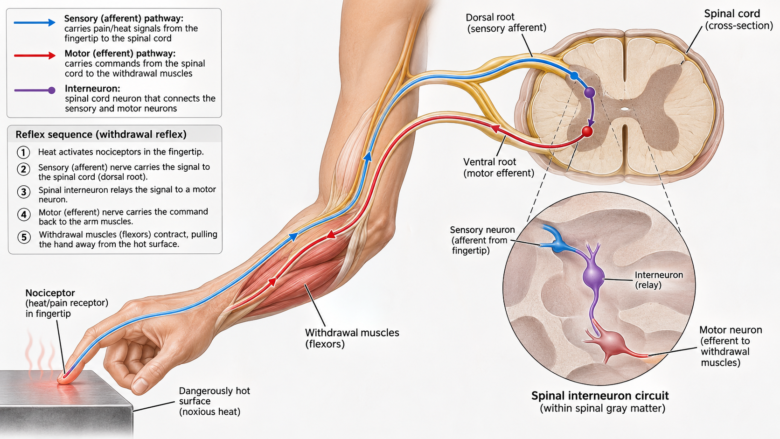
The first stage is relatively straightforward. Our skin contains specialised sensory nerve endings that respond to potentially damaging conditions, including extreme heat. These are known as nociceptors, and when they detect a sufficiently harmful stimulus, signals travel through sensory nerves towards the spinal cord. Some of those signals can activate a rapid protective movement through a spinal pathway known as the withdrawal reflex. This allows the muscles to pull the hand away without waiting for a deliberate decision from the brain.
Your hand can begin escaping the danger before you have fully processed what happened.
But the withdrawal reflex only solves the immediate problem of contact. Once your fingers are safely away from the pan, the nervous system still has to make sense of the signals arriving from the skin. The experience of pain involves more than detecting potentially harmful stimulation. It also depends on how the brain interprets information about the body, the situation and the possible consequences. Pain tells us that something needs attention, but it does not always provide a complete account of what has happened to the tissue.

That may help explain the second movement, when we lift the hand towards our eyes. The sensation tells us where to look, and vision offers another source of information. Is there redness? Has the skin changed colour? Is there a blister, a mark, or nothing visible at all? The answers can help us judge what to do next, even if the appearance of the skin cannot reliably reveal the full extent of an injury.
The pain alerts us to a possible problem, while looking gives us a chance to investigate it.
This combination of information from different senses is something the brain uses constantly. We recognise an object partly through what it looks like and partly through how it feels when we touch it. We also maintain a working understanding of where our hands and feet are, even when we are not looking directly at them. Researchers call this broader process multisensory integration. In the case of a hot pan, the sudden painful sensation draws attention to a particular finger, and visual information can help us understand its present condition.
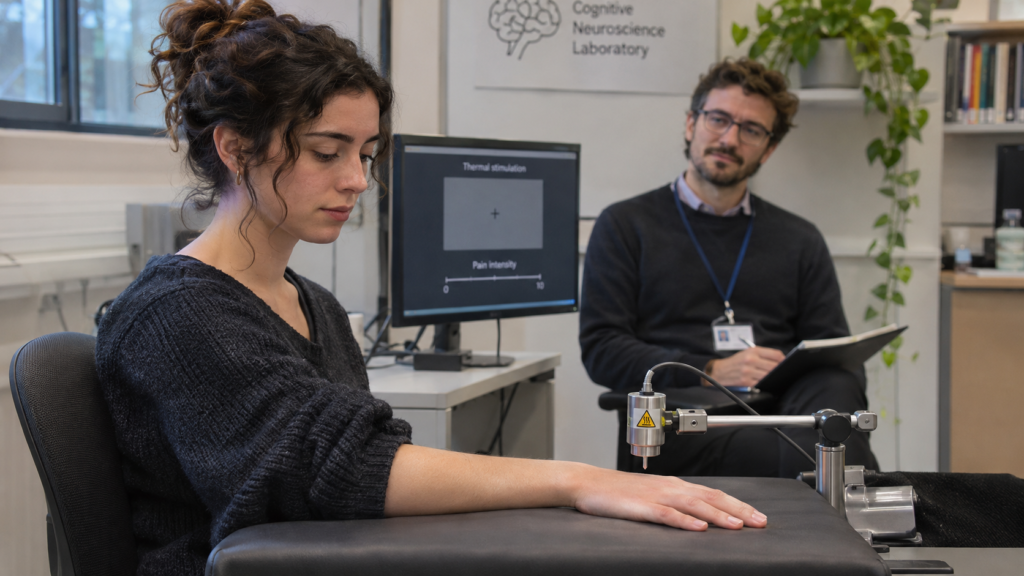
There is an interesting complication, however. Looking at a painful body part may do more than provide information. In a series of experiments, researchers found that seeing one’s own hand could sometimes reduce the intensity of experimentally induced pain. In one study, participants received controlled laser stimulation while looking either at their hand or at another object. Pain ratings were lower when they viewed their own hand. Later work also found changes in brain activity associated with this effect. The phenomenon has been called visually induced analgesia.
It would be tempting to conclude that people inspect their hands because looking automatically makes injuries hurt less. The evidence does not justify that explanation. These experiments involved carefully controlled conditions, and the researchers were not studying the everyday habit of examining a hand after an accidental burn. Other studies have found that visual information can influence pain differently depending on what the person sees and expects. Seeing an apparently unharmed hand may have a different effect from watching something visibly dangerous happen to it.
The relationship between looking and feeling pain depends partly on what the visual information seems to mean.
Consider the familiar disappointment of inspecting a finger that hurts considerably but shows no visible mark. You might turn it over, press gently around the area, or hold it closer to the light. The absence of an obvious injury can be reassuring, although it does not prove that the skin is unharmed. Burns, for example, may change in appearance as time passes, and pain intensity alone is not a dependable measure of severity. Nevertheless, looking provides a kind of immediate check that the painful sensation cannot supply by itself.
There may also be a simpler explanation for why the hand becomes so interesting in that moment. Sudden pain interrupts whatever we were doing and directs attention towards the affected region. An ordinary hand that barely occupied our awareness a moment earlier becomes the centre of it. We examine the fingers individually, notice the skin’s colour and perhaps become unusually conscious of every small sensation. The movement is familiar because it fits a broader pattern of human behaviour: when something unexpected happens to our bodies, we often turn towards the place where it happened.
Not everyone responds in exactly the same way. Someone touching a mildly hot surface might inspect their fingers for a second and continue working, while a more serious injury may prompt immediate protective action. Children may look towards a parent as much as towards the injured hand, seeking reassurance or assistance. People also learn from experience what different injuries tend to look and feel like. There is no established evidence that every person follows one fixed sequence of withdrawal, inspection and relief. The behaviour is better understood through several overlapping processes than through a single universal reflex.
What makes the moment especially curious is how quickly our relationship with the hand changes. Under ordinary circumstances, we use our fingers constantly without examining them. They turn pages, hold utensils, open doors and carry objects while our attention remains focused elsewhere. A brief encounter with something hot interrupts that arrangement. The hand becomes an object of inspection as well as the part of us experiencing pain.
For a few seconds, we seem to observe our own body almost as though we were checking on something separate from ourselves.
Eventually, the discomfort begins to settle, or we decide that the injury needs attention. We return to what we were doing, perhaps with a little more caution around the pan. The same fingers soon resume their ordinary work, and we stop noticing them again. Yet the next time a fingertip accidentally meets something hot, the sequence may repeat: a sudden withdrawal, a moment of pain, and that familiar look at the hand. We already know what touched it. What we still want to discover is what the touch has left behind.
Author’s Note
I find the second movement more interesting than the first. Pulling a hand away from something hot makes immediate sense, but examining it afterwards is a small behaviour we rarely question. What surprised me during the research was discovering that seeing our own body can actually influence how pain is experienced. It doesn’t fully explain the habit, but it makes that familiar glance at an injured finger considerably more interesting.
G.C., creator and writer of Ecosociosphere.
References & Further Reading
- Derderian, C., Shumway, K. R., & Tadi, P. (2023). Physiology, Withdrawal Response
- Longo, M. R., et al. (2009). Visually Induced Analgesia: Seeing the Body Reduces Pain
- Longo, M. R., et al. (2012). Linking Pain and the Body: Neural Correlates of Visually Induced Analgesia
- Mancini, F., et al. (2011). Visual Distortion of Body Size Modulates Pain Perception
- Beck, B., et al. (2016). Viewing the Body Modulates Both Pain Sensations and Pain Responses