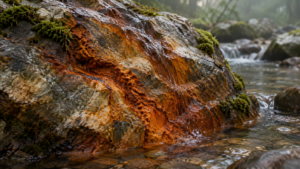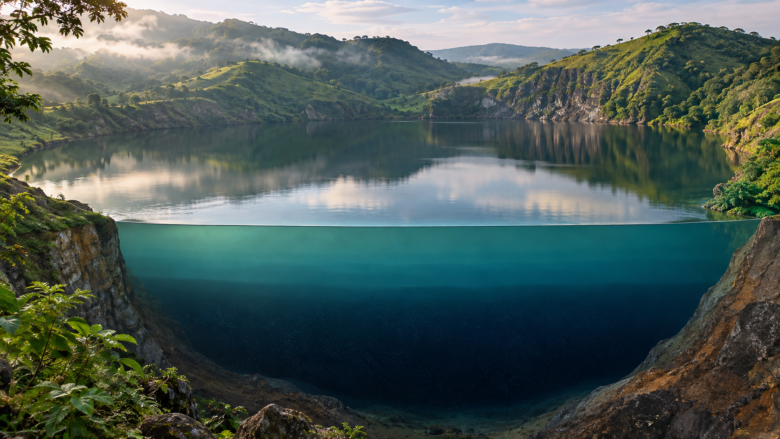
A lake surrounded by green hills is hardly the sort of place we associate with a natural disaster. Its surface might be perfectly still, reflecting the trees and clouds above it. People may live along its shores, grow crops nearby, or walk past it without giving much thought to what lies beneath the water. Yet in a few extraordinary cases, lakes have accumulated enormous quantities of dissolved gas, hidden far below their peaceful surfaces. Under certain conditions, that gas can escape with terrifying speed, spreading across the surrounding landscape.
A lake that appears completely harmless can sometimes be storing the ingredients of a disaster nobody can see coming.
On August 21, 1986, Lake Nyos, a volcanic crater lake in northwestern Cameroon, became the site of one of the most unusual natural disasters ever recorded. A massive quantity of carbon dioxide suddenly escaped from the water and spread into nearby valleys. The gas was invisible, and many people had little opportunity to understand what was happening. The disaster claimed around 1,700 human lives and killed thousands of farm animals in the surrounding communities. Buildings remained standing, and there was no ordinary volcanic eruption to explain the devastation. For those investigating the disaster, the most unsettling question was how an apparently quiet lake could have released enough gas to suffocate entire communities.
The answer begins deep beneath the lake. Lake Nyos occupies a crater associated with an ancient volcanic system, and carbon dioxide from geological sources can move upwards through rocks and groundwater. Some of this gas enters the lake and dissolves in its water. Normally, we associate dissolved carbon dioxide with something much less frightening: a bottle of sparkling water. The gas remains dissolved while the liquid is under sufficient pressure, but when the bottle is opened, the pressure decreases,3 and bubbles begin to form. Something related can happen inside a deep lake, although the scale and surrounding conditions are enormously different.
Water pressure increases with depth because of the weight of the water above. At greater depths, this pressure allows water to hold larger concentrations of dissolved gas without necessarily forming bubbles. If carbon dioxide continues entering a deep lake over many years, the lower water can gradually accumulate an extraordinary amount. The arrangement becomes especially significant when the lake is stratified, meaning its water remains divided into layers that mix only weakly with one another. Differences in dissolved minerals, temperature and density can help keep the deeper water isolated from the surface.
What looks like one continuous body of water may actually contain layers with remarkably different chemical conditions.
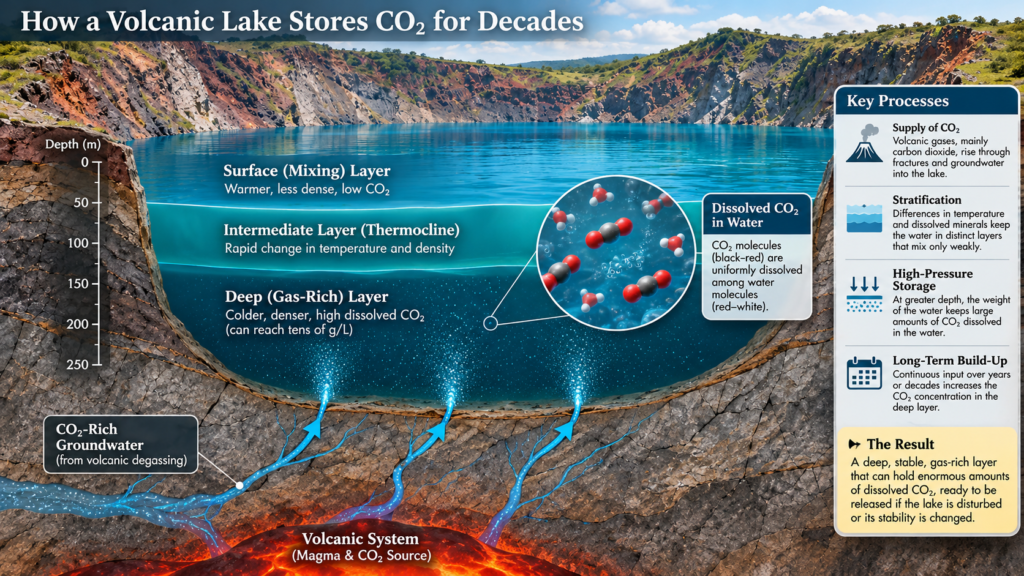
This is why not every volcanic lake presents the same danger. Many lakes experience seasonal mixing that brings deeper water towards the surface, allowing dissolved gases to escape gradually. But certain deep crater lakes can maintain unusually stable layers, preventing that regular exchange. Over time, carbon dioxide can accumulate in the lower water without producing an obvious disturbance above. There may be no strange smell, no dramatic bubbling and no visible warning of how much gas has collected. The danger depends on a particular combination of geological gas supply, lake depth, chemical composition and limited mixing.
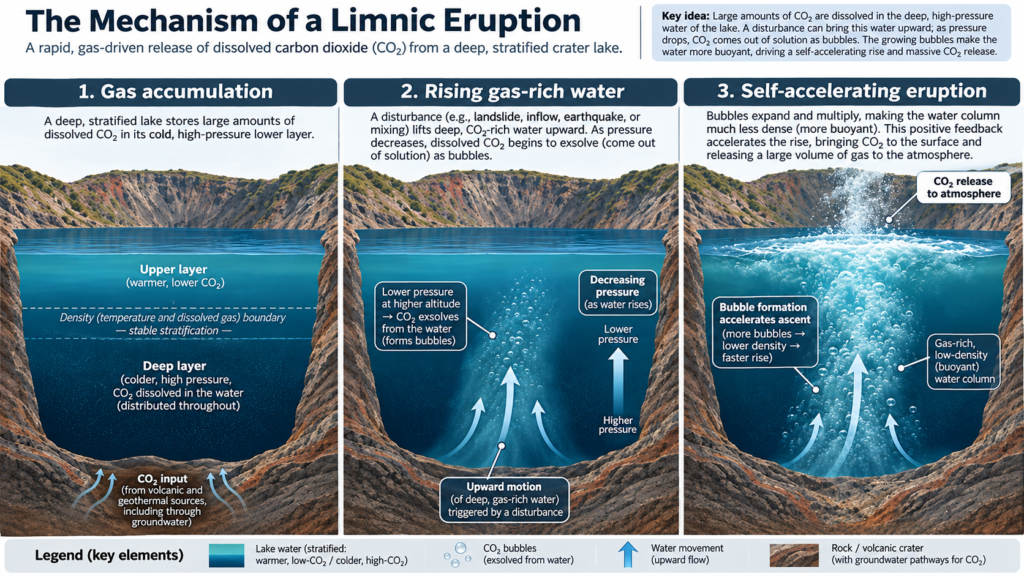
The critical moment arrives when gas-rich water is displaced upwards. As it rises, the surrounding water pressure decreases. If the dissolved gas becomes sufficiently supersaturated, carbon dioxide bubbles begin forming, rather like those appearing when a carbonated drink is opened. But the comparison becomes more disturbing here. The bubbles make the rising mixture less dense, encouraging it to move upwards even faster. This reduces the pressure further, allowing additional gas to escape.
A small upward movement of gas-rich water can potentially develop into a self-reinforcing release of enormous quantities of carbon dioxide.
Scientists call this phenomenon a limnic eruption. The word describes a sudden release of dissolved gas from a lake, not necessarily an eruption of molten rock or an explosion driven by fresh volcanic activity. They have yet to determine precisely what set off the sudden release of carbon dioxide from Lake Nyos. Researchers have considered possibilities including a landslide, changes in the lake’s internal stability and other disturbances. There is also the possibility that gas accumulation can eventually bring parts of a lake close enough to saturation for an eruption to begin without a dramatic external event. What is well established is that the gas had accumulated in deep water before the catastrophe. The evidence does not support a conventional volcanic explosion as the immediate cause.
Once the gas reached the surface, another physical property made it particularly dangerous. Carbon dioxide is denser than ordinary air under comparable conditions, and a large, concentrated release can initially remain close to the ground, especially when the gas is cool and the surrounding landscape channels its movement. At Lake Nyos, the cloud travelled into valleys below the lake, where people and animals were exposed to dangerously high concentrations. Carbon dioxide is normally present in the air we breathe, and our bodies produce it constantly. But at extreme concentrations, it can displace breathable air and disrupt normal respiration, causing rapid loss of consciousness and death. The hazard was not that the gas was chemically exotic.
It was an ordinary atmospheric substance appearing in an extraordinarily dangerous concentration.
Lake Nyos was not the first warning. Two years earlier, on August 15, 1984, Lake Monoun, also in Cameroon, released a deadly cloud of gas that killed 37 people. At the time, the event was so unusual that its underlying mechanism was not immediately understood. Together, the disasters established that certain lakes could behave in ways scientists had barely recognised as a natural hazard. They also raised an uncomfortable question about other deep lakes situated in volcanic regions.
One especially important example is Lake Kivu, which lies between Rwanda and the Democratic Republic of Congo. Its deep waters contain large quantities of dissolved carbon dioxide and methane, a combustible gas. The methane also represents a potential energy resource, and extraction projects have been developed to make use of it. However, Lake Kivu has different geological and chemical characteristics, so its potential risks cannot be understood simply by comparing it with Lake Nyos. Its depth, size, chemical layering and stability are different, and recent modelling suggests that spontaneous gas release under presently assumed conditions may be much less likely than some earlier fears implied. Scientists nevertheless continue studying how geological disturbances, environmental changes and human activities could affect its stability.
The Cameroon disasters also led to an unusual engineering solution. Researchers developed systems that bring gas-rich water from the depths through long pipes, allowing carbon dioxide to escape in a controlled manner rather than remain trapped below. At Lake Nyos, the first permanent degassing pipe began operating in 2001, with additional pipes installed later. Once the flow is established, gas bubbles help lift the water through the pipe, producing a fountain at the surface.
It is a remarkable reversal of the original danger: the same tendency of dissolved gas to escape under reduced pressure can be used to make the lake safer.
What I find most unsettling about these lakes is how little their surfaces reveal. We are accustomed to recognising danger through movement, noise, heat or some other visible sign that something is wrong. But the conditions responsible for a limnic eruption can develop quietly beneath the water for years. The lake may continue reflecting the sky while its deeper layers accumulate gas through geological processes occurring far below. Its appearance tells us almost nothing about that hidden chemical history.
A visitor standing beside Lake Nyos today might see little more than an attractive body of water surrounded by steep green hills. The landscape does not immediately reveal what happened there in 1986, or why scientists have spent decades studying the gases beneath its surface. Yet those investigations uncovered a rare form of natural disaster and showed that it could be monitored and, to some extent, managed. The unsettling lesson is not that lakes are secretly dangerous. Most are not. It is that an apparently ordinary landscape can sometimes conceal physical conditions very different from anything its surface leads us to expect.
Author’s Note
What interested me most about limnic eruptions was the contrast between the peaceful appearance of a lake and the extraordinary amount of dissolved gas it can contain. The physics is almost familiar when compared with a carbonated drink, but its consequences become difficult to imagine on the scale of a deep volcanic lake. I also find it remarkable that understanding the mechanism helped scientists develop ways to reduce the danger. Sometimes the most important part of a landscape is something we cannot see at all.
G.C., creator and writer of Ecosociosphere.
References & Further Reading
- Kling et al. (1987). The 1986 Lake Nyos Gas Disaster in Cameroon, West Africa
- Sigurdsson et al. (1987). Origin of the Lethal Gas Burst from Lake Monoun, Cameroun
- Woods (2006). Dynamics of Lake Eruptions and Possible Ocean Eruptions
- Tassi & Rouwet (2014). An Overview of the Structure, Hazards, and Methods of Investigation of Nyos-Type Lakes
- NASA Earth Observatory (2015). Lake Nyos, Cameroon
- Saboorian-Jooybari & Hassanzadeh (2026). On the Risk of a Dissolved Gas-Triggered Limnic Eruption in Lake Kivu
- U.S. Geological Survey. Exploding Lakes in Cameroon