
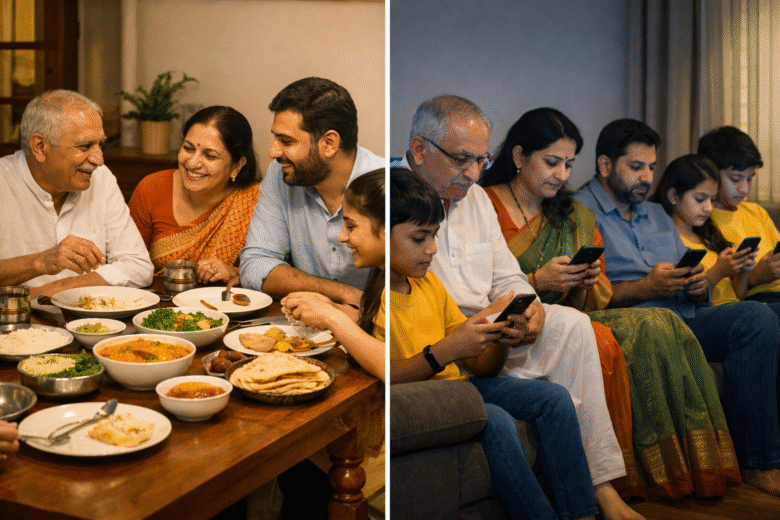
Fun fact: Studies show that the average teenager now sends more messages in a single day than many grandparents spoke words outside their home in an entire week half a century ago.
“Family Dinner vs Family DM: How Different Generations Communicate Tonight” is not just a catchy headline. It is a snapshot of what is happening inside homes across India and around the world. At one end of the dining table sits a father who grew up waiting all day to talk at dinner. At the other end sits a daughter who has already shared her entire day — through short videos, voice notes, and emojis — before the first roti is served.
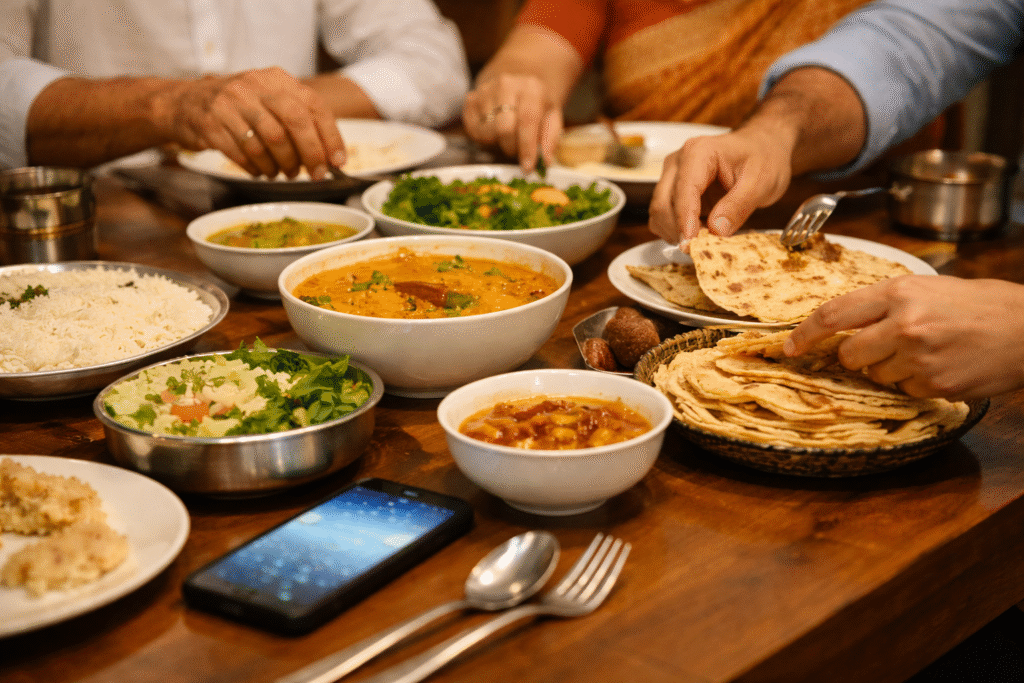
The plates are warm. The phones are warmer.
So what exactly changed? And what does this shift reveal about social bonds, trust, and the way families understand one another?
Let us pull up a chair.
The Ritual of the Dinner Table
For older generations, dinner was not just about food. It was a daily press conference. A family meeting. A performance review.
You reported your marks. Your mood. Your mistakes.
If you were quiet, someone noticed. If you were upset, it was visible in the way you tore your chapati. Communication was face-to-face, often intense, sometimes uncomfortable — but undeniably human. Tone mattered. Eye contact mattered. Silence meant something.
Conversations were long. Stories were repeated. Advice was given freely, whether asked for or not.
There was no mute button.
Family dinner was slow communication. It required patience. You waited for your turn. You listened. Sometimes you argued. Sometimes you stormed off. But even conflict had a physical presence. You could see it. Feel it.
In that world, communication was not optional. It was unavoidable.
Enter the Family DM
Now imagine the modern family group chat on WhatsApp — a messaging platform owned by Meta Platforms, Inc., a global technology company that operates social media and communication services. The group is named something predictable: “Family Forever” or “The Legends.”
Good morning messages arrive at 6:12 a.m., usually from an uncle with a stock image of a sunrise. A mother sends a recipe video. A cousin reacts with a thumbs-up emoji. A teenager leaves the group muted for eight hours.
Communication is constant — and strangely, sometimes shallow.
The Direct Message (DM) culture allows everyone to speak at once. It also allows everyone to ignore at once. You can craft your response. Delete it. Rephrase it. Add a smiley to soften criticism. Or avoid responding altogether.
You are always present — but not always engaged.
This is fast communication. Efficient. Filtered. Controlled.
And it reveals something important: modern family bonds are becoming less about proximity and more about connectivity.
The Illusion of Closeness
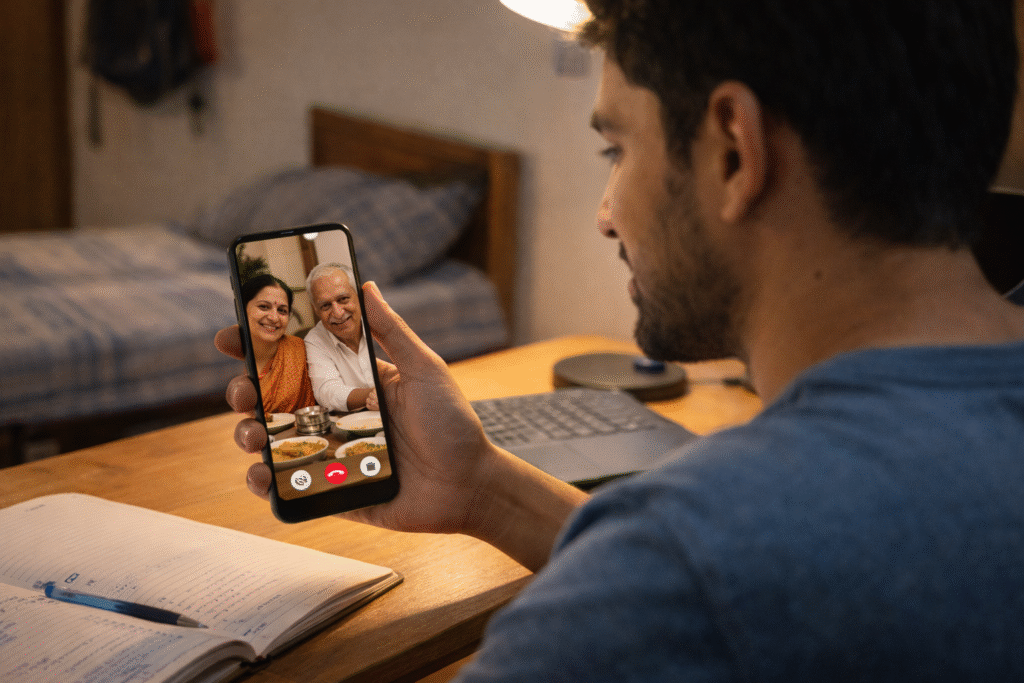
Today, a son studying in Bengaluru can video call his grandmother in Jaipur within seconds. Platforms like Zoom (a video communication company that provides online meetings and conferencing tools) and Google Meet (a video meeting service by Google, a global technology company known for its search engine and digital services) make distance feel smaller.
On paper, this should make families closer than ever.
But closeness is not the same as connection.
You can send twenty heart emojis and still avoid a difficult conversation. You can “like” a message and not actually listen. You can be online without being emotionally available.
Older generations often say with frustration, “You’re constantly on that phone, yet we hardly have a real conversation.”
Younger generations reply, “We are talking. Just differently.”
Both are right. And both are missing something.
Tone vs Text
At a dinner table, sarcasm can be detected in a raised eyebrow. In a message, sarcasm becomes a potential argument.
Text strips away tone. Emojis attempt to replace it. But can a yellow laughing face really carry the weight of shared laughter?
This is where the generation gap becomes visible.
Parents interpret delayed replies as disrespect. Teenagers interpret constant check-ins as surveillance. A simple “Where are you?” can feel like care to one person and control to another.
The communication medium changes the meaning.
Dinner demands emotional exposure. Direct Messages allow emotional editing.
And perhaps that is why some difficult topics — mental health, career confusion, heartbreak — are sometimes easier to type than to say aloud.
A daughter may send a long message about feeling anxious but struggle to speak those same words across a table.
Digital culture has made vulnerability portable.
The Quiet Shift in Power
In traditional family dinners, elders controlled the conversation. They asked the questions. They offered advice. Their voice carried authority.
In family group chats, the hierarchy flattens slightly. A teenager can share a news article. A meme can challenge an opinion. A grandmother can forward a video that sparks debate.
The platform democratizes the room.
Yet, new tensions appear. Fake news circulates faster. Political arguments erupt in thirty seconds. Someone leaves the group dramatically. Someone else adds them back.
Conflict has moved from the dining room to the notification bar.
Are We Losing Something — Or Just Rewriting It?
It is tempting to romanticize the past. To imagine candlelit dinners full of meaningful conversations. But let us be honest: many dinners were also filled with silence, pressure, and unspoken expectations.
And it is equally tempting to criticize the present. To blame “screen addiction” for everything. But digital communication has allowed migrant workers to see their children daily. It has allowed siblings across continents to share birthdays in real time.
The real question is not which is better — family dinner or family Direct Message.
The real question is this: Are we intentional about either?
If dinner becomes a silent room where everyone scrolls, it loses its magic. If group chats become a place only for forwarded jokes, they lose their depth.
Communication tools do not destroy bonds. Neglect does.
What This Reveals About Social Bonds
The shift from dinner to Direct Message reveals three powerful truths:
First, families still want connection — but they want it on their terms.
Second, control is being renegotiated. Younger generations prefer autonomy. Older generations prefer structure.
Third, vulnerability is evolving. Some conversations are braver in text than in person.
The generation gap is not just about language. It is about speed. About control. About who defines what “respect” looks like.
A father raised in the era of fixed landlines measures love by physical presence. A daughter raised in the era of smartphones measures love by responsiveness.
Both are measuring connection — just with different tools.
So What Do We Do Tonight?
Perhaps the solution is not dramatic.
Maybe it is simple.
One meal without phones.
One group chat message that is not a forward, but a question: “How are you really?”
One video call that is not rushed.
Communication is not dying. It is transforming.
But transformation requires awareness.
If we do not consciously create spaces for listening — whether at a table or in a chat window — we risk mistaking activity for intimacy.
And that would be the real loss.
Conclusion
This blog is not a battle between old and new. It is a mirror.
It shows us that technology has changed the form of communication, not the need for it. We still crave to be heard. To be understood. To belong.
Maybe tonight, after reading this, you could do something radical.
Put the phone face down.
Or send a message that says more than “Ok.”
Because at the end of the day, whether across a wooden table or a glowing screen, family communication only works when someone is truly listening.
Author’s Note
I wrote this because I have seen the silence on both sides — the quiet father at the table and the quiet child behind a screen. Neither is indifferent. Both are waiting. Writing about this felt necessary because communication is not just about words; it is about courage. And sometimes, the bravest thing a family can do is simply pause long enough to hear one another.
References and Further Reading