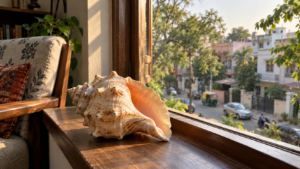
Every house on Earth is quietly filling with dead skin.
That sounds disgusting, but it is true. The dust sitting on your bookshelf right now is not just “dirt.” It is fragments of you. Tiny skin cells. Fabric fibres from your clothes. Pollution drifting in from roads. Pollen. Hair. Smoke particles. Bits of insects. Microbes. Ash. Microscopic leftovers of everyday life floating through the air until gravity slowly pulls them down onto your furniture like soft evidence that human beings were here.
We think of dust as something lifeless.
But dust is deeply alive.
This blog is not really about cleaning. It is about the strange realization that our homes are constantly recording us. Every room becomes a biological archive. Every curtain, mattress, carpet, and shelf quietly collects traces of the people living there. A house remembers you physically long before it remembers you emotionally.
And honestly, the more you think about it, the stranger it becomes.
Modern people are obsessed with cleanliness. We buy air purifiers, antibacterial sprays, vacuum cleaners with futuristic names, chemical fragrances pretending to smell like mountains and rainforests. Entire industries now exist to convince us that a truly successful life is a sterile one. Smooth surfaces. White walls. Dust-free shelves. Odorless air.
But the truth is almost funny.
Human beings are basically leaking into their surroundings all the time.
Your body sheds millions of skin cells every day. Your clothes release microscopic fibers every time you move. Your bedsheets trap sweat, oils, and particles from outside. Open a window and the city enters your room invisibly. Traffic smoke, construction dust, industrial residue, pollen, soot — all of it quietly mixing with the biology of your home.
A perfectly clean room is still floating with microscopic chaos.
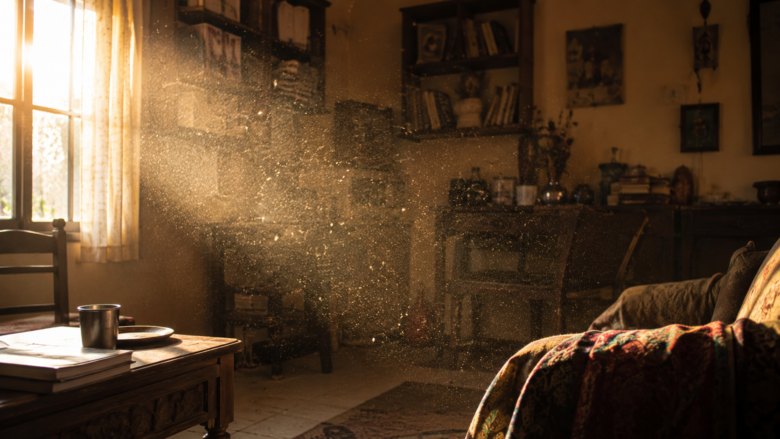
Sunlight reveals this beautifully. You know those moments in the morning when a beam of light cuts across a room and suddenly you can see thousands of particles drifting through the air? It almost feels magical until you realize you are looking at the physical remains of life slowly circulating around you.
Dust is what existence looks like under a spotlight.
Scientists who study household dust have discovered entire microbial ecosystems living inside homes. Different houses contain different microbial signatures depending on where people live, whether they own pets, what chemicals they use, what kind of neighborhood surrounds them, and even how often windows stay open. In some ways, your dust knows more about your lifestyle than your social media profile does.
And unlike social media, dust does not lie.
There is something oddly emotional about that.

Because dust also reveals how connected we actually are to the world around us. We like imagining ourselves as separate beings moving cleanly through life. But we are constantly mixing with our environment. The city enters us. We enter the city. The outside world settles onto our furniture while our bodies slowly settle into the world around us.
Human beings are not sealed creatures.
We are porous.
The modern world forgets this constantly. We live inside buildings pretending we are disconnected from nature while breathing microscopic fragments of plants, pollution, microbes, smoke, and synthetic fibers every single day. Even our homes have become ecosystems we barely understand.
And today’s dust is not ancient dust.
It is industrial dust.
Microplastics now exist inside ordinary household dust. Tiny fragments from synthetic clothes, packaging, furniture, carpets, paint, electronics, and plastic products drift invisibly through homes across the planet. Scientists have found microplastics in oceans, rainwater, blood, lungs, and now increasingly inside indoor air itself.
The terrifying part is how normal this has started to feel.
We are literally manufacturing invisible particles faster than we can study their long-term effects.
And yet dust is not entirely the enemy either.
Some researchers argue that modern humans may actually be suffering from environments that are too sanitized. Children exposed to more natural microbial diversity sometimes develop stronger immune responses than children raised in overly sterile conditions. Human biology evolved in messy environments filled with soil, bacteria, plants, and animals — not polished apartments smelling like artificial lemon chemicals.
Maybe that is part of why modern life feels psychologically strange too.
Everything today is optimized to look untouched. Untouched skin. Untouched houses. Untouched identities. Untouched lives. Social media especially has trained people to present existence without residue. No mess. No aging. No disorder. No dust.
But real life always leaves traces.
And dust may be the most honest trace of all.

Old classrooms covered in dust feel emotional for a reason. Abandoned houses feel heavy for a reason. Dust makes time visible. It settles over forgotten notebooks, unused chairs, family photographs, broken clocks, old clothes. It quietly records absence.
You walk into certain rooms and the dust almost feels louder than silence.
Maybe that is why people rush to erase it. Dust reminds us that nothing in this world stays untouched forever. Fabric decays. Wood decays. Paper decays. Bodies decay. Entire civilizations eventually become layers of particles buried underground. Archaeology is basically humanity studying old dust and trying to reconstruct stories from it.
Which means one uncomfortable thing.
Your home right now is already becoming part of history.
There is also something strangely beautiful about realizing that dust contains tiny pieces of ordinary human existence. The sweater you wore last winter. Smoke from someone cooking nearby. Soil carried in on shoes. Hair from people you love. Pollen from trees outside your street. Fibers from your sofa. Tiny invisible fragments of daily life slowly gathering together in silence.
Dust is not just dirt.
It is memory, breaking apart into particles.
And maybe that is the real reason sunlight through dusty windows feels emotional sometimes. For a brief moment, the invisible becomes visible. You suddenly see proof that life is happening constantly, even when nobody notices.
Not loudly.
Just slowly.
Quietly.
Floating in the air around you.
Author’s Note
I think I wanted to write this because dust feels ordinary until you really look at it. Then suddenly it becomes philosophical. Scientific. Emotional. Almost existential. There is something deeply human about the fact that we leave traces everywhere without realizing it. Maybe writing works the same way. A sentence leaves residue in someone’s mind long after they finish reading it. And sometimes that invisible residue matters more than we think.
G.C., Ecosociosphere contributor.