
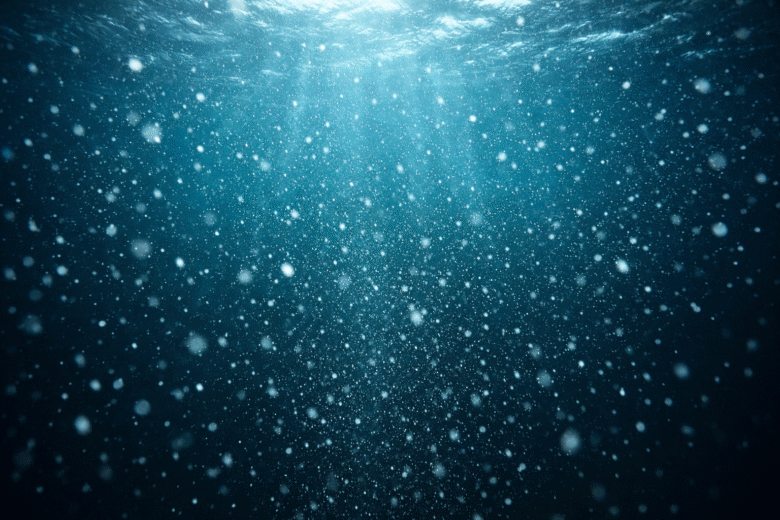
Fun fact: Every day, more organic material falls through the ocean than snow falls on most mountain ranges—yet almost no one ever sees it.
We rarely imagine the ocean as a place where anything “falls.” But beneath the glittering surface, a silent snowfall never stops. This article, Microbes in Ocean ‘Snow’ Rain Down Constantly, explores an invisible blizzard known as marine snow—a constant rain of dead plankton, microbes, waste particles, and organic debris drifting from sunlit waters to the darkest depths of the sea.
It is one of Earth’s most important ecological processes, quietly moving carbon and nutrients across kilometres of water, feeding creatures that never see sunlight, and shaping the planet’s climate without ever making headlines.
A Blizzard No One Feels
Marine snow is not snow in the way we understand it. There are no flakes, no cold gusts, no silence. Instead, there is a slow, continuous drift of tiny particles—bits of dead algae, discarded shells, bacterial clumps, microscopic fecal pellets, and organic dust. Together, they form a steady rain that falls from the ocean surface to the seafloor.
This snowfall never pauses. Day and night, summer and winter, calm seas or raging storms—marine snow keeps falling.
What makes it extraordinary is scale. Over the course of a single year, billions of tonnes of organic matter descend into the deep ocean. Without this process, most deep-sea life would starve. The deep ocean produces almost no food of its own. It survives on leftovers.
Microbes: The Hidden Engineers of the Fall
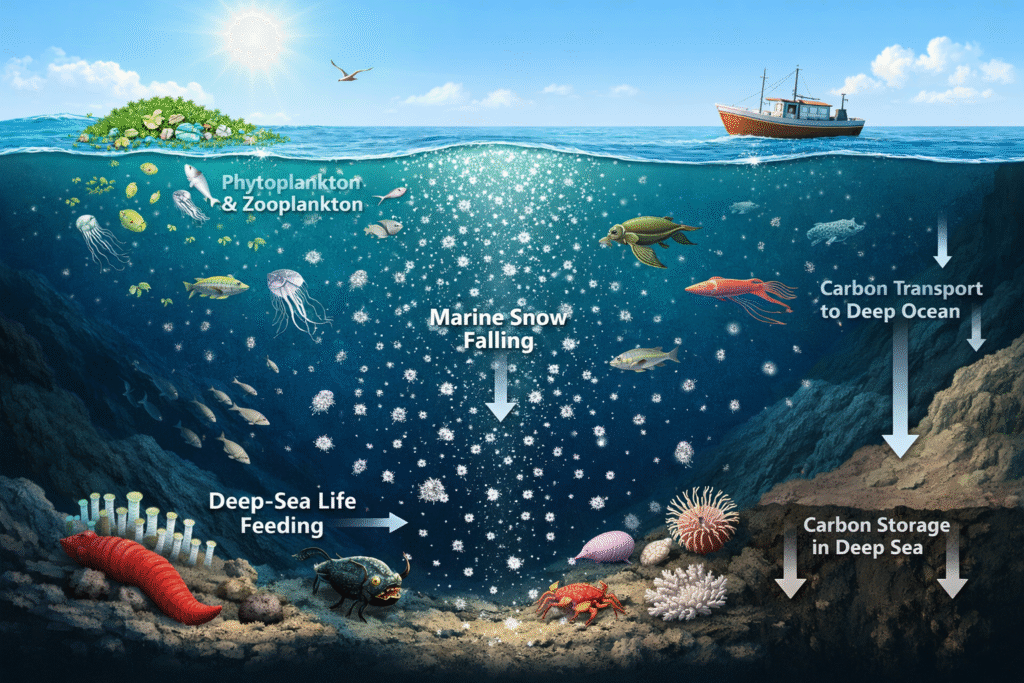
At the heart of marine snow are microbes. Tiny, ancient, and relentless, they are both builders and recyclers of this falling feast.
When phytoplankton—microscopic plants floating near the surface—die or are eaten, their remains begin to sink. But they rarely fall alone. Bacteria quickly colonise these particles, secreting sticky substances that glue fragments together into larger clumps. The bigger the clump, the faster it falls.
These microbes don’t just hitch a ride. They actively reshape marine snow as it descends, breaking down complex organic material into simpler forms, releasing nutrients back into the water, and altering how much carbon reaches the deep ocean.
In this sense, marine snow is not debris. It is a living, breathing system in motion.
A Lifeline for the Deep Sea
Thousands of metres below the surface, where sunlight never reaches, and temperatures hover near freezing, entire ecosystems depend on marine snow.
Deep-sea corals extend delicate arms to catch falling particles. Worms, crustaceans, sea cucumbers, and strange gelatinous creatures wait patiently for food to drift down from above. Even bacteria living within ocean sediments rely on this steady rain to survive.
Without marine snow, the deep ocean would be a biological desert.
This connection between surface life and the abyss reminds us of something uncomfortable: even the most remote ecosystems on Earth depend on activity near the surface—including human activity.
Carbon’s Long Journey Downward
Marine snow plays a crucial role in Earth’s carbon cycle. When phytoplankton absorb carbon dioxide during photosynthesis, that carbon becomes part of their bodies. If those organisms die and sink, some of that carbon is transported away from the atmosphere and stored deep in the ocean.
This process, often called the biological carbon pump, helps regulate Earth’s climate. It slows the accumulation of carbon dioxide in the atmosphere and buffers global warming.
But the system is fragile. Warmer waters can change plankton communities. Acidification can affect shell-forming organisms. Pollution can alter microbial behaviour. Each change reshapes how marine snow forms, sinks, or dissolves.
When marine snow weakens, the planet feels it.
Human Footprints in an Invisible Storm
We like to believe the deep ocean is untouched by human hands. Marine snow tells a different story.
Microplastics—tiny fragments shed from clothes, packaging, and tyres—are now embedded within marine snow particles. These plastics sink alongside organic matter, carrying toxic chemicals into the deep sea.
Pollutants bind to falling particles. Excess nutrients from agricultural runoff can trigger plankton blooms that later collapse, creating massive pulses of marine snow that alter oxygen levels below.
Even climate change leaves fingerprints here. As oceans warm, stratify, and lose oxygen, the delicate choreography between microbes, particles, and gravity begins to change.
The snowfall continues—but it no longer falls the way it once did.
Why This Should Matter to Us
Marine snow feels abstract because we never see it. There are no photographs of people shovelling it. No weather alerts. No headlines.
Yet this invisible process feeds half the planet, locks away carbon, and sustains ecosystems older than humanity itself.
Ignoring marine snow is like ignoring soil beneath our feet simply because it is underground. Life depends on what falls, settles, and slowly transforms.
If we want to understand climate change, ocean health, or the future of fisheries, we must pay attention to the quiet systems that never demand attention.
Conclusion: Learning to Respect the Unseen
Marine snow teaches us humility. It reminds us that the planet runs on processes too slow, too small, or too deep for daily notice—but not for survival.
Every choice we make at the surface echoes downward. Every pollutant, every emission, every discarded fragment eventually joins the fall.
The ocean is not a void beneath us. It is a living archive, collecting what we release, one particle at a time.
Perhaps the most radical thing we can do is learn to care about what we cannot see.
Author’s Note
I was drawn to marine snow because it felt like a metaphor for teaching itself—quiet work that settles slowly, unseen, shaping futures long after the moment passes. Some systems don’t shout for attention; they wait patiently for understanding. Writing about them feels like an act of listening. And listening, I’ve learned, is where change begins.
G.C., Ecosociosphere contributor.