For most of the history of plastic, the story seemed straightforward.
Plastic was something we made, used, and discarded. When it accumulated in rivers, oceans, beaches, and landfills, it became an environmental problem. Scientists worried about wildlife. Conservationists documented polluted coastlines. Governments debated recycling programs and bans on single-use products.
The problem appeared to exist outside of us.
That assumption is beginning to change.
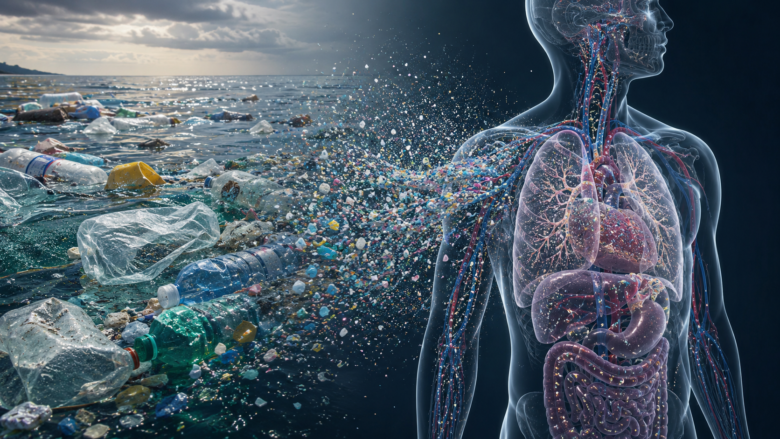
Over the past few years, researchers have discovered tiny plastic particles inside the human body. They have been detected in blood, lungs, placentas, breast milk, and even in tissues associated with unborn babies. What was once viewed primarily as an environmental issue is increasingly becoming a biological one.
The discovery feels unsettling for a simple reason.
Most of us can understand the idea of plastic floating in the ocean. It is far more difficult to imagine that some of those same materials may eventually become part of the air we breathe, the food we eat, and the bodies we inhabit.
The journey begins with a misconception about plastic itself.
Many people think of plastic as a durable material that remains unchanged for decades. In reality, plastic rarely disappears, but it does change. Sunlight, wind, waves, friction, and weather gradually break larger objects into smaller fragments. A discarded bottle does not vanish. Instead, it slowly becomes thousands of tiny pieces.
These fragments are known as microplastics when they are smaller than five millimetres. Some continue breaking down into nano plastics, particles so small that they can only be measured in billionths of a meter.
The modern world is now filled with them.
Scientists have found microplastics in oceans, rivers, agricultural soils, rainwater, mountain snow, and Arctic ice. They have been detected in places so remote that few people ever visit them. The particles travel through water, air currents, and ecosystems with remarkable efficiency.
Once researchers realized how widespread microplastics had become, a natural question followed.

If these particles are everywhere around us, how many are finding their way into us?
The answer appears to be more than anyone expected.
Food is one pathway. Plants can be exposed through contaminated soil and water. Marine organisms can ingest plastic fragments that move through food chains. Packaging materials themselves may shed microscopic particles during storage and transportation.
Water provides another route.
Microplastics have been detected in both bottled and tap water around the world. The exact amount varies between studies and locations, but the broader pattern remains consistent. Tiny plastic particles have become a common feature of modern environments.
The air may be just as important.
Synthetic fabrics release microscopic fibres during everyday use. Vehicle tires gradually wear down on roads. Countless plastic products shed particles over time. Many of these fragments eventually become airborne, where they can be inhaled without us ever noticing.
Unlike visible pollution, microplastics rarely announce their presence.
There is no smell, no warning sign, and no obvious indication that they are there. Most exposure likely occurs during ordinary daily activities that seem completely routine.
Perhaps this is why recent discoveries have attracted so much attention.
In 2022, researchers detected plastic particles in human blood samples. The finding was significant not because it proved disease, but because it suggested movement. Blood functions as the body’s transportation system. It carries oxygen, nutrients, hormones, and immune cells throughout the body.
The presence of plastic particles raised an important possibility.
If they can enter the bloodstream, they may be capable of reaching organs and tissues far beyond the digestive system.
Scientists do not yet know the full implications of this. What they do know is that the particles are not necessarily remaining where they first enter the body.
They appear capable of traveling.
Researchers have also found microplastics in human lung tissue.
This discovery makes intuitive sense once we consider how much of our lives are spent breathing indoor and outdoor air. Every breath represents an interaction between the body and the surrounding environment. Most of the time, we think only about oxygen. Yet every breath also contains microscopic particles from countless sources.
For decades, scientists studied the effects of smoke, dust, and industrial pollutants on respiratory health.
Microplastics are now becoming part of that conversation.
The discovery that has perhaps captured the public imagination most strongly, however, involves pregnancy.
The placenta is often viewed as one of the body’s most remarkable protective structures. It regulates the exchange of nutrients and oxygen between mother and foetus while helping shield developing life from many external threats.
Researchers have now detected microplastics in human placentas.

The finding does not automatically mean harm is occurring. Science is rarely that simple. Yet the discovery remains significant because it suggests that exposure to plastic particles may begin before birth.
The implications extend beyond medicine.
They challenge the way many of us think about pollution itself.
For much of modern history, environmental problems were imagined as distant consequences of industrial society. Pollution happened somewhere else. It affected rivers, forests, oceans, and wildlife. Human beings were often treated as observers of environmental change rather than participants within it.
Microplastics complicate that distinction.
The particles found in blood, lungs, and placentas suggest that the environment does not remain outside the body for very long. The air around us becomes the air within us. The water around us becomes part of us. The substances we release into ecosystems often find unexpected pathways back into human life.
This is where the science becomes both fascinating and uncertain.
Researchers are investigating whether microplastics contribute to inflammation, oxidative stress, immune system disruption, reproductive challenges, cardiovascular disease, or developmental effects. Laboratory studies have provided reasons for concern, but many questions remain unanswered.
The presence of microplastics in the body is becoming increasingly difficult to dispute.
The consequences are still being explored.
That distinction is important because uncertainty is not the same thing as safety, but neither is it proof of danger. Scientific understanding develops gradually. Discoveries often arrive long before definitive conclusions.
For now, the most remarkable fact may simply be that we have reached a point where plastic pollution can no longer be described solely as an environmental issue.
It has become a human issue in a very direct sense.
A material invented for convenience less than a century ago has spread so thoroughly through the world that traces of it are now being discovered inside the very species that created it.
Future research will reveal whether these particles pose serious long-term health risks, minor risks, or something in between. Whatever those answers turn out to be, the discoveries already tell us something important about the modern world.
The boundary between humanity and the environment is far thinner than we often imagine.
For generations, we treated nature as the place where our waste eventually ended up.
Microplastics suggest a different reality. Sometimes the things we release into the world do not stay there.
They come back. And occasionally, they come back inside us.
Author’s Note
Microplastics have been detected in human blood, lungs, placentas, breast milk, and other tissues. While scientists are still investigating their health effects, these discoveries are reshaping how researchers think about pollution, exposure, and the relationship between the environment and the human body.
G.C., Ecosociosphere contributor.
References and Further Reading
- Leslie, H. A. et al. (2022). Discovery and quantification of plastic particle pollution in human blood.
- Jenner, L. C. et al. (2022). Detection of microplastics in human lung tissue.
- Ragusa, A. et al. (2021). Plasticenta: First evidence of microplastics in human placenta.
- Marfella, R. et al. (2024). Microplastics and Nanoplastics in Atheromas and Cardiovascular Events.