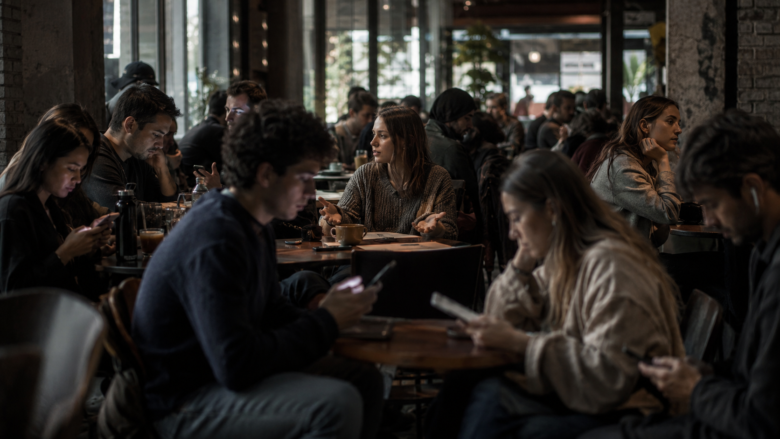
There was a time when silence inside a conversation did not feel dangerous.
Somebody would finish speaking. Another person would sit with the words for a second. Maybe longer. There was room for confusion. Room for reflection. Room for emotional processing. Conversations moved slowly enough for people to actually arrive inside them.
Now everybody is already preparing their reply before the other person finishes the sentence.
You can feel it everywhere. In classrooms. In family dinners. In podcasts. In political debates. In relationships. Online, especially. People interrupt not because they are rude in the traditional sense, but because modern life has trained them to fear disappearing from the conversation. Attention moves fast now. Too fast. If you pause too long, somebody else takes the spotlight. If you hesitate, the algorithm buries you. If you stop to think carefully, somebody louder wins the moment first.
So people respond instantly. Reflexively. Emotionally.
Not after understanding. Before understanding.
The attention economy did not simply shorten our focus spans. It quietly changed the social meaning of listening itself.
Listening used to be connected to patience. Now it is connected to waiting for your turn to speak.
That difference matters more than we realize.
Social media platforms are built around reaction speed. The fastest outrage spreads the furthest. The quickest joke gets the engagement. The strongest opinion gets amplified before nuance even enters the room. Entire platforms reward immediacy over comprehension. The person who pauses to ask, “Wait, what exactly did they mean?” often loses to the person who immediately declares certainty.
And after years of living inside these systems, people start carrying that rhythm into real life.
Conversations increasingly feel like parallel performances instead of shared understanding.

You see it when somebody shares pain and immediately receives advice instead of presence. You see it when a person finishes explaining something deeply personal and the response somehow becomes about the listener’s own experience within seconds. You see it when arguments escalate because people are responding to the version they imagined instead of the words actually spoken.
Modern communication often feels less like listening and more like competing interpretations colliding at high speed.
Part of the problem is that listening has become economically invisible.
The internet monetizes visibility, expression, branding, reaction, posting, and performance. It does not reward quiet attention. Nobody becomes influential for deeply understanding another human being in silence. Platforms measure engagement through output, not absorption. Talking is visible. Listening is private.
So we unconsciously begin valuing visible participation more than careful understanding.
Even emotionally, many people no longer experience conversations as places to discover another person. Conversations become opportunities to display intelligence, morality, humor, knowledge, trauma, or identity. The goal quietly shifts from connection to self-positioning.
And the frightening part is that most people do not notice this transformation happening inside themselves.
Sometimes you can feel it physically. Someone is talking to you, and you already sense the impatience in their eyes before you finish your sentence. Their body is present, but mentally they are editing their response in advance. You are no longer being heard in real time. You are being processed.
This is one reason so many people feel emotionally lonely despite constant communication.
Being heard and being reacted to are not the same thing.
A person can receive hundreds of replies and still feel profoundly unseen.
The attention economy also changed how we experience disagreement. People no longer listen to understand opposing views because platforms train us to treat conversations like battles for dominance. Every discussion becomes public positioning. Every opinion becomes identity. Every misunderstanding becomes threat. Once that happens, genuine listening becomes psychologically dangerous because understanding somebody else can feel like betraying your own side.
So people stop listening altogether and start hunting for trigger words instead.
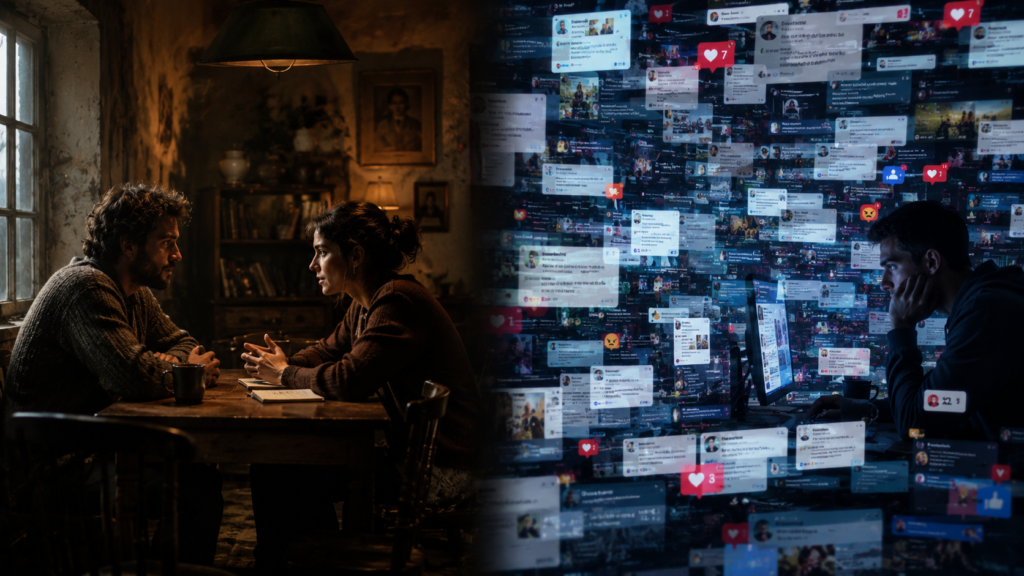
The internet did not invent bad listening. Humans have always struggled with ego, interruption, and misunderstanding. But digital systems industrialized these tendencies. They accelerated them. Monetized them. Rewarded them.
And eventually they reshaped everyday human behaviour.
The tragedy is that deep listening may be one of the last remaining forms of human generosity that cannot be automated properly.
Artificial intelligence can generate responses instantly. Algorithms can predict reactions. Machines can simulate empathy surprisingly well now. But real listening still requires something deeply unfashionable in modern life: surrendering attention without immediately turning the moment back toward yourself.
It requires patience without reward.
Presence without performance.
And maybe that is why good listeners feel almost sacred now.
When somebody genuinely listens today — fully, calmly, without interruption or self-display — it feels strangely rare. Almost disorienting. You suddenly realize how starved people have become for undivided attention. Some conversations stay in memory for years not because the advice was brilliant, but because for ten minutes someone made another human being feel fully received.
Not optimized. Not scanned. Not managed.
Received.
Maybe the real crisis of the attention economy is not distraction itself. Maybe it is that we are slowly forgetting how to make another person feel real while they are speaking.
And civilizations do not collapse only when people stop talking to each other. Sometimes they begin collapsing when nobody truly listens anymore.
Author’s Note
I do not think human beings were designed for this much constant reaction.
Sometimes it feels like modern life has turned conversation into a race where everyone is terrified of disappearing for even a few seconds. But the older I get, the more I suspect that understanding another person has always required slowness. Not efficiency. Not speed. Not performance.
Just attention that stays long enough for another human being to unfold.
G.C., Ecosociosphere contributor.