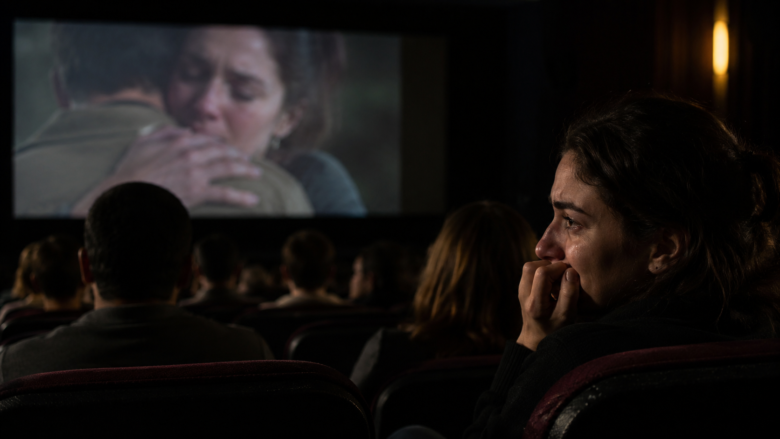
There is something slightly embarrassing about crying during a movie.
Not during documentaries. Not during footage of real suffering. But during scenes involving people who do not exist, in worlds that were carefully written by strangers, lit by studio lights, edited with music, and performed on a set surrounded by cameras and microphones.
You sit there fully aware that it is fictional. You know the actor will go home afterward. You know the spaceship is computer-generated. You know the dialogue was rewritten fifteen times by screenwriters drinking coffee in a conference room.
And yet your throat tightens anyway.
Your eyes burn anyway.
Sometimes you cry harder for fictional people than for real headlines scrolling across your phone every morning.
Which raises an uncomfortable question: what exactly is happening inside the human brain when a made-up story emotionally devastates us?
Part of the answer lies in something called mirror neurons. These are specialized brain cells that activate not only when we perform an action ourselves, but also when we observe someone else performing it. When you watch someone smile, suffer, panic, laugh, or grieve, parts of your brain partially simulate that emotional experience internally.
Your brain does not simply “watch” emotion. It rehearses it.
That matters because storytelling is not passive entertainment in biological terms. Stories are emotional simulations. A movie is essentially a controlled neurological experience where the brain temporarily practices being another person.
And the human brain is astonishingly willing to participate in the illusion.
When a character loses someone they love, your nervous system begins constructing fragments of that emotional reality inside you. Your body releases chemicals associated with empathy and stress. Your heart rate changes. Your breathing changes. Muscles tense. Tears appear before logic fully catches up.
In some sense, the brain responds less to “Is this real?” and more to “Does this feel emotionally coherent?”

That is why people cry during animated films about toys, robots, or elderly men floating houses with balloons.
The emotional architecture matters more than literal reality.
Human beings evolved through stories long before books, theaters, or streaming platforms existed. Around fires, inside caves, across villages, people told stories because stories were survival technology. Narratives taught danger, morality, cooperation, betrayal, sacrifice, love, and loss in ways raw information never could.
A warning becomes memorable when attached to a person.
A lesson becomes unforgettable when attached to emotion.
The brain learned to treat stories seriously because stories once carried survival value.
And perhaps they still do.
Modern cinema simply industrialized this ancient biological system. Filmmakers now understand rhythm, music, close-ups, silence, facial expressions, lighting, and narrative tension with an almost unsettling level of precision. Entire industries are built around guiding emotional responses.
A swelling violin soundtrack is not accidental.
Neither is the long pause before a goodbye scene.
Neither is the close-up of trembling eyes.
These techniques bypass intellectual distance and move directly toward emotional circuitry. Good storytelling does not ask permission from logic first.
But there is another reason fictional stories affect people so deeply.
Real life often denies emotional closure.
Movies usually do not.
In reality, people disappear without explanation. Relationships fade awkwardly. Grief stretches for years without resolution. Justice rarely arrives cleanly. Conversations end unfinished. Pain often feels meaningless.
Stories reorganize emotional chaos into something understandable.
Even tragic endings provide structure. The suffering means something inside the narrative. The loss connects to a larger emotional arc. Fiction gives shape to emotions that real life frequently leaves scattered and unresolved.
Sometimes people cry during movies not because the story is fictional, but because it touches emotions they have been carrying silently in real life.
The film becomes a safe container for feelings that already existed.
That is why completely different people cry at completely different scenes. One person cries when a father apologizes. Another cries when someone finally feels seen. Another cries during scenes of loneliness, reconciliation, sacrifice, or missed chances.

People often think they are reacting to the movie itself.
In reality, they are reacting to parts of themselves the movie accidentally uncovered.
And maybe that explains why storytelling has survived every technological revolution humans have ever created.
Empires collapsed. Religions changed. Civilizations disappeared. Yet human beings still gather in dark rooms to watch imaginary people experience imaginary lives.
Because stories are not distractions from reality.
They are one of the ways human beings emotionally process reality.
The strange truth is that fiction sometimes reaches emotional honesty more effectively than facts do. A two-hour film can make someone confront grief, love, fear, regret, loneliness, or tenderness more honestly than months of ordinary conversation.
Not because the story is real.
But because the feelings are.
And maybe that is what crying during movies actually reveals.
The human brain was never designed only to detect reality.
It was designed to feel meaning.
Author’s Note
I think people underestimate how biologically vulnerable we are to stories. We like to imagine ourselves as rational observers watching screens from a safe emotional distance. But stories have been shaping human nervous systems for thousands of years. Sometimes a fictional scene reaches places inside people that ordinary life cannot access directly. Maybe tears during movies are not signs of confusion between fiction and reality. Maybe they are signs that human beings were always built to emotionally inhabit other lives for a while.
G.C., Ecosociosphere contributor.