Not long ago, people mostly bought things because they needed them.
A coat kept you warm. A chair gave you somewhere to sit. A notebook held your thoughts. Of course, objects have always carried meanings beyond their practical purpose, but those meanings usually remained in the background.
Today something feels different.
Increasingly, products are being asked to do emotional work.
A water bottle promises discipline. A skincare routine promises healing. A gym membership promises transformation. A particular brand of clothing promises confidence. Even a cup of coffee is often marketed less as a drink and more as a lifestyle.
The product matters, but the feeling attached to it matters even more.
We are living through the rise of emotional consumerism—a world in which people increasingly buy not just objects but identities, comfort, hope, and meaning.
This is not necessarily because people have become more materialistic. In many ways, the opposite may be true.
Human beings have always searched for belonging, purpose, and self-understanding. What has changed is where those needs are being directed.
Many of the institutions that once helped answer life’s larger questions have become less central. Communities are often weaker than they once were. People move more frequently. Careers feel less predictable. Relationships are increasingly shaped by digital spaces. The result is a quiet sense of uncertainty that many people struggle to describe.
Who am I?
Where do I belong?
What kind of life am I trying to create?
Markets have become remarkably good at responding to these questions.
Modern advertising rarely focuses on products alone. Instead, it focuses on the person you could become. Buy this and become healthier. Buy this and become more confident. Buy this and become more productive. The object is presented as a bridge between your current self and your ideal self.
Hope has become one of the most valuable things being sold.
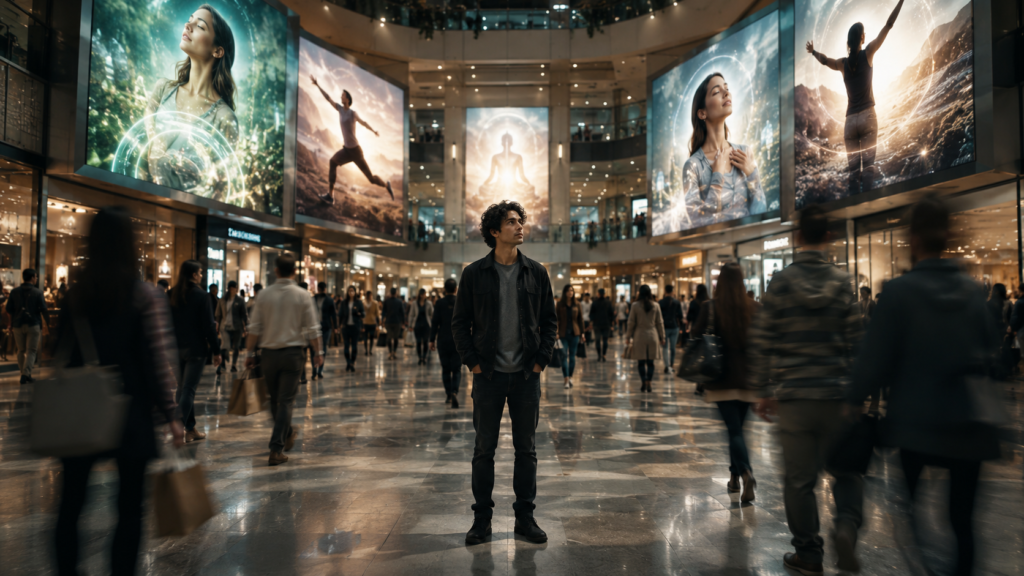 That is why so many purchases feel emotional rather than practical. Someone buys running shoes and imagines a healthier future. Someone purchases books and imagines becoming wiser. Someone redesigns their home because they want a fresh beginning. The object often represents a possibility more than a need.
In this sense, many purchases are really purchases of imagined futures.
The problem is that emotional needs are rarely solved by transactions.
A package arrives. There is excitement. For a moment, life feels slightly different. Then the novelty fades and the original uncertainty quietly returns.
This does not happen because people are foolish.
It happens because confidence cannot be delivered in a box. Purpose cannot be shipped overnight. Belonging cannot be purchased through a checkout page.
Products can support these things, but they cannot replace them. A journal may encourage reflection. It cannot create meaning on its own. A wellness product may improve well-being. It cannot replace rest. A beautiful home may provide comfort. It cannot guarantee connection.
Yet emotional consumerism continues to grow because it speaks to needs that are real. People genuinely want healing. They genuinely want confidence. They genuinely want purpose. The marketplace succeeds because it offers symbolic versions of things many people are struggling to find elsewhere.
Perhaps that is why modern consumption often feels both comforting and strangely unsatisfying at the same time. It offers glimpses of what we truly want without always delivering the thing itself.
The deeper story here is not about shopping. It is about a society searching for emotional needs in commercial spaces.
When belonging becomes scarce, it gets marketed. When purpose becomes uncertain, it gets branded. When people feel disconnected, connection becomes a product category.
The rise of emotional consumerism reveals something important about the modern world. Beneath the endless advertisements, lifestyle brands, and self-improvement products lies a simple human reality.
People are not merely buying things. They are buying possibilities.
And perhaps the most revealing question is not why so many products now promise comfort, identity, and meaning.
Perhaps the more revealing question is why so many people are looking for those things in the first place.
Author’s Note
“The Rise of Emotional Consumerism” is not really about shopping. It is about what happens when products begin carrying emotional responsibilities that once belonged to communities, relationships, traditions, and shared meaning. The products themselves may change with every generation. The human longings underneath them remain remarkably familiar.
G.C., Ecosociosphere contributor.