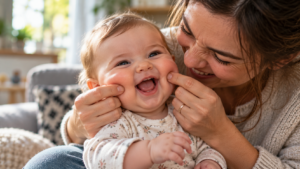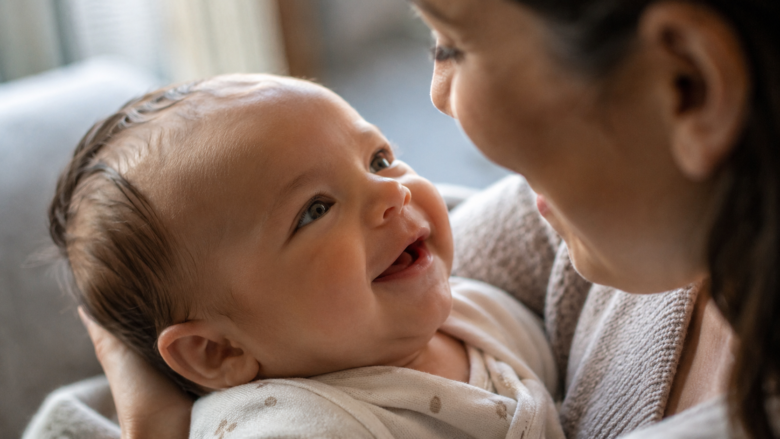
Long before a baby learns to say mama, ask for food, or point toward something interesting, they already possess a remarkably effective way of communicating. A tiny face brightens, the corners of the mouth rise, the eyes seem to come alive—and suddenly the adult looking down is smiling too. No vocabulary has been exchanged, yet something meaningful has happened. A connection has been made.
A baby’s smile may appear simple, but it belongs to a communication system far older than spoken language.
Human beings arrive in the world unusually dependent on others. Compared with many animals, our infants cannot walk, feed themselves, escape danger, or survive for long without constant care. This extreme helplessness created an important evolutionary challenge: babies needed ways to influence the people around them long before they were capable of speech.
Crying became one powerful signal, immediately drawing attention when something was wrong. But survival could not depend only on signals of distress. Infants also needed ways to maintain closeness when everything was going well. Smiling became part of that quieter social conversation.
Interestingly, not every early smile means quite the same thing.
Newborn babies sometimes smile while sleeping, and these early expressions are generally considered spontaneous rather than deliberate attempts to interact.
Within the first few months, however, something changes. Babies begin producing what researchers call social smiles—smiles that appear in response to familiar faces, voices, eye contact, and interaction. The expression is no longer merely something happening on the baby’s face. It becomes part of an exchange between two people.
That exchange can be surprisingly powerful. An adult smiles at a baby; the baby smiles back; the adult becomes more animated, perhaps speaking in a softer, higher-pitched voice or moving closer. The baby responds again. What looks like a few seconds of playful interaction is actually an early form of turn-taking.
Before babies learn the rhythm of conversation through words, they begin learning it through faces.

One person signals, another responds, and the first responds to that response. The basic architecture of communication is already being practised.
From an evolutionary perspective, this ability makes considerable sense. Our ancestors lived in intensely social groups where infants depended not only on mothers but often on fathers, siblings, grandparents, relatives, and other members of the community.
A baby capable of attracting positive attention may have strengthened the emotional investment of the adults responsible for its care. Smiles encourage adults to approach, interact, protect, and continue engaging with the child. They help transform caregiving from a purely practical responsibility into an emotional relationship.
There is something almost ingenious about the system because smiling does not simply communicate information—it changes the person receiving the signal. Adults often find themselves automatically smiling when a baby smiles at them. Positive facial expressions can trigger emotional responses remarkably quickly, creating a feedback loop between infant and caregiver.
The baby receives attention; the adult experiences pleasure and connection; the interaction continues.
Neither participant needs to consciously understand what is happening for the system to work.
This helps explain why human communication cannot be understood simply by studying language. Words arrived relatively late in our evolutionary story, while bodies, faces, gestures, sounds, and eye movements had already been carrying information for millions of years. Our primate relatives use facial expressions extensively to signal fear, threat, submission, reassurance, playfulness, and social intention.
Humans inherited this ancient nonverbal foundation and developed it alongside increasingly sophisticated social intelligence. Spoken language eventually became extraordinarily powerful, but it never replaced the older system beneath it.
We still rely on that system every day. A raised eyebrow can question something without interrupting a conversation. A glance across a crowded room can communicate recognition. A slight change in posture may reveal discomfort before someone admits feeling uncomfortable. A genuine smile can reassure a stranger faster than a carefully constructed sentence.
Language tells us what people choose to say; nonverbal communication often helps us understand how they feel while saying it.
Babies enter this world of signals long before they enter the world of grammar.

Their early interactions may also help prepare the brain for more complex communication later. When caregivers respond consistently to smiles, sounds, movements, and expressions, babies gradually discover that their behaviour can produce responses in other people.
They begin noticing patterns: I do something, you react; you do something, I react.
These exchanges encourage attention to faces, emotional cues, timing, and social expectations. Months before meaningful words appear, the foundations of conversation are quietly being assembled.
This is also why interacting with babies can feel strangely conversational even when they cannot understand most of what is being said. Adults instinctively pause after speaking, wait for a coo or expression, respond to movements, exaggerate facial expressions, and repeat sounds.
The baby participates with smiles, noises, kicks, gaze, and eventually gestures. There may be no sentences, but there is already dialogue. Communication begins not when the first word is spoken, but when two minds begin responding to one another.
The baby’s smile therefore belongs to something much larger than childhood cuteness.
It is a reminder that human connection did not begin with dictionaries, alphabets, or carefully constructed sentences.
Long before our ancestors could explain affection, trust, safety, or belonging, they could show them. Faces carried messages before voices carried words, and those ancient signals remain woven into every conversation we have today.
Perhaps that is why a baby’s smile can feel so immediately understandable. It crosses language, education, and culture with almost no explanation required. The child may still be months away from saying anything recognisable, yet the message somehow reaches us.
I see you. I am responding to you. Stay here with me. And in that tiny exchange lies one of the oldest chapters in the story of human communication.
Author’s Note
A baby’s smile is so familiar that we rarely think of it as a sophisticated form of communication. Yet long before children understand language, they are already participating in social exchanges through expressions, sounds, eye contact, and movement. I wanted to explore that small but extraordinary detail because it reveals something much larger about us: human communication did not begin with words. It began with our ability to respond to one another.
G.C., creator and writer of Ecosociosphere.
References & Further Reading
- Darwin, C. — The Expression of the Emotions in Man and Animals
- Messinger, D. S. & Fogel, A. — Research on the development of smiling and early emotional communication in infants
- Yale Child Study Center — Research on infant social development and early communication
- Harvard Center on the Developing Child — Serve and Return Interaction Shapes Brain Circuitry