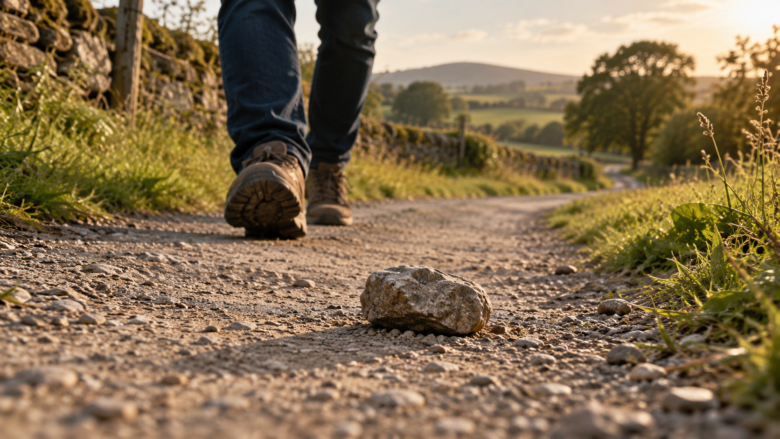
You are walking down a familiar road when a small stone catches your attention. Without giving it much thought, you give it a gentle kick. It rolls a short distance ahead, and when you catch up, you kick it again. Soon, you are adjusting your steps to reach it at just the right moment, trying to keep it away from the roadside or send it through a particular gap. You weren’t looking for a game when you left home, and you have somewhere else to be. Yet for the next few minutes, that little stone becomes an unexpected part of your journey.
An object that meant absolutely nothing a moment ago has somehow become worth following.
It is a familiar habit, particularly from childhood, although plenty of adults still do it when nobody is paying attention. A pebble on a footpath, an empty bottle cap, or a dry leaf can become something to kick along as we walk. Sometimes we give the object a destination, perhaps deciding to keep it moving until the next junction. Other times, there is no particular goal beyond seeing how far it will go. The interesting thing is how little effort it takes for an ordinary object to become entertaining. Nothing about the stone has changed, but our relationship with it has.
Part of the explanation may lie in how we perceive the physical world. When we look at an object, we don’t simply register its shape, size and colour. We also recognise what we can do with it. A low wall offers somewhere to sit, a railing can be held, and a puddle might be something to step around or jump over. Psychologist James J. Gibson developed the concept of affordances to describe opportunities for action that exist in the relationship between an organism and its surroundings. A small stone lying on a clear path offers one such possibility: it can be moved with the foot, and we can see what happens next.
That last part matters. When you kick a stone, the result is immediate and visible. A slightly stronger kick sends it farther, while striking it from the side changes its direction. Its shape and the roughness of the ground make the outcome somewhat unpredictable, so you have to keep making small adjustments. Without planning an exercise, you are using your eyes, legs and sense of timing to guide something through the environment.
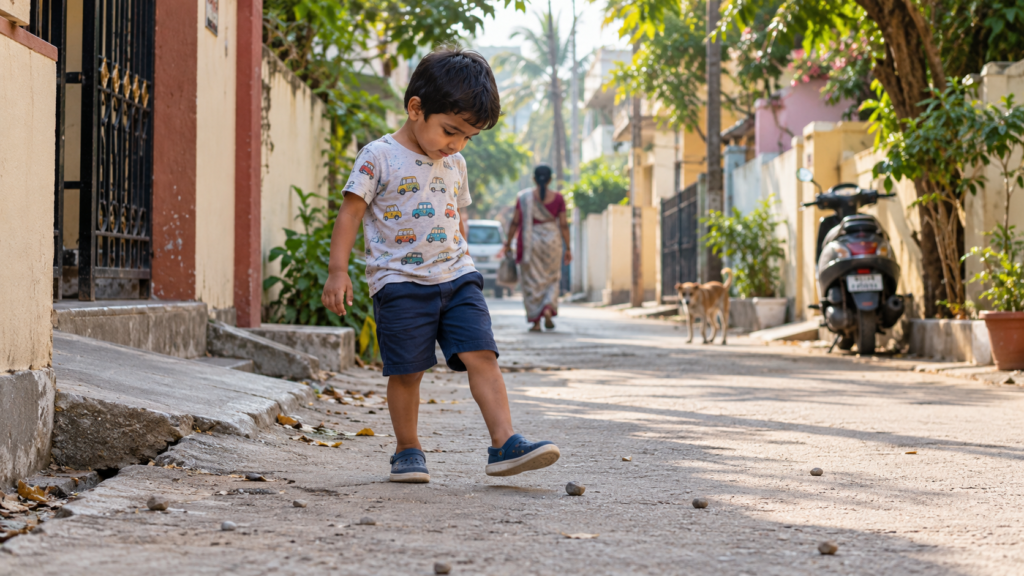
The stone gives you a tiny problem to solve, followed almost instantly by a chance to try again.
This resembles a simple form of play. Psychologists studying object play describe how people can interact with things for the enjoyment of the activity itself, rather than to accomplish a practical task. Children demonstrate this constantly, rolling objects, arranging pebbles, tapping surfaces or experimenting with whatever happens to be nearby. Such activities allow them to explore what objects do and how their own actions influence the results. Research has connected object play with exploration and the development of practical skills, although that does not mean every playful kick has an important developmental purpose.
Adults are not entirely different. We may become less willing to play openly, especially in places where we are expected to behave seriously, but playful behaviour does not simply disappear after childhood. A 2024 study examining adult play found that people experience play through several different qualities, including creativity, enjoyment, engagement and mastery. These experiences are not limited to organised games or activities officially labelled as recreation. A person absent-mindedly balancing on the edge of a pavement or trying to land a crumpled paper ball in a bin may be creating a small playful challenge in an otherwise ordinary moment.
And a challenge is often exactly what stone-kicking becomes. At first, you simply nudge the stone forward. After a few kicks, you might start aiming for a crack in the pavement or try to avoid sending it into the grass. There are no written rules, but you gradually invent some. If the stone goes too far, you lose control of it; if it barely moves, the game becomes dull. Somewhere between those extremes is a satisfying level of difficulty that keeps you interested.
A meaningless object acquires a temporary purpose because you decide what counts as success.
Boredom may also contribute, particularly during a walk that requires little concentration. Research suggests that boredom can motivate people to seek new stimulation or alternative activities when their current situation feels insufficiently engaging. A familiar route may offer few surprises, while a moving stone introduces a small element of uncertainty. Yet boredom cannot explain every instance. Someone enjoying a walk may kick a pebble simply because it is there, and children frequently invent games even when they are already entertained. The possibility of playful interaction may be enough, without any particular need to escape an unpleasant state.
What seems especially interesting is the way the stone begins to influence the walk itself. You might slow down to let it settle, lengthen your stride to reach it, or change direction slightly because it has rolled toward the edge of the road. For a few moments, your movements are organised around something you had no intention of carrying along. The stone becomes a kind of temporary companion, although the word is obviously metaphorical. It has no intentions of its own, and it isn’t cooperating with you. Still, its unpredictable movements help shape what you do next, creating an interaction that continues until either you or the stone can go no farther.
Of course, not everyone enjoys this behaviour, and there is no established scientific explanation specifically demonstrating why humans kick stones while walking. The connection with affordances, play and self-created challenges is a plausible interpretation drawn from broader psychological research. Some people may enjoy the movement and feedback, others the distraction, and some may simply be repeating a familiar habit. Context matters too. A stone on an empty footpath is rather different from one beside traffic or other pedestrians, where kicking it could easily be unsafe.

There is also something curious about the rules we invent during these small games. We can become mildly disappointed when the stone rolls into a drain or disappears beneath a parked vehicle, despite knowing that nothing important has been lost. We might even look around for another suitable stone, although the replacement somehow feels less interesting. The original had accumulated a tiny history through the journey: the difficult kicks, the lucky recoveries, the distance covered.
For a short while, we had turned an interchangeable object into something particular.
Perhaps that is what makes the habit worth noticing. Much of adult life is organised around activities with clear purposes, schedules and expected results. Kicking a stone interrupts that arrangement without demanding anything serious in return. It allows us to invent a goal, follow it for a while, and abandon it without consequences. The satisfaction belongs to the activity itself, not to anything we gain at the end.
Eventually, the stone rolls into the grass, reaches an awkward corner or simply stops being interesting. You leave it behind and continue towards wherever you were going, probably without giving the little game another thought. Someone passing the same spot later might see nothing more than an ordinary pebble lying beside the road. They would have no reason to know that, for several minutes, it had been involved in a game with its own changing rules, small successes and unexpected ending. Then again, they might notice it, give it a gentle kick, and begin a completely different game of their own.
Author’s Note
I remember how easily a stone on the road could become something to follow during an otherwise uneventful walk. Sometimes the challenge was simply to keep it moving, while other times an imaginary finish line somehow appeared along the way. What interested me about the psychology was how little a game actually needs. A simple object, the possibility of doing something with it, and a reason to try again may be enough.
G.C., creator and writer of Ecosociosphere.
References
- Chong, I., & Proctor, R. W. (2020). On the Evolution of a Radical Concept: Affordances According to Gibson and Their Subsequent Use and Development.
- Towards a Comprehensive View of Object-Oriented Play (2021).
- Blanche, E. I., Chang, M. C., & Parham, L. D. (2024). Experiences of Adult Play.
- Bench, S. W., & Lench, H. C. (2019). Boredom as a Seeking State: Boredom Prompts the Pursuit of Novel (Even Negative) Experiences.
- The Role of Play Objects and Object Play in Human Cognitive Evolution and Innovation (2018).