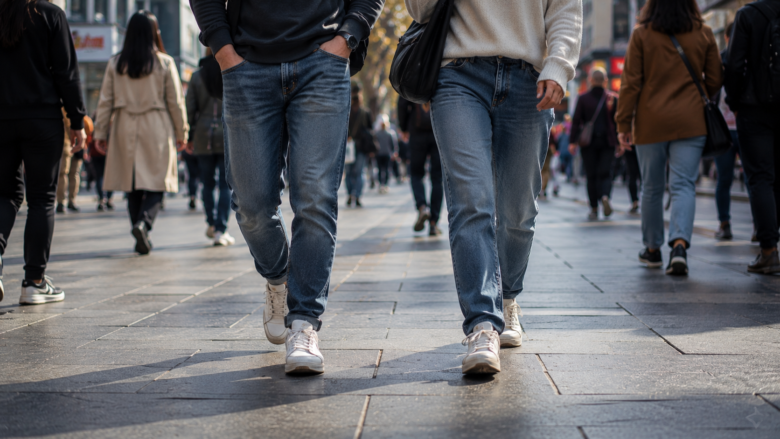
Walk beside another person for long enough and something curious often begins to happen. You may start with slightly different strides, one person walking faster and the other taking shorter steps, yet after a while those differences seem to soften. Your footsteps begin arriving at roughly the same rhythm.
Sometimes the same legs move forward together; sometimes opposite legs alternate with surprising regularity. Neither person announces the change, and in most cases neither even notices it.
Two separate bodies have quietly begun behaving as though they are part of the same moving system.
This tendency is known as interpersonal synchronization, and walking provides one of its most ordinary examples. Studies of people walking side by side have repeatedly found periods in which their stepping rhythms become coordinated without anyone deliberately trying to match the other person.
A systematic review of research on spontaneous gait synchronization found evidence for the phenomenon across all 16 studies it examined, although how strongly people synchronized depended on the situation and the sensory information available to them. Researchers have even analysed hundreds of videos of people walking naturally through cities and found the same basic tendency outside the laboratory. What feels like an unremarkable stroll, in other words, contains a surprisingly sophisticated form of coordination.
Walking itself already depends on rhythm. Each step is part of a repeating cycle involving muscles, joints, balance, sensory feedback and neural systems that continuously adjust movement.
Much of this happens automatically, which is why we can walk while talking, thinking or looking around without consciously instructing each leg what to do. But when another moving person enters our immediate environment, the nervous system suddenly has another rhythm to work with.
We hear their footsteps, glimpse the movement of their body and notice changes in their position relative to ours.
Without requiring much conscious attention, those signals can begin influencing our own movements.
This is why synchronization does not depend entirely on watching someone’s feet. Researchers have experimented with restricting different forms of sensory information while people walk together. Visual cues matter, but so do the sounds of footsteps and the physical sensations created when people are touching.
One study of over-ground walking found synchrony in 36 percent of walks and reported that tactile and auditory information produced stronger synchronization than visual information alone. Earlier work similarly found spontaneous synchronization in almost half of experimental walking trials, with particularly strong coordination when participants held hands.

Our bodies can apparently conduct a small conversation through rhythm without language ever becoming involved.
Holding hands makes that conversation especially interesting. Each person’s arm is physically connected to the other’s, allowing tiny movements and forces to travel between them. Those signals can provide information about timing, balance and movement, creating another route through which the two walking patterns can influence one another.
Research has found that people can synchronize while walking hand in hand even when useful visual and auditory information is restricted. Yet physical contact is not necessary. The ordinary sights and sounds produced by someone beside us can provide enough information for subtle adjustments to emerge.
And those adjustments do not necessarily produce perfect marching. People may briefly fall into step, drift apart and then coordinate again. Sometimes their corresponding legs move together, known as in-phase synchronization.
At other times, one person’s left step roughly coincides with the other’s right step, producing an anti-phase pattern. Both arrangements have been observed experimentally and in naturalistic walking. A study of pedestrians going about their everyday lives found that only about 6 percent of 498 pairs remained continuously synchronized, but it also found evidence that walkers may subtly adjust their preferred stepping patterns toward one another even without achieving continuous step-for-step synchrony.
Coordination, then, does not require us to become identical; often it simply means becoming slightly more compatible.
That distinction matters because walking with someone involves more than matching footsteps. Two people are also trying to remain beside each other. If one person consistently moves faster, the conversation becomes awkward: one drifts ahead while the other repeatedly catches up.
Maintaining a comfortable social formation therefore requires continuous adjustment. The faster walker may shorten a stride or reduce speed, while the slower walker may lengthen a step. These changes can be so small that neither person experiences them as decisions. What emerges is a shared pace created through countless tiny corrections.
The phenomenon belongs to a much larger human tendency.
We coordinate movements while dancing, playing music, carrying objects together and performing countless cooperative tasks.
Groups may even begin clapping in rhythm without anyone directing them.
Interpersonal synchrony appears to emerge partly because humans continuously perceive, predict and respond to the actions of other humans. Recent experimental research has also found links between cooperation, rapport and greater interpersonal synchrony, suggesting that moving together and relating to one another are not entirely separate processes.
There may also be a social consequence hidden inside those synchronized footsteps. Research examining people walking and talking together found that greater synchronization of their steps predicted more positive interpersonal impressions, even when conversational behaviour was considered separately.
That does not mean matching someone’s stride automatically creates friendship, nor that close relationships must produce perfectly synchronized walking. The relationship between movement and social connection is more complicated than that. But it suggests that bodily coordination may participate in the subtle process through which people become comfortable with one another.

Perhaps that is why walking together can feel different from simply travelling in the same direction.
A shared walk gradually creates a temporary rhythm: speed changes together, bodies navigate obstacles together, conversation pauses and resumes, and footsteps repeatedly negotiate the space between two people. No one needs to appoint a leader. The coordination emerges from both people responding to each other.
We usually imagine social connection as something created through words, expressions and deliberate gestures. Yet much of human interaction takes place beneath that level of awareness. We adjust our posture during conversation, respond to another person’s movements and alter our timing without consciously deciding to do any of it.
Walking beside someone reveals this hidden layer unusually well because every step leaves a visible trace of the negotiation.
The next time you walk with a friend, colleague or family member, you might notice that your feet occasionally land with an unexpected regularity. It may last only a few seconds before disappearing again.
But inside that ordinary moment is something deeply human: two nervous systems observing one another, two bodies making continuous adjustments, and two individual rhythms finding enough common ground to move through the world together.
Sometimes cooperation begins long before either person realizes they are cooperating.
Author’s Note
We often think of coordination as something deliberate—dancers rehearsing movements, musicians following a beat, or athletes working together. Yet some of the most fascinating forms of coordination happen without us noticing them at all. Walking beside another person is a wonderfully ordinary example. This article grew from a simple observation: when two people share a path for long enough, their bodies often begin negotiating a rhythm of their own.
G.C., creator and writer of Ecosociosphere.
References & Further Reading
- Zivotofsky JM, Gruendlinger L, Hausdorff JM. Modality-specific communication enabling gait synchronization during over-ground side-by-side walking. PubMed article
- van Ulzen NR, Lamoth CJC, Daffertshofer A, Semin GR, Beek PJ. Characteristics of instructed and uninstructed interpersonal coordination while walking side-by-side. PubMed article
- Zivotofsky JM, Hausdorff JM. The sensory feedback mechanisms enabling couples to walk synchronously: An initial investigation. Full article on PMC
- Spontaneous interpersonal synchronization of gait: A systematic review. Systematic review on PMC
- Walking and talking together: The relationship between interpersonal synchrony and interpersonal impressions. PubMed article