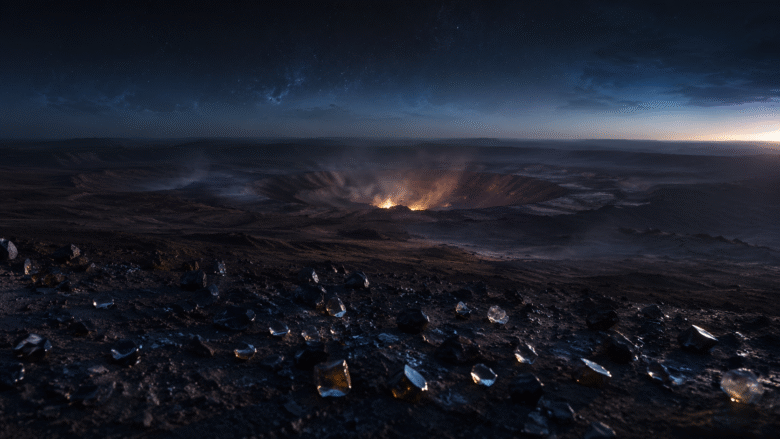
Fun fact: Every time a massive asteroid hits Earth, the ground can melt, fly into the sky, and come back down as glass.
Somewhere in Australia, scientists found glass that shouldn’t exist. Not man-made. Not volcanic. Not ordinary.
Glass that was born in fire so intense it could only have come from a cosmic collision—an asteroid slamming into Earth with unimaginable force. And yet, there’s a problem.
There is no crater.
No scar. No obvious wound. No visible trace of where this catastrophic event actually happened. It’s like finding bullet fragments… but no gun, no shooter, no crime scene. And that’s what makes this discovery so unsettling. Because if something this big can disappear—what else have we missed?
The Discovery: Glass That Doesn’t Belong
The story begins with something small. Tiny pieces of glass, scattered across parts of Australia. At first glance, they look unremarkable—dark, smooth, almost like burnt pebbles. But these aren’t ordinary rocks.
They’re called tektites—natural glass formed when an asteroid impact melts Earth’s surface, ejects molten material into the atmosphere, and lets it cool mid-air before falling back down. Scientists have known about tektites for a long time. Most in the Australasian region date back to around 800,000 years ago, linked to a known impact event.
But these newly studied samples were… different. Different composition. Different properties. And most importantly—a completely different age. Around 11 million years old. This wasn’t just a variation. This was something entirely new.
A Hidden Impact: A Chapter We Never Read
If these tektites are real—and the evidence says they are—then something extraordinary must have happened. An asteroid hit Earth. Not a small one. Not a minor collision.
A massive, high-energy impact powerful enough to:
- Melt large sections of the Earth’s crust
- Launch molten material thousands of kilometres
- Scatter glass across continents
And yet, we somehow… never noticed. No entry in our geological memory. No clearly identified event. It’s like discovering a lost earthquake that shook the planet—but left no fault line behind.
The Missing Crater: Science Meets a Puzzle
Here’s where the story turns into a mystery. Every major asteroid impact leaves behind a crater. That’s the rule. But in this case?
Nothing. No confirmed site. No visible structure. So where did it happen?
Scientists have a few theories: The crater might be buried under layers of sediment, slowly hidden over millions of years. It might lie in a region of intense volcanic activity, where geological processes have erased or reshaped the evidence. It could even be sitting in plain sight—misidentified as a volcanic formation.
Regions like Southeast Asia, Indonesia, or Papua New Guinea are being considered. But for now, the crater remains missing. And that absence is louder than any discovery.

How Earth Erases Its Own History
We often imagine Earth as a perfect archive—a place where every event leaves a permanent mark. It doesn’t. Earth forgets. Slowly. Quietly. Relentlessly. Mountains rise and fall. Rivers carve and erase. Tectonic plates shift. Volcanoes rebuild what was destroyed.
Over millions of years, even something as violent as an asteroid impact can be:
- worn down
- buried
- reshaped
- or completely erased
What survives are fragments. Like these pieces of glass. Small, silent witnesses to something enormous.
Why This Changes Everything
This discovery isn’t just interesting—it’s unsettling. Because it forces us to rethink a few things.
First, Earth may have experienced far more major impacts than we realize. If one event this large can go missing, others probably have too.
Second, it challenges our confidence in geological records. We like to believe we understand Earth’s past. But maybe we only understand the parts that survived.
And third, it reminds us of something uncomfortable: The planet we stand on is not as stable—or as predictable—as we think.
A Planet That Keeps Secrets
There’s something almost poetic about this. A violent cosmic event, powerful enough to reshape landscapes, reduced to a few scattered pieces of glass. No crater. No obvious trace. Just evidence that whispers instead of shouts.
It makes you wonder: How many other stories are buried beneath our feet? How many times has Earth been changed in ways we no longer remember? And how many clues are still waiting to be noticed—not because they are big, but because they are strange?
Conclusion: The Silence After the Impact
We often think the biggest events leave the biggest marks. But sometimes, they don’t. Sometimes, they leave behind fragments—quiet, overlooked, easy to dismiss.
And it takes someone, somewhere, looking a little closer… to realize that those fragments don’t belong. This glass didn’t just form. It survived. And in doing so, it revealed something profound:
Earth’s history isn’t a complete story. It’s a puzzle with missing pieces. And every now and then, we find one.
Author’s Note
There’s something humbling about knowing that a massive asteroid impact—something that would dominate headlines today—can vanish so completely that we only rediscover it through fragments. Maybe the Earth isn’t hiding its secrets. Maybe we’re just not very good at seeing them yet.
G.C., Ecosociosphere contributor.